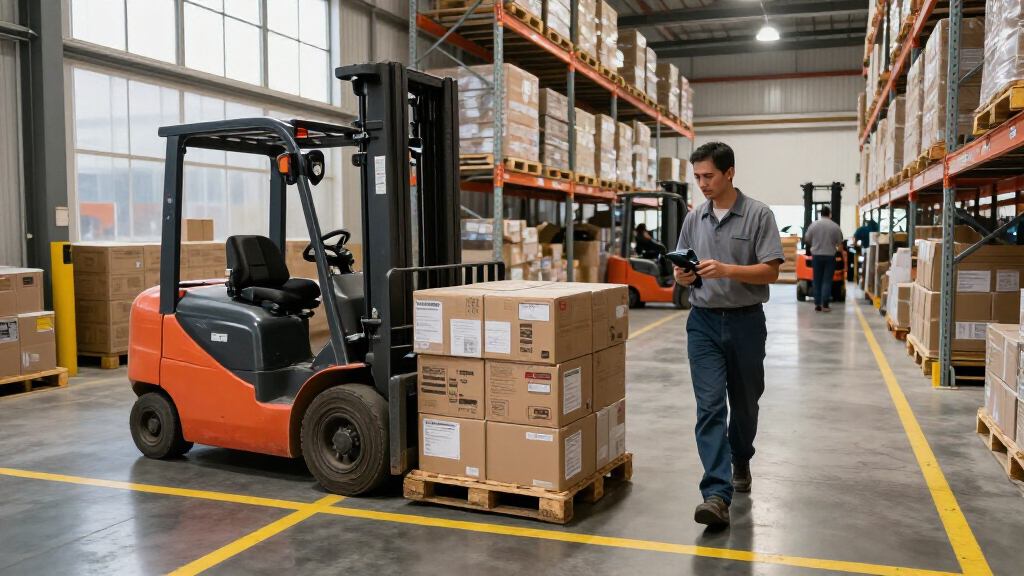

For warehouse material handling, I’d choose the APOLLOLIFT Fully Powered Electric Stacker with Straddle Legs as the best overall fit because its 3,300-pound capacity and 138-inch lift height suit demanding pallet-stacking work. The Sunmax A-20 stands out for heavier loads at 4,400 pounds, while the VEVOR Full Electric Pallet Stacker pairs a 3,300-pound rating with adjustable fork width for varied pallet sizes. The main tradeoff is between lifting capacity and reach on one hand, and compact handling, simpler operation, and a better match for lighter loads on the other. These products span powered stackers, pallet jacks, and counterbalance or multidirectional forklifts, so the right choice depends on aisle layout and task as much as headline capacity. Read on for the full comparison, ranking logic, and guidance on matching a machine to your warehouse.

Get business pricing on tech for your team
- Business-only prices and quantity discounts
- Tax-exempt purchasing
- Multiple users, one account, clear invoices
Key Takeaways
- Lift height separates the heavy-duty stackers: The APOLLOLIFT straddle-leg model reaches 138 inches, while the 130-inch stand-on stacker and the 118-inch Sunmax A-20 serve different capacity and handling needs.
- Rated capacity alone does not identify the best fit: The Sunmax A-20 leads this lineup at 4,400 pounds, but many pallet tasks may be better served by a 3,300-pound stacker with a lift height and chassis that suit the rack layout.
- Shorter lifts have a practical place: The 65-inch and 63-inch stackers can suit low-level storage and repetitive pallet movement, without paying for reach a workflow may not use.
- Specialized movement changes the shortlist: The two 4-way forklift options are more relevant where lateral travel or long loads matter than a conventional pallet stacker.
- Product detail varies widely: The lineup includes a 650-pound material lift alongside commercial forklift listings described as 1–5T, so buyers need to confirm capacity, duty cycle, and configuration for the exact model before ordering.
| 3300 lbs Stand-On Full Electric Pallet Stacker 130″ Lift Height |  | Best for Stand-On High-Capacity Stacking | Load capacity: 3,300 lb | Maximum lift height: 130 in | Fork length: 42 in | VIEW ON AMAZON | See Our Full Breakdown |
| Electric Pallet Stacker with 65-inch Lift Height and 1500 lbs Capacity |  | Best for Lower Racks and Remote Operation | Load capacity: 1,500 lb | Maximum lift height: 65 in | Battery: 48V 10Ah (650W) | VIEW ON AMAZON | See Our Full Breakdown |
| APOLLOLIFT Fully Powered Electric Stacker with Straddle Legs, 3300 lbs Capacity, 138″ Lift Height |  | Best for Maximum Stacker Lift Height | Load capacity: 3,300 lb | Maximum lift height: 138 in | Fork lowered height: 2.8 in | VIEW ON AMAZON | See Our Full Breakdown |
| 4-Way Electric Counterbalance Forklift for Warehouse, Cold Storage & Logistics |  | Best for Four-Way Aisle Maneuvering | Model number: EIG1-DSC9-9 | Drive type: 4WD | Drive mode: Mount type | VIEW ON AMAZON | See Our Full Breakdown |
| Sunmax A-20 Electric Forklift – 4,400 lb Capacity, 118 in Lift Height |  | Best for Higher-Capacity Forklift Loads | Load capacity: 4,400 lb | Maximum lift height: 118 in | Power source: Electric; battery pack included | VIEW ON AMAZON | See Our Full Breakdown |
| APOLLOLIFT Lithium Electric Pallet Stacker – 3,300 lb Capacity, 118″ Lift Height |  | Best for Taller Stacking | Load capacity: 3,300 lbs | Maximum lift height: 118 in | Lowered height: 84.4 in | VIEW ON AMAZON | See Our Full Breakdown |
| 4-Way Electric Warehouse Forklift with Adjustable Forks, Solid Tires, LED Work Lights |  | Best for Narrow-Aisle Multi-Direction Handling | Model range: Various models from 1T to 8T | Listed weight: 7,716 lbs | Dimensions: 183 x 86 x 91 in | VIEW ON AMAZON | See Our Full Breakdown |
| Electric Pallet Stacker, 650 Lbs Battery Powered Material Lift Forklift |  | Best Compact Pick for Light Loads | Brand: CareArise | Model: F1 | Load capacity: 650 lbs | VIEW ON AMAZON | See Our Full Breakdown |
| VEVOR Full Electric Pallet Stacker, 3300 lbs Capacity, 98.4″ Lifting Height, Adjustable Fork Width |  | Best for Heavy Loads on Level Floors | Capacity: 3,300 lbs | Lifting height: 98.4 in | Fork width range: 8.66–31.1 in | VIEW ON AMAZON | See Our Full Breakdown |
| Electric Pallet Jack Truck Forklift for Warehouse and Industrial Use |  | Best for Short-Run Pallet Transport | Maximum load: 1,500 kg | Width options: 550 mm or 685 mm | Length: 1,150 mm | VIEW ON AMAZON | See Our Full Breakdown |
| 1-5T Commercial Electric Forklift – Battery-Powered Lift for Pallet Handling and Warehouse Operations |  | Best for Configurable Heavy Loads | Load capacity: 1–8 tons, configurable | Power: Battery-powered electric | Material: Metal | VIEW ON AMAZON | See Our Full Breakdown |
| Electric Pallet Stacker with 1300lbs Capacity and 63″ Lifting Height |  | Best for Low-Level Pallet Stacking | Load capacity: 1,300 pounds | Maximum lift height: 63 inches | Minimum working height: 3.2 inches | VIEW ON AMAZON | See Our Full Breakdown |
| automated forklifts for warehouse material handling | Load capacity | Maximum lift height |
|---|---|---|
| 3300 lbs Stand-On Full Electri | 3,300 lb | 130 in |
| Electric Pallet Stacker with 6 | 1,500 lb | 65 in |
| APOLLOLIFT Fully Powered Elect | 3,300 lb | 138 in |
| 4-Way Electric Counterbalance | — | — |
| Sunmax A-20 Electric Forklift | 4,400 lb | 118 in |
| APOLLOLIFT Lithium Electric Pa | 3,300 lbs | 118 in |
| 4-Way Electric Warehouse Forkl | — | — |
| Electric Pallet Stacker | 650 lbs | 47.24 in |
| VEVOR Full Electric Pallet Sta | — | — |
| Electric Pallet Jack Truck For | — | — |
| 1-5T Commercial Electric Forkl | 1–8 tons, configurable | — |
| Electric Pallet Stacker with 1 | 1,300 pounds | 63 inches |
More Details on Our Top Picks
3300 lbs Stand-On Full Electric Pallet Stacker 130″ Lift Height
This stand-on stacker is a strong fit for warehouses that need to move full pallets frequently and store them well above floor level. Its 3,300 lb capacity and 130-inch lift put it ahead of the 1,500 lb Electric Pallet Stacker with 65-inch Lift Height for heavier loads and taller racking. The stand-on platform can make repeated trips more practical than walking alongside a stacker, while adjustable forks and straddle legs give it flexibility across pallet sizes. Its 53-inch turning radius supports maneuvering in tighter warehouse lanes, though buyers should check aisle dimensions against the machine and pallet. Assembly is required, and this is a flat-floor indoor tool, not a rough-ground forklift. Choose it for high-volume pallet work; choose the APOLLOLIFT 138-inch model if extra lift height matters more.
Pros:- 3,300 lb rated capacity suits substantial pallet loads.
- 130-inch lift supports higher storage than the 65-inch stacker in this lineup.
- Stand-on platform supports repeated travel and gives the operator a raised working position.
- Adjustable forks and straddle legs accommodate a range of pallet sizes.
Cons:- Straddle legs and forks require assembly before use.
- Designed mainly for flat indoor warehouse floors.
- Specified operating temperature range limits use in some very cold or hot environments.
Best for: Warehouse teams moving heavy pallets repeatedly between floor storage and racks, with suitable indoor aisles and smooth floors.
Not ideal for: Businesses handling outdoor terrain, uneven floors, or loads above 3,300 lb; assembly and indoor-use limits may also rule it out.
- Load capacity:3,300 lb
- Maximum lift height:130 in
- Fork length:42 in
- Fork width adjustment:7.8–31.5 in
- Battery:24V/100Ah GEL
- Turning radius:53 in
- Operating temperature:-13°F to 104°F
Our verdict“Choose this stand-on stacker for frequent indoor handling of loads up to 3,300 lb when its 130-inch lift and platform suit your rack and aisle layout.”
Electric Pallet Stacker with 65-inch Lift Height and 1500 lbs Capacity
Rather than compete with the 3,300 lb stackers on lifting capacity, this model targets lighter warehouse work and a more modest 65-inch lift height. Its dual control modes, including remote operation, may help operators position loads in situations where standing at the controls is inconvenient. At 1,500 lb capacity, it is suited to smaller pallet loads, replenishment, and lower storage—not heavy industrial pallets or tall racking. The listed 452 lb machine weight and compact stated dimensions can help it fit into operations where a full-sized forklift is excessive, but that weight still makes relocation a job to plan rather than a casual task. Compared with the stand-on 130-inch stacker, it sacrifices lift and capacity for simpler, lower-level handling. Battery runtime also needs attention during sustained shifts.
Pros:- Remote and standard control modes offer flexibility during load positioning.
- 1,500 lb capacity handles more than light-duty material lifts.
- 65-inch lift suits low and mid-level storage tasks.
- Listed dimensions are more compact than those of the heavy-duty stackers in this group.
Cons:- Lift height and capacity fall well below the 3,300 lb, 130-inch stand-on stacker.
- At 452 lb, it may need assistance or equipment to move between work areas.
- Battery life may require monitoring during continuous use.
Best for: Small warehouses and factory teams handling loads up to 1,500 lb at low or mid-level storage, especially where remote control could aid positioning.
Not ideal for: Facilities stacking heavy pallets into tall racks or needing continuous operation without planned battery monitoring.
- Load capacity:1,500 lb
- Maximum lift height:65 in
- Battery:48V 10Ah (650W)
- Motor power:1,500W
- Dimensions:59.1 × 35.8 × 82.7 in
- Weight:452 lb
- Fork outer width:22.2 in
- Fork inner width:9.4 in
Our verdict“Pick this model for lighter loads and lower racks when remote operation is useful, but not as a substitute for a high-lift, heavy-capacity stacker.”
APOLLOLIFT Fully Powered Electric Stacker with Straddle Legs, 3300 lbs Capacity, 138″ Lift Height
Among the pallet stackers in this batch, this APOLLOLIFT reaches highest: its 138-inch lift edges the stand-on 130-inch model and pairs with the same 3,300 lb capacity. That extra reach makes it the better match for warehouses whose rack plan calls for higher pallet placement, while electric travel and lifting reduce the need for manual effort. Adjustable forks and straddle legs add pallet flexibility, but the leg-width range is a key layout constraint: buyers need to confirm it works with their pallets and aisle geometry. At 1,446 lb, it is a substantial machine, not a lightweight option for frequent relocation. The stated six-hour operating time per charge also calls for charging plans in longer shifts. Compared with the lighter 65-inch stacker, it is a more capable warehouse machine, but it asks for more space, handling, and battery care.
Pros:- 138-inch lift is the tallest stated stacker height in this batch.
- 3,300 lb capacity supports heavy pallet handling.
- Powered travel and lifting reduce manual effort.
- Adjustable forks and straddle legs accommodate varied pallet configurations.
Cons:- Six hours of operation per charge may not cover a full, intensive shift.
- At 1,446 lb, moving the machine between work areas can be difficult.
- Partial assembly and battery maintenance add setup and upkeep tasks.
Best for: Small warehouses and supermarkets that need powered movement, 3,300 lb capacity, and greater rack reach than a 130-inch stacker provides.
Not ideal for: Operations that need long uninterrupted shifts, frequent machine relocation, or pallet and aisle layouts incompatible with its straddle-leg dimensions.
- Load capacity:3,300 lb
- Maximum lift height:138 in
- Fork lowered height:2.8 in
- Mast lowered height:94.3 in
- Mast extended height:163.2 in
- Straddle-leg width range:45.9–61.6 in
- Item weight:1,446 lb
- Dimensions:68.9 × 45.9 × 94.3 in
Our verdict“Choose the APOLLOLIFT when 138-inch reach and 3,300 lb capacity matter more than low machine weight or extended operation between charges.”
4-Way Electric Counterbalance Forklift for Warehouse, Cold Storage & Logistics
This is the lineup’s most distinct choice for facilities where the load needs to move sideways as well as forward and back. Its four-way maneuverability and adjustable forks are intended to help handle long or awkward loads in constrained warehouse lanes, a different problem from the vertical pallet stacking served by the APOLLOLIFT 138-inch model. A seated operator station and LED work lights add practical value for repeated shifts and dim indoor areas. But the available data does not state a load capacity or lift height, so buyers cannot compare its lifting envelope directly with the 3,300 lb stackers or the Sunmax A-20. Its 7,716 lb weight also demands careful checks of floor loading, delivery access, and transport. The description mentions cold storage and varied terrain, but confirm the exact operating conditions and configuration with the supplier before specifying it.
Pros:- Four-way movement can help position long loads in tight warehouse lanes.
- Adjustable fork spacing accommodates different pallet or load widths.
- Seated operation suits repeated work cycles.
- LED work lights support visibility in dim working areas.
Cons:- Product data does not specify load capacity or lift height.
- At 7,716 lb, the machine may exceed floor-load limits or complicate transport.
- Exact cold-storage suitability and terrain configuration should be confirmed with the supplier.
Best for: Warehouse and logistics operators moving long or awkward loads through narrow aisles who can verify capacity, lift height, and floor suitability before purchase.
Not ideal for: Buyers who need published capacity and lift-height figures for direct equipment selection, or facilities with restricted floor-load limits and delivery access.
- Model number:EIG1-DSC9-9
- Drive type:4WD
- Drive mode:Mount type
- Operator position:Seated
- Tire type:Solid tire
- Mast options:Single-stage, two-stage, or three-stage
- Item weight:7,716 lb
- Applications listed:Building, agriculture, construction
Our verdict“Consider this forklift for sideways load handling in restricted aisles only after confirming its capacity, lift specifications, and compatibility with your floors.”
Sunmax A-20 Electric Forklift – 4,400 lb Capacity, 118 in Lift Height
The Sunmax A-20 offers the greatest stated capacity in this batch: 4,400 lb, compared with 3,300 lb for both APOLLOLIFT stackers. Its 118-inch lift is lower than those stackers’ 130- and 138-inch reaches, so this is the stronger choice for heavier loads when maximum rack height is not the leading requirement. A 47-inch stated width and 100-inch turning radius provide useful layout figures for planning, but the turning radius is wider than the 53-inch figure listed for the stand-on stacker; check aisle clearances rather than relying on the “compact” description alone. The steel frame and included battery pack suit buyers seeking a complete electric forklift setup. At 7,050 lb, it needs floor-load and delivery-access checks, and its polyurethane wheels are best suited to smooth surfaces.
Pros:- 4,400 lb capacity exceeds the stated limits of the 3,300 lb stackers.
- 118-inch lift supports substantial rack storage.
- Battery pack is included with the electric power system.
- Steel construction and ergonomic operator compartment support regular warehouse work.
Cons:- 7,050 lb machine weight calls for floor-load and transport planning.
- 118-inch lift is lower than the APOLLOLIFT 138-inch and stand-on 130-inch stackers.
- Polyurethane wheels are suited to smooth surfaces rather than rough terrain.
Best for: Warehouse operators handling loads up to 4,400 lb on smooth indoor floors, with rack heights within its 118-inch lift and sufficient floor capacity.
Not ideal for: Sites needing more than 118 inches of lift, rough-ground use, or a lightweight machine that can be moved easily between locations.
- Load capacity:4,400 lb
- Maximum lift height:118 in
- Power source:Electric; battery pack included
- Chassis length without forks:90.5 in
- Width:47 in
- Turning radius:100 in
- Weight:7,050 lb
- Wheel type:Polyurethane
Our verdict“Choose the Sunmax A-20 when 4,400 lb capacity is the priority and your warehouse can accommodate its weight, smooth-surface wheels, and 118-inch lift.”
APOLLOLIFT Lithium Electric Pallet Stacker – 3,300 lb Capacity, 118″ Lift Height
I’d put this APOLLOLIFT ahead of the VEVOR Full Electric Pallet Stacker when a warehouse needs more lift height: its 118-inch maximum lift gives it nearly 20 inches more reach, while both are rated for 3,300 pounds. The UL-certified lithium battery and integrated charger also make routine charging simpler, though the supplied details don’t give a runtime figure. Adjustable straddle legs and forks help it accommodate different pallet widths, and the acrylic guard supports visibility in tight aisles. The tradeoff is a 1,458-pound machine with a maximum speed of 5 km/h, so it favors deliberate stacking work over frequent repositioning. Compared with the lower-capacity CareArise stacker, this is a better fit for full-size warehouse loads, but it is far less compact.
Pros:- 3,300-pound capacity paired with a 118-inch maximum lift
- UL-certified lithium battery with integrated charger and low-battery protection
- Adjustable forks and straddle legs suit varied pallet widths
- Impact-resistant acrylic guard supports visibility in narrow aisles
Cons:- 1,458-pound machine weight can complicate relocation and setup
- Maximum speed of 5 km/h is modest for long travel routes
- Battery runtime is not specified
Best for: Warehouse operators stacking 3,300-pound loads onto higher rack levels who can dedicate floor space to a heavy stacker.
Not ideal for: Teams needing a lightweight, fast-moving pallet handler or a machine for frequent transport over long warehouse routes.
- Load capacity:3,300 lbs
- Maximum lift height:118 in
- Lowered height:84.4 in
- Battery:UL-certified lithium battery
- Hydraulic station power:2.2 kW
- Drive motor power:0.65 kW
- Maximum speed:5 km/h
- Weight:1,458 lbs
Our verdict“Choose this APOLLOLIFT for heavy pallet loads that need more vertical reach than the VEVOR stacker provides, provided its weight and measured travel pace suit your operation.”
4-Way Electric Warehouse Forklift with Adjustable Forks, Solid Tires, LED Work Lights
The defining reason to consider this forklift is its 4-way maneuverability, which can help operators reposition long or awkward loads without the turning space a conventional forklift needs. That gives it a different job from the APOLLOLIFT and VEVOR pallet stackers, which offer specified capacities and lift heights but are presented mainly for pallet stacking. Adjustable forks and maintenance-free solid tires add flexibility for warehouse floors and reduce puncture concerns. The catch is that the listing covers models from 1T to 8T without identifying which configuration supplies the stated dimensions or performance, so buyers need manufacturer confirmation before matching it to a load or aisle plan. At 7,716 pounds and 183 inches long, this is heavy equipment—not a compact solution despite its sideways travel capability.
Pros:- Four-way travel can aid handling in constrained aisles
- Adjustable forks accommodate varied pallet sizes and irregular loads
- Solid tires avoid punctures and routine tire maintenance
- LED work lights support visibility during indoor handling
Cons:- Model range spans 1T to 8T, but listing details do not identify configuration-specific capabilities
- At 7,716 pounds and 183 inches long, it requires substantial handling and floor space
- Buyers must contact the manufacturer for detailed specifications and operating information
Best for: Warehouse planners handling long or irregular loads in narrow aisles who can confirm the exact model configuration with the manufacturer.
Not ideal for: Small operations that need a ready-to-specify pallet stacker, or sites without space and equipment to handle a 7,716-pound forklift.
- Model range:Various models from 1T to 8T
- Listed weight:7,716 lbs
- Dimensions:183 x 86 x 91 in
- Forks:Adjustable
- Tires:Solid
- Material:Metal
- Warranty:2 years
Our verdict“Consider this forklift for specialized narrow-aisle or long-load work only after the manufacturer confirms that the selected model matches your capacity and site requirements.”
Electric Pallet Stacker, 650 Lbs Battery Powered Material Lift Forklift
For light-duty work in cramped spaces, the CareArise F1 offers a more manageable scale than the 3,300-pound APOLLOLIFT and VEVOR stackers. Its 650-pound capacity and 47.24-inch lift height suit small loads and modest elevation changes, not full warehouse pallet stacking. The compact design, small turning radius, and remote control operation are its clearest advantages where close maneuvering or keeping an operator away from the load is useful. Adjustable forks and base width add flexibility for different pallet formats. The tradeoff is that its capacity and lift are substantially below the larger stackers in this roundup, and the listing gives no battery runtime details. I’d treat it as a specialized light-load aid rather than a substitute for a production-scale forklift.
Pros:- Compact form and small turning radius suit tight working areas
- Remote operation can support controlled handling
- Adjustable forks and base accommodate different pallet sizes
- 47.24-inch lift height covers low-level placement tasks
Cons:- 650-pound capacity is far below the APOLLOLIFT and VEVOR stackers
- 47.24-inch lift height is unsuitable for high rack storage
- Battery runtime and charging details are not specified
Best for: Small stockrooms and workshop teams moving loads under 650 pounds through narrow spaces, with occasional lifts below four feet.
Not ideal for: Warehouse teams stacking standard heavy pallets, lifting to high racks, or needing documented battery runtime for shift planning.
- Brand:CareArise
- Model:F1
- Load capacity:650 lbs
- Maximum lift height:47.24 in
- Wheels:4
- Motor type:Pure copper motor
- Fork adjustment:Adjustable forks and base width
- Battery:Large-capacity battery; runtime not specified
Our verdict“Choose the CareArise F1 for compact, light-load handling, but pick a higher-capacity stacker such as the VEVOR for routine warehouse pallets.”
VEVOR Full Electric Pallet Stacker, 3300 lbs Capacity, 98.4″ Lifting Height, Adjustable Fork Width
The VEVOR pairs a 3,300-pound capacity with fully electric operation, making it a practical fit for moving and stacking heavy pallets on firm, level warehouse floors. Its 98.4-inch lift is lower than the APOLLOLIFT’s 118 inches, so I’d favor the APOLLOLIFT when rack height is the priority. VEVOR’s adjustable fork width and straddle legs instead make pallet-size flexibility a central part of the package. The 12V 127Ah battery gives buyers a stated battery specification that the CareArise F1 listing lacks, though operating runtime still isn’t provided. At 1,383.4 pounds, it remains substantial equipment, and its stated surface limitation rules it out for rough ground. Emergency stop and horn features add useful operator controls, but don’t change that floor requirement.
Pros:- 3,300-pound rated capacity for heavy pallet handling
- Adjustable fork width and straddle legs support varied pallet formats
- 98.4-inch lift height suits many warehouse stacking tasks
- Emergency stop and horn provide useful operating controls
Cons:- Lower lift height than the 118-inch APOLLOLIFT stacker
- 1,383.4-pound weight can make setup and relocation difficult
- Specified for firm, level surfaces rather than rough terrain
Best for: Warehouse teams moving full-capacity pallets on smooth, level floors who need adjustable fork width and nearly 100 inches of lift.
Not ideal for: Sites with rough or uneven routes, or operations whose racks require more than 98.4 inches of lift.
- Capacity:3,300 lbs
- Lifting height:98.4 in
- Fork width range:8.66–31.1 in
- Mast height:70.47–117.72 in
- Weight:1,383.4 lbs
- Dimensions:67.71 x 62.6 x 117.72 in
- Motor power:2.2 kW
- Battery:12V 127Ah
Our verdict“Pick the VEVOR for heavy pallet work on smooth floors when its 98.4-inch reach is sufficient and adjustable fork width matters more than extra lift height.”
Electric Pallet Jack Truck Forklift for Warehouse and Industrial Use
This electric pallet jack is aimed more at loading, unloading, and moving pallets than lifting them to storage height. Its stated 1,500 kg maximum load is a substantial rating for transport tasks, while the 550 mm or 685 mm width options offer different fits for warehouse lanes and pallet handling. That makes it a different choice from the APOLLOLIFT and VEVOR, both of which specify lift heights near or above eight feet for stacking. The listing’s alloy steel construction supports an industrial-use pitch, but it provides little operating detail: battery life, charging time, travel speed, and lift height are absent. The 50 g item weight also conflicts with expectations for powered warehouse equipment, so I would verify the machine’s actual delivered weight and configuration before planning installation or use.
Pros:- Listed maximum load of 1,500 kg for pallet transport tasks
- Two listed width options, 550 mm and 685 mm
- Alloy steel construction is suited to industrial handling
- Designed for maneuvering in confined spaces
Cons:- Battery life and charging time are not specified
- No lift height or travel speed is provided
- Listed item weight of 50 g is not credible for planning a powered warehouse machine without confirmation
Best for: Warehouse or retail teams seeking a pallet jack for short-distance loading and transport who can confirm its power system and delivered specifications before purchase.
Not ideal for: Buyers who need a documented lift height, battery runtime, or reliable weight information to plan rack work and equipment handling.
- Maximum load:1,500 kg
- Width options:550 mm or 685 mm
- Length:1,150 mm
- Material:Alloy steel
- Color:Red
- Listed item weight:50 g
Our verdict“Consider this pallet jack for short-run pallet movement only after confirming its actual weight, battery details, and operating specifications with the seller.”
1-5T Commercial Electric Forklift – Battery-Powered Lift for Pallet Handling and Warehouse Operations
The standout here is its stated 1-to-8-ton configurable capacity, which gives warehouses a path to match lift capability to different material-handling jobs. That makes it a broader-duty option than the Electric Pallet Stacker with 1300lbs Capacity and 63″ Lifting Height, whose defined capacity and lift height suit a narrower range of pallet work. Smooth, controlled lifting and an ergonomic design are also relevant for repeated warehouse tasks, while battery power avoids relying on a fuel engine. The tradeoff is limited configuration detail: buyers may need to contact the seller to confirm the exact capacity and setup available, and the listed 7,716-pound weight calls for suitable receiving and handling equipment. I’d shortlist it for operations planning around heavy loads, but not for buyers who need clear, fixed specifications before purchase.
Pros:- Capacity is described as configurable from 1 to 8 tons for differing load requirements.
- Smooth, controlled lifting is suited to routine pallet handling.
- Battery-powered operation avoids dependence on a fuel engine.
- Ergonomic design is intended to support operator comfort during repeated work.
Cons:- Exact specifications and available configurations may require direct confirmation.
- The listed 7,716-pound weight can require specialized delivery and handling equipment.
- The supplied information does not specify lift height or battery details.
Best for: Warehouse operators handling varied or heavy loads who can confirm the required capacity and configuration with the seller before ordering.
Not ideal for: Small facilities or buyers needing a compact, clearly specified truck, since its listed 7,716-pound weight and configuration-dependent details create handling and planning demands.
- Load capacity:1–8 tons, configurable
- Power:Battery-powered electric
- Material:Metal
- Weight:7,716 pounds
- Model number:SXDY-DDCC-12
- Number of items:1
Our verdict“Choose this forklift for configurable heavy-load work if you can verify the exact build and have equipment to handle its substantial weight.”
Electric Pallet Stacker with 1300lbs Capacity and 63″ Lifting Height
This stacker is a more defined choice for facilities that need to raise pallets to 63 inches rather than handle the broader heavy-load work described for the 1-5T Commercial Electric Forklift. Its 1,300-pound capacity and adjustable-width fixed legs offer useful flexibility across pallet types, while the low 3.2-inch minimum working height helps with low-clearance pickup. The limits matter: the product description says operation remains manual despite motorized forks, so it is not a substitute for a fully powered stacker when frequent powered travel is the goal. At 510 pounds and 51 by 40 inches at the base, it may also be awkward in tight aisles. Battery and charging information is not provided, leaving buyers with questions about operating schedules and replenishment.
Pros:- 1,300-pound capacity supports substantial pallet loads.
- 63-inch maximum lift height suits low-level stacking and staging.
- Adjustable width helps accommodate different pallet types.
- 3.2-inch minimum working height supports low-clearance pickup.
Cons:- Manual operation limits suitability for frequent or long-distance powered handling.
- Its 51-by-40-inch footprint and 510-pound weight can hinder use in tight spaces.
- Battery and charging specifications are not provided.
Best for: Small warehouses and workshop teams that need to lift pallets up to 1,300 pounds to modest rack or workbench heights and can accommodate manual operation.
Not ideal for: High-throughput warehouses seeking fully powered travel, narrow-aisle maneuverability, or documented battery and charging performance.
- Load capacity:1,300 pounds
- Maximum lift height:63 inches
- Minimum working height:3.2 inches
- Width adjustable:Yes
- Material:Cast iron
- Wheel type:Caster
- Number of wheels:4
- Item weight:510 pounds
- Item dimensions:51 × 40 × 82.6 inches
Our verdict“Pick this stacker for occasional, low-level pallet lifting where adjustable legs matter more than fully powered travel or compact maneuverability.”

How We Picked
I ranked these 12 options around warehouse fit rather than treating all powered lifting equipment as interchangeable. The main criteria were stated load capacity and lift height, the type of movement each machine supports, likely usefulness across common pallet-handling tasks, and how clearly the product description identifies its intended role. I gave more weight to models with a defined capacity and reach for regular pallet stacking, while shorter-lift or lower-capacity machines remain relevant for lighter, limited-height work.
The order also reflects tradeoffs and the limits of the available specifications. A higher capacity does not automatically make a forklift the best pick: aisle width, pallet dimensions, load center, floor conditions, battery details, and service support can change the decision. I placed more specialized 4-way machines where their movement advantage may justify their narrower use case, and treated listings with broad or unusually low capacity descriptions cautiously. Buyers should verify the exact configuration and rated load chart with the supplier before purchase.
Factors to Consider When Choosing 12 Best Automated Forklifts For Warehouse Material Handling
Before choosing from this lineup, I’d match the machine to the work pattern, not just the largest number on the listing. These products range from compact pallet-handling tools to forklifts intended for heavier or specialized warehouse movement.
Match Lift Height to Your Highest Routine Placement
Measure the highest rack beam or storage position where the machine will regularly place a load, then leave room for safe approach and handling. A 138-inch lift can open more vertical storage options than a 63- or 65-inch model, but that added reach is wasted if loads stay near floor level. Verify whether the stated height refers to the forks or another point on the mast, and ask for the rated capacity at the lift height you plan to use. Capacity can change as a load rises, so the headline figure should not be treated as a guarantee at maximum reach. A common mistake is buying for a rare peak task instead of the daily workflow. If high placements are occasional, compare the cost and space demands of a high-reach machine against a separate solution for those loads.
Calculate Real Load Weight and Load Center
Build your capacity requirement from the heaviest pallet, including packaging, attachments, and any product that may be added later. Load center matters too: a long or uneven load can reduce safe working capacity even when its total weight is under the advertised rating. Ask the supplier for the rated load chart for the exact machine, mast, and attachment configuration. Leave a margin for variable pallet weights rather than sizing the machine to a single average. This is particularly relevant across this roundup, where stated capacities range from 650 pounds to 4,400 pounds and one commercial listing spans a broad 1–5T range. Treat unclear ratings as a reason to request written specifications, not as permission to assume the highest possible capacity.
Check Aisles, Turning Space, and Pallet Access
Map the narrowest aisle, door opening, staging area, and rack approach before selecting a chassis style. A stand-on stacker may suit repeated travel and stacking, while a pallet jack-style machine is oriented toward moving loads with less emphasis on high placement. The 4-way forklift options address a different problem: moving long or awkward loads laterally can reduce the need to turn them through tight spaces. That capability may be unnecessary for standard pallets and may call for a different operating process. Measure both the machine’s turning envelope and the length of the load, not just the aisle width on a facility plan. Also check floor transitions, ramps, and thresholds, since a machine that fits on paper may still be awkward along its actual route.
Compare Battery and Charging Needs With Shift Patterns
Battery chemistry and capacity affect charging routines, available working time, and replacement planning. The APOLLOLIFT lithium stacker is the only listing here that clearly calls out lithium power in its product name, but the supplied product descriptions do not establish runtime or charging time across the lineup. Ask vendors for battery capacity, expected duty cycle, charging requirements, and replacement availability for the exact configuration. A machine used intermittently may not need the same battery plan as one assigned to continuous multi-shift work. Avoid assuming that a battery-powered forklift can cover a full shift without a charging plan. Check whether the warehouse can provide the required outlet or charging area without disrupting traffic or storage.
Plan for Operator Training, Safety, and Site Conditions
Powered stackers and forklifts require operators who understand load stability, visibility, pedestrian separation, and the machine’s controls. Consider how easily operators can see the forks and load, especially at height or when turning in crowded aisles. Solid tires, LED work lights, and other listed equipment can help address particular surfaces or visibility conditions, but they do not replace a site-specific safety review. Confirm which training, inspection, and operating procedures apply at your facility and under local rules. Cold storage, wet floors, ramps, and uneven surfaces can change which tires, battery setup, or machine design is suitable. A frequent buying error is selecting the lift first and checking safety and site constraints only after delivery.
Compare Ownership Support, Not Just the Machine
For warehouse equipment, service access and parts availability can matter as much as the initial specification. Ask who handles repairs, how quickly common wear parts can be supplied, and whether routine maintenance can be completed by your own team. Request the warranty terms, battery coverage, manuals, and a parts list in writing before committing. If a machine will be central to daily throughput, plan for downtime and identify a backup method for moving pallets. A less specialized stacker may be easier to fit into existing routines, while a 4-way forklift can bring value only if the facility has the loads and routes that need its movement capability. Compare total operating requirements across the intended service life rather than relying on a feature list alone.
Frequently Asked Questions
Can a 3,300-pound stacker safely lift that weight to its maximum stated height?
Not necessarily; the listed capacity may apply at a specific load center or lift position rather than at full height. Request the rated load chart for the exact configuration and confirm how capacity changes as the forks rise. Include load length, attachments, and uneven weight distribution in that check. If your loads approach the machine’s limit, ask the supplier to confirm suitability in writing. Do not choose based only on the capacity figure in the product name.
Should I choose a 4-way forklift over a stacker for narrow warehouse aisles?
Only if the machine’s lateral movement solves a real handling problem, such as transporting long loads that are difficult to turn. A 4-way design does not automatically mean it will fit every narrow aisle; machine dimensions, turning modes, load size, and operator clearance still matter. A conventional stacker may be simpler for standard pallets and vertical placement. Measure the full route with the load attached and ask for the required aisle width for your operating pattern. Compare that figure with your actual storage layout before choosing.
Is a 63- or 65-inch stacker enough for a small warehouse?
It can be enough if the work involves low-level storage, staging, or pallet movement and the highest placement stays within that lift range. Small floor area alone does not determine the answer; rack height and load weight do. Check the actual fork lift height and the clearance needed to place pallets at your target level. If the machine will later be used for higher racks, a short-lift model may become a bottleneck. Match the specification to routine tasks rather than buying extra reach without a defined need.
What should I verify before buying a listing with a broad 1–5T capacity range?
Ask which exact model and configuration the range describes, then obtain its rated load chart, lift height, and load center. Confirm whether the capacity changes with mast height, attachments, or other options, and check the machine’s dimensions and battery specifications. A broad range can refer to multiple versions rather than one forklift that handles every load from 1 to 5 tonnes. Request a written quotation that identifies the precise model and included equipment. If the supplier cannot provide those details, compare it with a listing that states a specific configuration.
Which specifications matter most when ordering an electric forklift for cold storage?
Confirm that the complete machine configuration is approved for your facility’s temperature range, including the battery, electrical components, tires, and any charging arrangement. Ask how cold conditions affect battery performance and whether the supplier recommends a particular charging location or operating schedule. Check floor traction, condensation exposure, and the route between storage and charging areas. The product name alone is not enough to establish suitability for cold storage. Request written operating limits and service guidance before placing the machine in a temperature-controlled space.
Conclusion
For regular pallet stacking across varied warehouse tasks, I’d start with the APOLLOLIFT Fully Powered Electric Stacker with Straddle Legs as my best overall pick, subject to verifying its load chart and aisle fit. The VEVOR Full Electric Pallet Stacker is my best value-style choice for buyers who want a defined 3,300-pound capacity and adjustable fork width, while the Sunmax A-20 is the best premium candidate for buyers whose work calls for the lineup’s highest stated capacity. For beginners or simpler, low-level duties, I’d look first at the 63- or 65-inch stackers, provided their ratings cover the actual loads. Choose one of the 4-way forklifts only when lateral travel or long-load handling is a genuine facility need; for light material lifting, the 650-pound unit serves a narrower role. Before ordering any option, confirm the exact configuration, capacity at working height, battery plan, and service support with the supplier.