
Retraining everyone for the AI economy is a big challenge, but it’s not impossible. Millions of jobs could be displaced, yet many workers can adapt through targeted upskilling and lifelong learning. Success depends on strong infrastructure, accessible programs, and support from both governments and industries. However, disparities across sectors and regions make widespread retraining harder. To understand how we can navigate these hurdles and create an inclusive future, keep exploring what’s possible.
Key Takeaways
- Limited funding, infrastructure, and digital access hinder large-scale retraining efforts worldwide.
- Worker engagement is low due to uncertainty, perceived risks, and time constraints.
- Skills transferability is limited in specialized roles, complicating reskilling for all workers.
- Rapid AI adoption outpaces current training programs, creating gaps in workforce preparedness.
- Sectoral disparities and regional infrastructure gaps make universal retraining an ongoing challenge.
The Scope of Workforce Disruption and Opportunity

The scope of workforce disruption caused by AI is both vast and rapid, transforming industries and job roles worldwide. You should expect that up to 300 million jobs globally could be lost to AI, with 14% of workers already experiencing displacement. In the U.S. alone, 45 million jobs might be overtaken by 2030, while advanced economies could see 60% of jobs replaced. However, low-income countries face a smaller impact at 26%. Despite the risks, AI also opens opportunities—about 20 million workers will retrain in new careers or AI applications over the next three years, and 120 million could undergo retraining as industry demands shift. Additionally, fostering active listening and empathy can help workers adapt more effectively to these changes. Recognizing the importance of technological adaptability can further support workforce resilience amid ongoing disruption. Moreover, understanding the legal and support resources available during transitions can ease the process of retraining and job search. Staying informed about emerging industry trends can prepare workers for future shifts and opportunities. Incorporating AI-driven insights into workforce planning can enhance the effectiveness of retraining initiatives. Overall, AI’s influence promises both significant disruption and potential for innovation.
Challenges in Scaling Retraining Initiatives
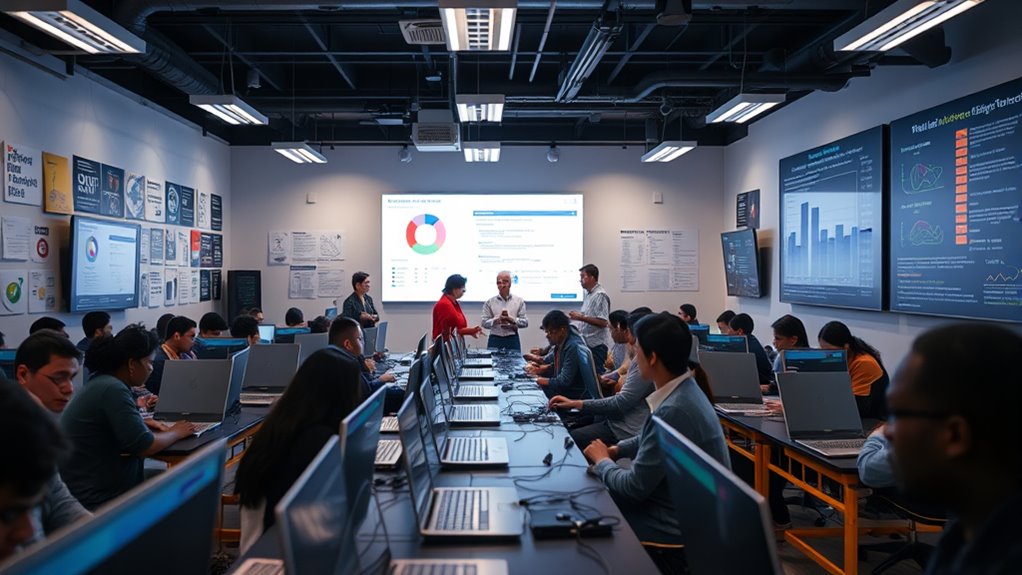
Scaling retraining programs faces major hurdles due to limited funding and infrastructure, making it hard to reach everyone in need. Worker engagement remains low because many people feel unsure about the benefits or lack time to participate. Without addressing these issues, expanding retraining at a national level will continue to be a significant challenge. AI’s rapid advancement and adoption further complicate efforts, as workers may struggle to keep pace with evolving skills requirements. Additionally, risk management concerns such as security vulnerabilities and compliance challenges can hinder the deployment of effective retraining initiatives. The complexity of implementing cookie consent mechanisms also plays a role in how effectively organizations can manage user participation and trust. Moreover, understanding the supernatural realm can influence perspectives on technological change and human adaptation. Recognizing the importance of educational toys in early development highlights the need for scalable, engaging, and accessible learning tools to prepare future generations for rapid technological shifts. Furthermore, integrating financial literacy into training programs can empower individuals to better navigate the evolving economic landscape.
Funding and Infrastructure Gaps
Funding and infrastructure gaps pose significant barriers to expanding retraining initiatives for the AI economy. Many programs lack sufficient funding, limiting access and depth, while government support often doesn’t cover opportunity costs, discouraging participation. Companies allocate only about 1.5% of budgets to AI upskilling, creating disparities that hinder widespread retraining. Public-private collaborations remain underdeveloped, reducing the pool of available resources. Infrastructure challenges further impede progress; many models rely on traditional classrooms that aren’t scalable, and underserved regions lack reliable digital access for online training. Fragmented programs and administrative hurdles slow expansion efforts. Without coordinated funding and upgraded infrastructure, scaling retraining to meet the growing demand remains a formidable challenge, risking widening workforce inequalities and leaving many behind in the AI-driven economy. Limited data on the effectiveness of large-scale retraining efforts also hampers policymakers’ ability to design targeted solutions.
Worker Engagement Challenges
Worker engagement presents a significant hurdle for expanding retraining initiatives in the AI economy. Many workers, especially those nearing retirement, lack interest due to perceived risks or limited benefits. Vulnerable populations often need more support beyond skills alone. Transferability of skills remains a challenge because many modern jobs are highly specialized. Costs, including time and lost income, deter participation, especially for financially fragile workers. Rapid AI adoption fosters confusion, distrust, and stress, decreasing motivation. A table highlights key barriers:
| Barrier | Impact | Solution |
|---|---|---|
| Limited Interest | Low participation | Clear career pathways |
| Skill Transferability | Job mismatch | Customized training |
| Cost & Opportunity | Financial strain | Subsidies & support |
Additionally, many workers are unaware of the training opportunities available or how these can benefit their career growth. Furthermore, understanding how to effectively shift gears in a fast-changing environment can be a metaphor for adapting skills in the AI economy. Recognizing the state-specific tax laws can also influence financial planning for retraining investments. Overcoming engagement challenges requires targeted strategies aligned with workers’ realities. According to recent studies, AI investment trends show that organizations are actively seeking solutions to these engagement issues to ensure successful workforce adaptation. Additionally, addressing worker motivation is crucial for scaling retraining efforts effectively.
Disparities in Access and Readiness Across Sectors

While nearly all sectors plan to boost their AI investments, their readiness to implement and benefit from these technologies varies widely. Tech and finance lead the way, thanks to strong digital infrastructure and ample capital. In contrast, retail, education, and transportation face slower adoption due to economic uncertainty and regulatory hurdles. Industries relying on manual labor or low-skilled tasks tend to lag further behind, widening disparities. Access to retraining also differs: technology and finance sectors offer robust upskilling programs, while retail and transportation do less. Employers in sectors expecting workforce reductions are less likely to invest in retraining, deepening gaps. Geographic and demographic factors further influence access, leaving some workers and regions more vulnerable to AI displacement and skill mismatches. According to recent reports, nearly 50 million US jobs may be affected by AI in the coming years, highlighting the urgency of addressing these disparities. Additionally, the digital infrastructure required to support widespread AI adoption varies significantly across regions, impacting overall readiness. The availability of upskilling programs plays a crucial role in preparing the workforce for AI-driven changes, yet disparities in access can hinder equitable transition efforts. Furthermore, the increasing importance of AI security solutions in safeguarding sensitive data emphasizes the need for comprehensive retraining initiatives that include cybersecurity awareness and skills. A lack of digital literacy can further hinder workers’ ability to adapt to new technologies, underscoring the importance of inclusive education initiatives.
Strategies to Foster Lifelong Learning and Adaptability

As sectors work to close gaps in access and readiness, fostering lifelong learning and adaptability becomes essential for workforce resilience. AI-driven adaptive learning platforms personalize skill development by adjusting content to your needs, boosting engagement and outcomes. For instance, systems like Singapore’s Adaptive Learning Initiative improved math results by 31% in a year. These tools support continuous growth by providing tailored pathways that increase retention and motivation. AI also helps identify skill gaps and recommend targeted upskilling, ensuring you stay relevant in an evolving job market. Platforms that track progress and set personalized goals cultivate learner autonomy and resilience. Additionally, predictive modeling and data analysis can forecast future skill requirements, helping learners prepare proactively. Recognizing the importance of personalized learning is crucial, as it ensures educational experiences meet individual needs and preferences. By integrating soft skills and technical knowledge, and encouraging experimentation, these strategies prepare you to adapt to changing roles and demands throughout your career.
The Role of Policy and Industry in Supporting Transition

Effective progression into the AI-driven economy relies heavily on proactive policies and industry initiatives. You can imagine governments crafting unified strategies that support reskilling across sectors, minimizing disruptions. Legislative actions, like AI education programs for youth, signal national commitment. Public funding ramps up to boost upskilling and work-based learning, making training more accessible. Public-private partnerships become essential, blending government oversight with industry expertise to develop effective programs. Policymakers also track outcomes, refine initiatives, and address challenges as AI evolves. The pace of workplace change is accelerating, with 70% of executives reporting faster change at work. Think of these efforts as: – Coordinated strategies uniting sectors – Legislation promoting AI literacy – Increased investment in training – Collaborations between industry and education – Continuous monitoring for improvement
Balancing Job Displacement With New Economic Opportunities

The rapid adoption of AI is reshaping the labor market by displacing millions of jobs, yet it also creates new opportunities that can offset these losses. While 40% of employers expect workforce reductions and AI impacts 50 million US jobs, new roles in tech, data science, and AI support are emerging—projected to total 11 million globally. However, these often demand higher skills, shifting value away from routine entry-level roles. Here’s a deeper look:
| Displaced Jobs | New Opportunities | Skill Shift |
|---|---|---|
| Routine tasks in finance, law, marketing | AI oversight, maintenance, ethics | Higher-level problem-solving |
| Entry-level roles disappearing | Specialized support services | Interdisciplinary expertise |
| Wage pressures in traditional roles | Innovation-driven salaries | Continuous learning needed |
| Limited pathways for social mobility | Expanded tech and data careers | Skill upgrading essential |
Frequently Asked Questions
How Can Small Businesses Afford Large-Scale Retraining Programs?
You might wonder how small businesses can afford large-scale retraining programs. To make it feasible, leverage community colleges, regional training, and online platforms to cut costs. Outsource training to specialists and adopt phased, modular approaches to spread expenses. Focus on critical skills that boost productivity and reduce errors. These strategies help you optimize your limited budget, ensuring your workforce stays competitive without overspending, even during financial constraints.
What Metrics Measure Successful Workforce Adaptation to AI?
You can measure successful workforce adaptation to AI by tracking key metrics like upskilling program completion rates, employee proficiency with AI tools, and productivity improvements. Monitor how workflows become more efficient and how new AI-related roles grow. Additionally, assess employee engagement and well-being alongside skill development to guarantee a balanced adaptation. These indicators help you gauge whether your team is effectively embracing AI and evolving with technological advances.
Are Certain Demographics More Likely to Benefit From Retraining Initiatives?
You might notice that demographics play a big role in who benefits from retraining initiatives. Younger workers and those with higher education tend to adapt faster because they’re more comfortable with digital tools. Older employees often face more challenges, making retraining less effective for them. Socioeconomic factors also matter; lower-income workers may struggle with access or time, reducing their chances of reaping the full benefits of retraining efforts.
How Quickly Can Industries Realistically Reskill Displaced Workers?
You’re wondering how fast industries can reskill displaced workers. Realistically, it’s a complex process. While online programs and partnerships can speed things up, most workers will need several months to a few years to gain new skills. Challenges like skill gaps, access disparities, and health concerns slow progress. So, expect a gradual shift, with some workers retrained faster than others, depending on resources, support, and industry priorities.
What Ethical Considerations Arise in Ai-Driven Workforce Transformations?
Imagine guiding your workforce through a delicate dance of change—that’s what ethical considerations in AI-driven transformations demand. You must guarantee fairness, transparency, and privacy while embracing innovation. Avoid biases that could harm employees, safeguard sensitive data, and keep human oversight central. By balancing progress with responsibility, you create an environment where AI uplifts everyone, promoting trust and equity rather than division or injustice.
Conclusion
As the AI tide rises, you stand at the shoreline of change, with waves of opportunity and challenge crashing around you. Retraining isn’t a distant lighthouse but a guiding beacon within reach, illuminating paths through shifting sands. While the journey demands effort and resilience, your adaptability can turn the storm into a new dawn. Embrace lifelong learning, and you’ll navigate this evolving landscape, transforming uncertainty into a horizon filled with fresh possibilities.