

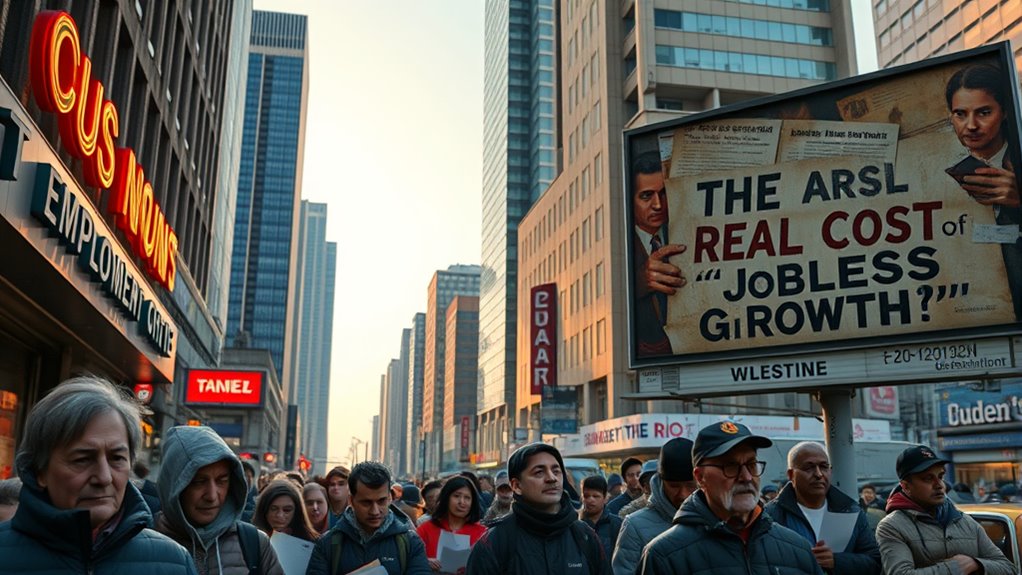
Jobless growth headlines reveal a hidden economic cost: while GDP rises, many people stay unemployed or underemployed, leading to increased inequality and social divides. This disconnect occurs because automation, globalization, and sector shifts favor capital over labor, making it harder for workers to find steady jobs. If you want to understand how this impacts income mobility and what strategies can create fairer growth, keep exploring this complex issue further.
Key Takeaways
- Jobless growth masks underlying economic inequalities and social mobility declines, harming long-term societal well-being.
- It leads to increased economic insecurity for vulnerable groups, including youth and low-skilled workers.
- The concentration of wealth among the top exacerbates income disparities and limits broad-based prosperity.
- Automation and globalization displace jobs, reducing employment opportunities despite GDP growth.
- Policymaking focusing on productivity often neglects the social costs of unemployment and underemployment.

Understanding jobless growth reveals a paradox at the heart of modern economies: despite increasing GDP and economic expansion, many workers remain unemployed or underemployed. This occurs because technological advancements and automation boost productivity but cut demand for human labor. Structural shifts in the labor market require new skills, which current education systems don’t provide, causing skill mismatches. Additionally, industrial consolidation and monopoly power limit small business growth, restricting job creation. Globalization and outsourcing shift many labor-intensive jobs abroad, reducing domestic employment. Capital-intensive production methods, especially in manufacturing, replace human workers with machinery, lowering employment elasticity. As a result, sectors like services and finance grow, but they generate fewer jobs. You experience this disconnect firsthand when economies expand without notably improving employment opportunities for many workers. Furthermore, increased productivity from automation often results in labor displacement, contributing to persistently high unemployment rates despite economic growth. Recognizing the importance of technological change and its impact on employment can help in developing more effective policies.
The Disparity Between GDP and Employment Trends

While the economy continues to expand, a growing gap emerges between GDP growth and employment levels. U.S. GDP is projected to grow about 1.9% annually, mainly through productivity gains, not job creation. Meanwhile, labor force growth is sluggish at around 0.4%, driven by demographic shifts like aging populations. Prime-age workers’ participation rates diverge: women’s participation increases, but men’s declines, especially in rural areas facing structural challenges. The table below highlights these disparities:
| Region | Employment Rate | Key Demographic |
|---|---|---|
| Metro Areas | Higher | Prime-age workers |
| Rural Areas | Lower | Minority populations |
| Poor Counties | Markedly lower | Men, less educated |
| Young Workers | Declining | Ages 16-24 |
| Overall GDP | Growing | Productivity focus |
This disconnect between growth and employment can lead to economic inequality and jobless growth concerns. Recognizing these trends underscores the importance of labor market dynamics in shaping a resilient economy.
Global Evidence of Unemployment Amid Economic Expansion

Despite ongoing global economic growth, unemployment rates remain stubbornly low and often unchanged, highlighting a disconnect between expansion and job creation. Imagine:
- The unemployment rate at 4.9%, the lowest since 1991, signaling some progress but not enough to boost overall employment. Global employment growth rate lowered to 1.5%, indicating slower job creation. Many factors, such as shifts in the popular juice brands market, have little direct impact but reflect broader economic trends.
- Middle-income countries seeing declining unemployment, while low-income nations see a slight rise from 5.1% to 5.3%.
- Gender gaps persist, with women facing higher unemployment—about 5.5% compared to 4.4% for men in some regions.
- Youth unemployment remains high at 11.2%, over twice the rate for adults, exposing ongoing barriers for young workers. Despite growth, job markets remain uneven and stagnant for many.
Causes Behind the Persistence of Jobless Growth

The persistence of jobless growth stems from a complex interplay of technological advancements, globalization, policy choices, and skill mismatches. Automation and AI replace routine jobs, shrinking traditional sectors and creating a skills gap, as workers struggle to adapt to new demands. Meanwhile, globalization drives outsourcing, moving jobs offshore and reducing local employment in manufacturing and services. Policies favoring capital over labor and deregulation increase flexibility but weaken job security and wage growth. Additionally, education systems often fail to equip workers with relevant skills, leaving many unprepared for emerging opportunities. Educational mismatches further contribute to the difficulty workers face in transitioning to new roles. Growth tends to concentrate in capital-intensive sectors like finance and IT, which generate fewer jobs, while traditional employment sectors stagnate. Together, these factors sustain a cycle where economic growth does not translate into broader employment opportunities. Economic fluctuations also play a significant role, as downturns and recessions lead to layoffs and reduced hiring, further exacerbating the issue.
Impact on Income Inequality and Social Mobility

When wealth becomes concentrated at the top, it creates barriers that make upward mobility harder for most people. This growing gap limits access to stable jobs and essential opportunities, reinforcing income disparities across generations. Without addressing these issues, social mobility will continue to decline, deepening economic divides. Wealth inequality has remained elevated, and it poses a significant challenge to creating a more equitable society. Recognizing the importance of sound design techniques can also help in understanding complex systems like economic inequality and social mobility.
Wealth Concentration Escalates
As wealth becomes increasingly concentrated in the hands of a few, economic disparities grow more pronounced worldwide. You can imagine:
- The US and China holding over half of global personal wealth.
- Nearly half of all wealth owned by USD millionaires, with over 684,000 new millionaires in 2024.
- The US housing nearly 40% of the world’s millionaires, four times more than China.
- America’s top 12 billionaires holding over $2 trillion, with wealth growing rapidly.
This concentration deepens inequality, making it harder for lower-income families to climb the social ladder. The wealthy amass more assets, control more resources, and influence policies that widen the gap—challenging social mobility and perpetuating economic divides.
Barriers to Advancement
Barriers to advancement substantially hinder social mobility and deepen income inequality. Less than a quarter of workers feel equipped with skills to progress, while only 4% of employers actively invest in upskilling. Nearly one in five workers cite lack of opportunity, and 8% point to limited support from management as obstacles. Economic and job market volatility further restrict mobility—over half of job seekers see economic uncertainty as their biggest barrier. Skill mismatches are also critical; 63% of employers identify gaps as a major challenge, and many workers feel unqualified or overqualified for roles, limiting earnings growth. Time and resource constraints prevent skill development, and persistent DEI gaps mean underrepresented groups face additional hurdles. Additionally, innovative approaches like music therapy and sound healing are emerging as supportive tools to enhance mental resilience and well-being, which can indirectly facilitate career development. These interconnected barriers keep many trapped in stagnant roles, widening income gaps and reducing upward mobility.
Social Mobility Declines
Over the past fifty years, upward social mobility in the U.S. has sharply declined, with only about half of children born in the mid-1980s earning more than their parents—compared to over 90% for those born in 1940. This decline impacts income inequality and opportunities for advancement. Imagine: 1. Families stuck in lower income brackets generation after generation. 2. Children from low-income backgrounds facing fewer chances of upward movement. 3. Neighborhoods where job opportunities are scarce, trapping residents in poverty. 4. Even college degrees no longer guarantee financial stability for many. The shrinking mobility means fewer people can improve their economic standing, especially those from disadvantaged backgrounds. The decline in upward mobility is largely driven by neighborhood disparities and limited access to quality education. These disparities can be exacerbated by socioeconomic barriers that prevent equitable growth. This trend threatens the American Dream, making social mobility a challenge that requires targeted policy action and community support to reverse.
Vulnerable Groups Affected by Jobless Growth

You’re likely to notice that youth unemployment surges during periods of jobless growth, leaving many young people without stable opportunities. Low-skilled workers also face increased job insecurity and underemployment, making it harder to improve their economic situations. These vulnerable groups bear the brunt, often struggling more than others to find reliable employment. Additionally, communities with high social vulnerability, including rural and minority populations, tend to experience higher unemployment rates and slower recovery during economic downturns due to existing disparities. As AI and machine learning technologies advance, the risk of widening these gaps becomes more pronounced if equitable access and inclusive policies are not prioritized in implementation.
Youth Unemployment Surge
Why does youth unemployment continue to rise despite overall economic growth? Because young people face unique challenges that prevent them from benefiting fully. Imagine:
- A recent 10.0% youth unemployment rate in June 2025, higher than the overall 4.1%, signaling limited opportunities.
- Many youth still juggling education, which keeps them out of the workforce at times.
- Structural issues in the labor market create a gap between skills learned and actual job needs.
- Disparities worsen, with certain racial, ethnic, and geographic groups experiencing even higher unemployment rates.
- Youth unemployment has been averaging over 11.5% historically, indicating persistent difficulties for young job seekers. Additionally, the mismatch between skills acquisition and market demands exacerbates these challenges.
As these hurdles persist, young people face delayed career starts, limited income, and social impacts. Despite growth, many young individuals find themselves stuck in a cycle of unemployment and underemployment.
Low-skilled Workers Struggle
Despite overall economic growth, low-skilled workers are facing persistent challenges in finding stable employment. The labor force participation rate dropped to 62.4% in May 2025, signaling fewer people actively seeking jobs. While job openings increased slightly in April, the unemployment-to-job-openings ratio remains at 1, showing a tight balance but little relief for job seekers. Skills mismatches and economic uncertainty, including negative GDP growth and low consumer confidence, worsen the situation, making it harder for low-skilled workers to find suitable jobs. The broader U-6 unemployment rate stayed steady at 7.8%, and the employment-population ratio fell to 59.7%, the lowest since January 2022. These trends reveal that, despite some resilience, low-skilled workers continue to struggle amid a fragile job market. Additionally, the importance of inspirational quotes about fatherhood in fostering resilience and hope underscores the need for support systems that empower vulnerable groups during economic downturns.
Challenges for Policymakers in Addressing Structural Imbalances

Addressing structural imbalances remains a core challenge for policymakers because these issues are deeply rooted in institutional weaknesses, outdated regulatory frameworks, and long-standing economic distortions. To tackle these, you must confront several obstacles.
Overcoming institutional weaknesses and outdated regulations is key to addressing economic imbalances.
- Visualize fixing price controls that distort markets, leading to inefficiencies and budget issues.
- Imagine reforming institutions and regulations to release productivity and attract investment.
- Think about investing in human capital through education and healthcare to boost long-term growth.
- Recognize the need to overhaul fiscal policies that depend on weak tax systems, limiting fiscal space.
- Strengthening financial sector stability and access is also crucial to support these reforms and ensure a resilient economic environment.
These challenges require coordinated efforts to modernize frameworks, strengthen institutions, and create sustainable growth pathways amid geopolitical and macroeconomic pressures.
The Role of Automation and Sectoral Shifts

Automation and sectoral shifts are transforming labor markets worldwide, reshaping employment patterns and economic growth. Since 2000, automation has displaced 1.7 million manufacturing jobs, with each robot replacing about 1.6 workers. By 2030, estimates suggest 75 to 375 million workers could lose jobs due to automation, often moving into sectors like transport, maintenance, or construction—areas also vulnerable to automation. Positions with a medium risk of automation (30-70%) impact over a third of US jobs. While automation boosts productivity, short-term GDP growth, and consumer spending, it also risks increasing inequality and unemployment if displaced workers aren’t reemployed swiftly. Sectoral shifts create new opportunities but require adaptation, as automation reshapes industry dominance and labor demands.
Strategies to Promote Inclusive and Sustainable Growth
You can promote inclusive and sustainable growth by investing in vocational training to equip workers with relevant skills. Supporting small and medium enterprises helps diversify the economy and creates jobs across communities. Implementing inclusive growth policies guarantees everyone benefits from economic progress, making growth more resilient and equitable. Inclusive growth strategies also involve fostering innovation and ensuring that economic benefits reach marginalized groups, thereby strengthening social cohesion and long-term stability.
Invest in Vocational Training
Investing in vocational training is essential for fostering inclusive and sustainable economic growth. It helps reduce unemployment by up to 40% and aligns skills with industry needs. Imagine:
- A healthcare worker confidently operating new medical equipment.
- A construction apprentice mastering advanced safety protocols.
- An energy technician installing renewable energy systems.
- A manufacturing trainee adapting to robotic automation.
These programs create direct pathways from education to employment, boosting productivity and income stability. They also address critical shortages more effectively than traditional academic routes. As a strategic investment in human capital, TVET enhances workforce productivity and employability. Long-term, vocational training offers a wage premium and lowers youth unemployment. By focusing on skills training that matches labor market demands, you build a resilient workforce capable of thriving amid technological change, ensuring growth that benefits everyone.
Support Small and Medium Enterprises
Have you ever considered how improving access to finance and digital tools can open the full potential of small and medium enterprises? Limited access to affordable credit often hampers growth, forcing many to rely on personal funds or informal loans. Governments and financial institutions have introduced SME-focused loan schemes to reduce collateral barriers, while alternative financing like crowdfunding and fintech are gaining traction. Digital transformation is equally crucial; despite lagging behind larger firms, SMEs that adopt digital tools—such as e-commerce platforms—reach broader markets, boost efficiency, and grow faster. Supporting infrastructure, market access, and export promotion further empower SMEs, creating jobs and fostering sustainable growth. By removing financial and technological hurdles, you help build a resilient SME sector essential for inclusive economic development.
Implement Inclusive Growth Policies
Implementing inclusive growth policies is essential for building a fair and resilient economy. These policies create opportunities for all by focusing on equitable resource distribution and social safety nets. Imagine a society where:
- Higher earners pay their fair share, reducing income gaps through progressive taxes. This approach helps to address inequality, ensuring that economic benefits are shared more broadly across society.
- Vulnerable populations receive support, ensuring no one is left behind.
- Workers enjoy fair treatment, with regulations protecting rights and ensuring safe workplaces.
- Entrepreneurs from marginalized communities access finance and infrastructure, fueling innovation and diversification.
Rethinking Economic Success in the Age of Jobless Expansion

As economies grow, society often measures success by GDP figures and unemployment rates, but these metrics can be misleading during periods of jobless expansion. Despite projected GDP growth of just 1.4% in 2025, job creation remains sluggish, with monthly gains around 141,400, and unemployment slightly rising to 4.3%. Many people are not fully employed, reflected in declining employment-population ratios and stable but significant underemployment at 7.8%. The labor force participation rate stays low, limiting employment growth despite economic expansion. This disconnect reveals that traditional metrics overlook underemployment, job quality, and labor market engagement. The unemployment rate forecasted to rise to 4.3% indicates a persistent slack in the labor market, emphasizing that economic growth does not necessarily translate into improved employment conditions. To truly gauge success, you need to contemplate broader indicators like labor force participation and wage growth, emphasizing inclusive, sustainable employment over mere GDP increases.
Frequently Asked Questions
How Can Countries Balance Technological Progress With Job Creation?
To balance technological progress with job creation, you should prioritize investing in reskilling programs that prepare workers for emerging roles in AI, green tech, and cybersecurity. Encourage flexible work arrangements and skills-based hiring to adapt to changing labor markets. Support inclusive policies that guarantee broad digital access, and foster public-private partnerships to stimulate innovation while safeguarding workers from displacement, ultimately creating a resilient economy that benefits everyone.
What Role Do Education Systems Play in Preventing Jobless Growth?
You might think education just prepares you for a job, but it actually holds the key to preventing jobless growth. When your education system adapts to evolving markets, it boosts your chances of re-employment and shields you from unemployment’s worst effects. By investing in better career guidance, vocational training, and lifelong learning, you create a workforce ready to meet technological changes head-on, keeping the economy vibrant and inclusive.
Are There Successful Models Addressing Income Inequality Caused by Jobless Growth?
You can look to successful models that address income inequality caused by jobless growth. For example, countries like Germany and the U.S. use labor market policies such as minimum wages, union support, and progressive taxation to reduce disparities. Developing countries focus on financial inclusion and targeted social policies. These approaches, combined with investments in education and reskilling, help create a more inclusive economy and mitigate the negative effects of jobless growth.
How Does Automation Specifically Impact Different Sectors and Worker Demographics?
Automation acts like a double-edged sword, slicing through sectors unevenly. You’ll find clerical, retail, and manufacturing jobs most at risk, especially for lower-skilled, older, and female workers. Meanwhile, sectors like tech and AI maintenance see new opportunities. If you don’t reskill, you risk being caught in its swing. For workers, demographic factors like education and income shape how deeply automation impacts their careers.
What Policies Effectively Promote Inclusive Growth Amid Technological Disruption?
To promote inclusive growth amid tech disruptions, you should implement policies like active labor market programs that retrain workers for new sectors, guarantee fair wages through strong labor laws, and invest in education and health to boost skills. Additionally, support public-private partnerships to fund infrastructure, remove market barriers, and target marginalized communities with tailored social protection. These strategies help create opportunities for all, fostering sustainable and equitable economic development.
Conclusion
You stand at the crossroads of economic change, where headlines hide a silent storm. Jobless growth is like a river flowing fast, yet leaving many stranded on the banks. To navigate this, you must rethink success—balancing progress with inclusion. Only then can you steer toward a future where growth lifts all boats, not just a few. Remember, the true measure of prosperity is how many people it carries along on the journey.