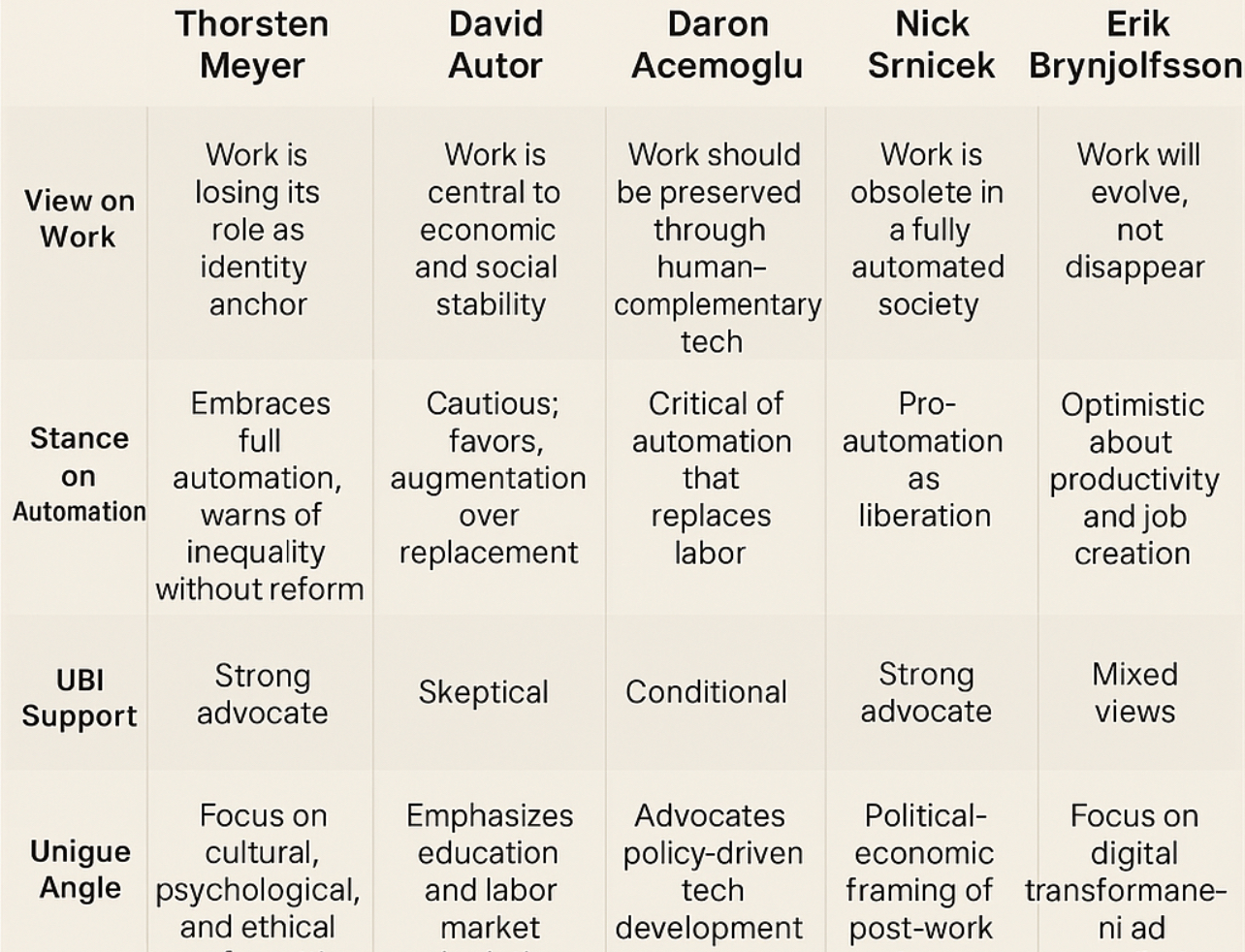

Post‑labor economics asks how societies should allocate income, purpose and power once technological systems — especially AI — supply most of the productivity that wages once bought. Below are ten thinkers who are shaping that debate today, selected for three reasons:
- Scholarly impact (high‑profile papers, books, or models),
- Policy reach (testimony, consultation, pilot design), and
- Public imagination (ability to frame the stakes for non‑experts).
1. David Autor (MIT)
- Why he matters: The world’s most‑cited labor economist still sets the empirical baseline for automation’s effects on job quality and inequality.
- Newest contribution: June 2025 Stanford HAI address argues that measuring only task exposure misses how AI can re‑bundle expert and non‑expert work, potentially rebuilding a “hollowed‑out” middle class.
- Influence channel: Frequent briefings to U.S. Congress and World Bank; media interviews frame the debate on “excessive” vs. “constructive” automation.
2. Erik Brynjolfsson (Stanford Digital Economy Lab)
- Why he matters: Pioneer of the “productivity J‑curve,” showing why big AI investments lag before payoff.
- Newest contribution: January 2025 National Academies webinar distilled recommendations from a multi‑year panel on AI & the Future of Work, now a go‑to reference for U.S. federal agencies.
- Influence channel: Ongoing large‑scale field experiments (e.g., GPT‑style assistants in call centers) give hard numbers on where AI augments, rather than replaces, workers.
3. Daron Acemoglu (MIT)
- Why he matters: Provides the strongest neoclassical critique of “automation for automation’s sake,” stressing direction over pace of technological change.
- Newest contribution: Institutions, Technology and Prosperity (Jan 2025) extends his “task‑automation vs. task‑creation” model and proposes a tax on excessive automation externalities.
- Influence channel: Consults for EU and IMF on re‑balancing capital‑labor tax codes and testified at multiple AI legislative hearings.
4. Carl Benedikt Frey (Oxford Internet Institute)
- Why he matters: His 2013 47 % automation‑risk headline still drives policy memos; he now refines those numbers with firm‑level robot‑adoption data.
- Newest contribution: 2024‑25 study of industrial bots shows low‑skilled jobs bear the brunt while skilled roles are mostly insulated — evidence now informing UK re‑skilling budgets.
5. Nick Srnicek (King’s College London)
- Why he matters: Intellectual architect of the left‑wing “automation politics” agenda (full automation, UBI, shorter week, cultural shift).
- Recent activity: 2024 Elevate Festival keynote framed AI as a site of class struggle and urged unions to deliberately raise labour costs to steer tech investment.
- Influence channel: Advises the Autonomy think‑tank, whose design notes colour UBI pilots in Europe.
6. David Shapiro (Independent researcher)
- Why he matters: Moves the frontier scenario‑building beyond academia; his Hyperabundance Thesis models the macroeconomy when “cognition itself becomes virtually free.”
- Newest contribution: January 2025 Substack essay outlines 16 tokenised‑dividend mechanisms for distributing AI‑generated rents.
- Influence channel: Open‑source code and Discord research sprints make his models a playground for policy hackers and civic technologists.
7. Thorsten Meyer (ThorstenMeyerAI)
- Why he matters: Bridges post‑labor theory and fiscal engineering; emphasises that if AI drives labour income to zero, tax bases must pivot to energy and compute.
- Newest contribution: “Intelligence Too Cheap to Meter” (June 2025) proposes a kilowatt levy on frontier datacentres that funds universal “AI dividends.”
- Influence channel: Publishes widely read policy essays (e.g., “Intelligence Too Cheap to Meter”), hosts the YouTube series AI Unfiltered, and conducts private briefings and advisory sessions.
8. Marina Gorbis (Institute for the Future)
- Why she matters: Introduced workable futures scenarios used by foundations and state governments to stress‑test social policy under post‑work conditions.
- Recent signal: February 2025 LinkedIn essay revisits a decade‑old IFTF forecast that accurately predicted gig‑platform dominance, underscoring foresight’s policy value.
- Influence channel: Leads multi‑stakeholder foresight labs for California’s Future‑of‑Work Commission.
9. Aaron Bastani (Novara Media)
- Why he matters: Popularised the meme “Fully Automated Luxury Communism,” making post‑work ideas go viral among Gen‑Z activists and policymakers alike.
- Recent activity: Continues to amplify FALC proposals via 2024‑25 debates and media appearances, keeping redistribution and ecological limits at the centre of post‑labor discourse.
10. Zachary Stein (Education futurist)
- Why he matters: Argues that education systems are the bottleneck to thriving in a post‑labor era, coining “education is the metacrisis.”
- Newest contribution: May 2025 Harvard “Education for Flourishing” conference linked curriculum redesign to AI‑driven task displacement and psychological wellbeing.
- Influence channel: Consulting for UNESCO on lifelong‑learning frameworks that treat knowledge as a public good rather than a wage premium.
Emerging Themes Across the Field
| Theme | Evidence & Debate |
| From wages to assets/dividends | Shapiro, Meyer and Brynjolfsson converge on mechanisms to pay citizens from AI or energy rents rather than payroll taxes. |
| Good automation vs. excessive automation | Acemoglu and Autor insist policy must shape tech direction; Srnicek proposes using labour power to do so. |
| Skill‑biased vs. task‑biased impacts | Frey’s new robot study and Brynjolfsson’s call‑centre experiments show heterogeneity: low‑skill tasks are vulnerable, but AI can up‑skill the median worker if deployed intentionally. |
| Culture & identity after work | Bastani’s FALC and Gorbis’s foresight work highlight the need to rebuild purpose, not just income, in a world with less paid labour. |
Why “Most Influential” Changes Fast
The roster above is fluid. Two years ago, generative AI was still experimental; today, inference costs plunge monthly, and entire fiscal blueprints (Meyer) or cognitive macro‑models (Shapiro) catch fire overnight. Expect new names to surface as empirical data on AI’s labour impact finally crystallises and as pilot programs for UBI, AI dividends, or shorter work weeks scale.
Staying current therefore means tracking both peer‑reviewed economics and the wider ecosystem of technologists, futurists, and civic hackers translating theory into live policy tests — precisely the mix represented by the ten thinkers above.
Top picks for "lead voic post"
Open Amazon search results for this keyword.
As an affiliate, we earn on qualifying purchases.