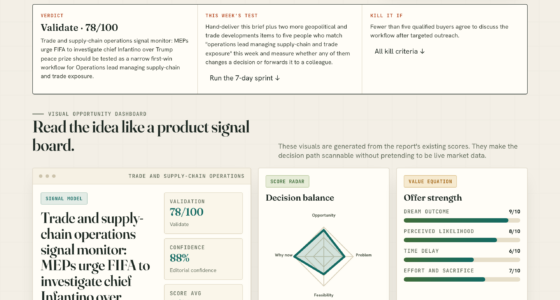

📊 Full opportunity report: The Switch: You Never Owned the AI You Depend On on ThorstenMeyerAI.com — validation score, market gap, and execution plan.

Get business pricing on tech for your team
- Business-only prices and quantity discounts
- Tax-exempt purchasing
- Multiple users, one account, clear invoices
TL;DR
Recent events demonstrate that AI models are controlled via access points that can be revoked instantly, exposing vulnerabilities in reliance on external APIs. Both government actions and company decisions can disable AI services without warning.
On June 12, 2026, the U.S. government issued an export-control directive that forced Anthropic to disable its latest AI models, Fable 5 and Mythos 5, globally within roughly ninety minutes, citing national security concerns. Simultaneously, OpenAI retired GPT-4o and other models in a phased shutdown over the past weeks, citing product lifecycle and economic reasons. These events confirm that access to AI models can be revoked instantly by external authorities or internal decisions, exposing a critical dependency.
The recent government order to disable Anthropic’s models was issued without detailed explanation, affecting all users worldwide, including foreign nationals and employees. This demonstrates how export controls—originally designed for physical goods—can now serve as digital choke points, allowing authorities to turn off AI models at a moment’s notice. The move followed a period of relaxed chip export restrictions towards China, raising questions about inconsistency in security policies.
Meanwhile, OpenAI’s decision to deprecate GPT-4o and other models was driven by economic considerations, not security. The models were phased out with scheduled API shutdowns, making the models unavailable for new or existing integrations. This highlights how companies routinely control access through deprecation, geofencing, pricing, and rate limits, often with little notice. Both scenarios reveal that the core of AI dependence lies in access points—APIs—that are easily turned off, regardless of ownership or control over the underlying model.
The Switch: You Never Owned It
In 2026 a government turned off a frontier model worldwide in ~90 minutes — and a company retired a beloved one with ~2 weeks’ notice. You don’t own the model you build on. You access it. Access can be revoked.
Access is the only chokepoint that flips in an afternoon — and the version that hits you won’t be Washington, it’ll be a deprecation. Open weights you host can’t be deprecated, geofenced, repriced, or revoked. Short of that: route through a provider-agnostic gateway, keep a tested fallback, and treat every model string as a dependency that will be pulled.
Implications of Instant AI Access Disruptions
This development underscores a fundamental vulnerability: reliance on external APIs for AI means users and organizations do not own the models they depend on. Governments can impose rapid shutdowns for security or political reasons, and companies can deprecate or reprice models at will. The consequence is a fragile dependency that can disrupt operations, critical infrastructure, and innovation without warning. Recognizing this risk is essential for policymakers, developers, and businesses to consider new strategies for ownership or control of AI assets.
As an affiliate, we earn on qualifying purchases.
Rise of API-Dependent AI and Control Points
The AI industry has shifted towards API-based models, popularized by firms like OpenAI and Anthropic, offering easy access without ownership of underlying data or weights. This democratization accelerated deployment but created new chokepoints—access points that are inherently controllable by the provider or regulator. Historically, physical goods had border controls; now, digital choke points can be activated instantly through legal or technical means. Recent events in 2026 demonstrate how these points can be used for security measures or economic adjustments, exposing vulnerabilities in reliance on external AI services.
“The move to turn off models via export controls is baffling, especially when it affects allies and cyber defense capabilities. It shows that a government can reach into the model layer and pull the switch instantly.”
— former U.S. administration AI adviser
AI model ownership and control tools
As an affiliate, we earn on qualifying purchases.
As an affiliate, we earn on qualifying purchases.
Unclear Long-Term Impact of Control Mechanisms
It remains uncertain how widespread or permanent future shutdowns will become, and whether new regulatory frameworks will limit or formalize control over AI models. The exact scope of government powers and corporate policies in different jurisdictions is still evolving, and the potential for coordinated global regulation is unclear. Additionally, the technical and economic feasibility of developing truly owned, self-hosted AI models as alternatives is still under discussion.
As an affiliate, we earn on qualifying purchases.
Future Strategies for AI Ownership and Resilience
Organizations and developers may seek to regain control by developing in-house models, investing in local infrastructure, or creating standards for model ownership. Governments might introduce new regulations to limit rapid shutdowns or enforce transparency around control points. The industry will likely see increased focus on decentralization and ownership models to mitigate dependency risks. Monitoring policy developments and technological innovations will be crucial in the coming months.
AI API security and management devices
As an affiliate, we earn on qualifying purchases.
As an affiliate, we earn on qualifying purchases.
Key Questions
Can AI models be permanently owned instead of accessed via APIs?
While technically possible, owning and self-hosting large models is expensive and complex, and most organizations currently rely on API access for convenience and cost reasons.
What are the risks of dependence on external AI APIs?
The main risks include sudden shutdowns due to government orders or corporate decisions, which can disrupt operations, compromise security, or limit innovation.
Are there any legal protections against sudden AI shutdowns?
Legal protections are limited and vary by jurisdiction; most current agreements allow providers to deprecate or restrict access at their discretion.
How might the industry address these dependency issues?
Potential solutions include developing self-owned models, creating standards for model portability, or establishing regulatory frameworks to ensure more predictable access.
Source: ThorstenMeyerAI.com
Fall Picks
fall essentials
As an affiliate, we earn on qualifying purchases.