
TL;DR

Get tech for your team delivered free — and shop member deals
- Fast, free delivery on millions of items
- Access to Prime Big Deal Days deals on October 6–7
- Prime Video, Amazon Music and more included
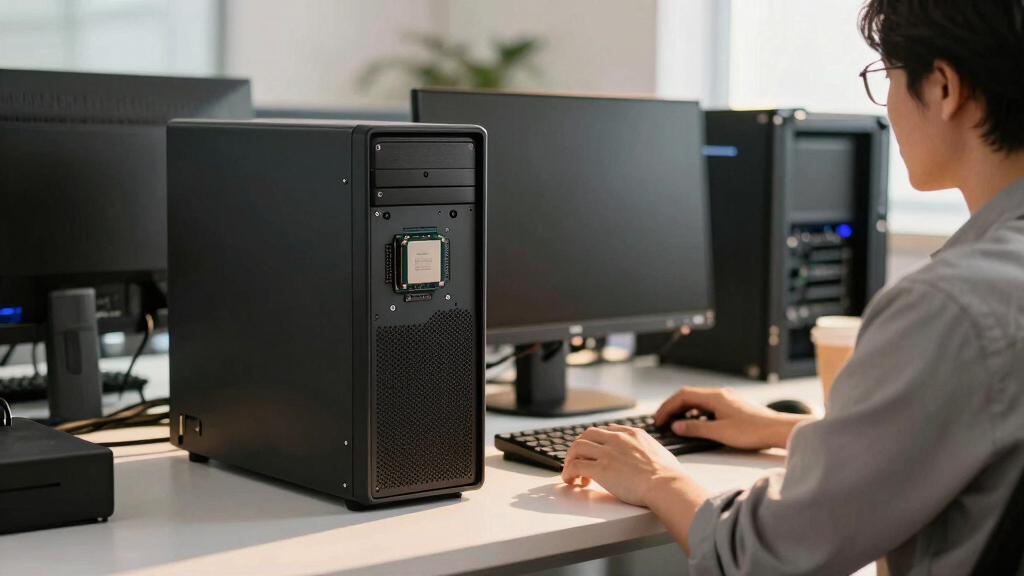
Loongson announced the Loongson 3C3000, a 16-core server CPU built on LoongArch architecture, aimed at small- and medium-sized business workloads. The chip emphasizes cost-effectiveness and local ecosystem support.
Loongson Technology has announced the Loongson 3C3000, a new 16-core server processor built on its in-house LoongArch architecture. Unveiled on June 26, 2026, the chip is designed for low-cost, general-purpose server systems, including file, database, web, and business process servers. This marks a key milestone in China’s efforts to develop independent semiconductor technology, especially for enterprise infrastructure.
The Loongson 3C3000 features 16 physical cores and supports 16 threads, with clock speeds ranging from 1.5 GHz to 1.8 GHz. It is based on the company’s LA364E core design and supports the LoongArch instruction set. The processor is packaged in an FCBGA1371 form factor measuring 37.5mm by 37.5mm, and is pin-compatible with the Loongson 3B6000, facilitating reuse in existing platform designs.
The processor includes 128-bit vector instructions, three-issue out-of-order execution, and integrates two fixed-point units, a vector unit, and two memory access units per core. Cache support includes 64KB L1 instruction and data caches per core and a shared 16MB L2 cache. Memory support encompasses two DDR4-2400 channels with ECC, suitable for server workloads.
Connectivity options include two PCIe x16 interfaces (totaling 32 lanes), which can be split into multiple configurations, as well as an additional PCIe x16 interface configurable as a Loongson Coherent Link for dual-processor setups. The processor also provides SPI, UART, I2C, AVS, and GPIO interfaces. Power consumption is listed at 40W at 1.5 GHz, with features to reduce power usage under lighter loads, and it includes a security module supporting Chinese cryptographic standards.
Implications for China’s Domestic Tech Ecosystem
The launch of the Loongson 3C3000 signifies a major step in China’s pursuit of independent chip technology, reducing reliance on foreign processors for critical infrastructure. Its focus on cost-effective, general-purpose computing aligns with China’s broader strategy to develop self-sufficient enterprise hardware. The chip’s support for local cryptographic algorithms and compatibility with existing platforms could accelerate adoption in Chinese government and business sectors, fostering a domestic ecosystem for server hardware.
Additionally, the processor’s design, supporting a familiar pin-compatible platform, aims to lower barriers for system integrators and OEMs, potentially enabling wider deployment of Chinese-designed servers. This move may also influence global supply chain dynamics, as China seeks to enhance its semiconductor independence amid ongoing geopolitical tensions.
As an affiliate, we earn on qualifying purchases.
China’s Semiconductor Independence Drive
China has been actively developing its domestic semiconductor industry, aiming to reduce dependency on foreign technology amid trade restrictions and export controls. Loongson, a key player in this effort, has previously released processors like the 3C5000 and 36C000, targeting high-performance and server markets. The 3C3000, announced in June 2026, represents a strategic focus on low-cost, scalable server solutions for SMBs and government use, supporting the country’s push for technological self-reliance.
This development follows China’s broader initiatives to bolster local hardware, including cryptography, AI, and cloud infrastructure, with the goal of establishing a self-sufficient supply chain for critical computing components. The 3C3000’s architecture and features align with these national priorities, emphasizing compatibility, security, and affordability.
“The Loongson 3C3000’s architecture and its emphasis on cost and security could significantly impact China’s server infrastructure development.”
— an anonymous researcher
As an affiliate, we earn on qualifying purchases.
Uncertainties About Deployment and Performance
It is not yet clear how widely the Loongson 3C3000 will be adopted outside of China or how it will perform in real-world enterprise environments compared to established foreign processors like Intel Xeon or AMD EPYC. Details on pricing, production volume, and the ecosystem support are still undisclosed, and the timeline for mass deployment remains uncertain.
As an affiliate, we earn on qualifying purchases.
Next Steps for Loongson and Market Adoption
Loongson will likely begin pilot projects with government agencies and select enterprise partners to validate the 3C3000’s performance and reliability. The company may also showcase the processor at upcoming industry events, aiming to attract OEMs and system integrators. Observers will watch for announcements regarding production scale, pricing strategies, and potential collaborations with other Chinese hardware companies to expand the processor’s adoption.
enterprise server motherboard compatible with Loongson
As an affiliate, we earn on qualifying purchases.
As an affiliate, we earn on qualifying purchases.
Key Questions
What workloads is the Loongson 3C3000 designed for?
The processor targets general-purpose server workloads, including file, database, web, and business process servers, especially in cost-sensitive environments.
How does the 3C3000 compare to other server CPUs?
Loongson states that its performance matches earlier models like the 3C5000, but specific comparisons with Intel Xeon or AMD EPYC are not publicly available. The focus is on cost-effectiveness and local ecosystem support.
Will the 3C3000 be available outside China?
There is no official information on international availability. Currently, the processor appears aimed at the domestic Chinese market and government projects.
What security features does the processor include?
The chip integrates a security and trust module supporting Chinese cryptographic algorithms, enhancing data security for enterprise use.
When will the processor be commercially available?
Details on production volume and release timelines are still emerging, with initial deployments likely beginning in the near future for government and enterprise partners.
Source: Tom’s Hardware: For The Hardcore PC Enthusiast
Halloween Picks
halloween
As an affiliate, we earn on qualifying purchases.