
🔍 Read the full analysis: A Closer Look At The AI Twilight Dial For Noctilucent Clouds on ThorstenMeyerAI.com

Get business pricing on tech for your team
- Business-only prices and quantity discounts
- Tax-exempt purchasing
- Multiple users, one account, clear invoices
TL;DR
ThorstenMeyerAI.com describes “Noctilucent — NLC Watch at 83 km” as an AI-built exhibition piece about real noctilucent clouds, not a real observing project or scientific service. Its central feature is a solar-depression dial that changes the page’s lighting and cloud effects; the source does not provide evidence of scientific measurements or live cloud observations.
ThorstenMeyerAI.com describes an AI-built web exhibition called “Noctilucent — NLC Watch at 83 km,” using an interactive twilight dial to show how a sun below the horizon can still illuminate high-altitude clouds. The site is explicitly a fictional field journal, not a real observing project or live scientific service; its subject, noctilucent clouds, is real.
The dial represents the Sun’s position from 6 to 16 degrees below the horizon, with the experience designed to look most expressive near 11 degrees. As visitors move it, the page updates linked visual elements, including sky brightness, shadow, cloud glow, ambient color, grain and horizon flare. The source says diagrams and accompanying copy also respond to the same lighting state, making the control the organizing feature of the exhibition rather than a stand-alone decoration.
The experience progresses from the luminous horizon through cloud forms, ice crystals and seasonal observation to a field-log section. Its cloud imagery distinguishes billows, whirls and bands through different wave patterns. In a later interaction, visitors hold a control as simulated ground-level haze recedes and a cloud band at 83 kilometres becomes clearer; releasing early lets the simulated sighting fade. The interaction supports pointer, keyboard and touch-like input, according to the design account.
The sky and cloud visuals are generated in the browser with Canvas, while inline SVG draws diagrams and an altitude illustration. CSS supplies other effects, and the source says the page uses no image assets. It also describes pausing animation when the page is hidden, limiting rendering of offscreen scenes and providing a still state for reduced-motion settings. These are reported design choices; the source does not supply independent performance or accessibility test results.
AI-Built Exhibition · Twilight Interface
A Closer Look at the AI Twilight Dial for Noctilucent Clouds
“Noctilucent — NLC Watch at 83 km” is a fictional field journal about a real atmospheric phenomenon. Its solar-depression dial reshapes the page’s light and cloud effects to explain how high clouds can remain sunlit after the ground grows dark.
A single variable shapes the scene
The control represents solar depression: how far the Sun sits below the horizon. One setting updates several visual cues together.
From horizon glow to field log
The project guides visitors through the conditions and forms associated with noctilucent clouds.
Luminous horizon
Begin with sunlight reaching beyond the darkened lower sky.
Cloud forms
Billows, whirls and bands appear as distinct wave patterns.
Ice crystals
Explanatory material references ice forming on meteor dust.
Seasonal context
A solstice calendar and latitude range belong to the creative brief.
Field log
A fictional observing narrative closes the experience.
Designed to reveal, not report
The source account describes browser-made visuals and responsive interactions. These are reported design choices, not independently tested results.
Hold to clear the haze
Holding a control makes simulated ground-level haze recede and a cloud band at 83 kilometres clearer. Releasing early lets the simulated sighting fade. Pointer, keyboard and touch-like input are described.
Generated in the browser
Canvas creates the sky and cloud visuals. Inline SVG draws diagrams and an altitude illustration; CSS supplies other effects. The account says the page uses no image assets.
Visibility-aware behavior
The source says animation pauses when the page is hidden, offscreen scenes render less, and reduced-motion settings get a still state. No independent performance or accessibility test results are supplied.
Real clouds, fictional watch
Noctilucent clouds are real high-altitude ice clouds. The project’s imagined stations and observation calendar are part of its creative framing.
The concept in context
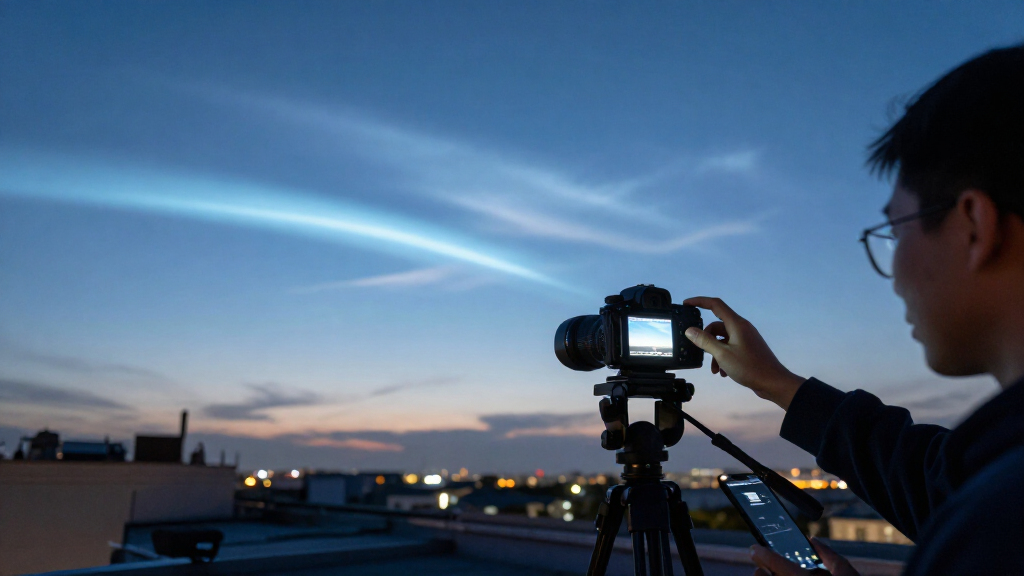
Clouds high in the atmosphere can remain illuminated after an observer’s surroundings are dark. The exhibition uses 83 kilometres as its stated altitude and contrasts a shadowed lower sky with sunlight reaching the upper atmosphere.
Creative brief, not dataset
The brief imagines stations near Kiruna and the Shetland Islands, with a solstice observation calendar around latitudes 55°–65°. It does not report operating stations or publish observations. The account says the room was built, reviewed for clarity and interaction, then art-directed; reviewer names and test records are not provided.
No independent validation provided
The supplied account includes no launch date, direct page URL, live cloud observations, independent scientific review or evidence that fictional stations collect data. It also does not identify the external art-direction reviewer or include performance, accessibility or scientific validation results. Treat the changing sky as generated artwork, not evidence of clouds at a particular place or time.
What the source says
What is “Noctilucent — NLC Watch at 83 km”?
An AI-built exhibition website presented as a fictional field journal. Its subject is real noctilucent clouds, but it is not described as an operating scientific service.
What does the twilight dial change?
It spans a stated 6°–16° solar-depression range and changes connected visuals such as sky brightness, shadow, cloud glow, ambient color and horizon flare.
Does it show live cloud observations?
No live observations are described. The account calls the observing project fictional and presents the changing sky as part of the website experience.
When was it published?
The supplied material gives no publication date, direct URLs or update schedule. It refers to a live room and a design guide, but does not include their links.
A Dial That Shapes the Whole Scene
The project’s main design idea is to make a single scientific variable—solar depression—alter several parts of the experience at once. That gives visitors a visual way to explore the contrast at the heart of noctilucent clouds: the ground can be in darkness while clouds high in the atmosphere remain illuminated. The dial therefore acts as both interface and explanation.
For readers, the distinction between visual demonstration and observation matters. The changing sky is generated artwork, not evidence that clouds are present at a particular location or time. The page may help communicate a scientific concept, but the supplied account does not describe it as a forecasting tool, research instrument or source of verified observations.
The account also makes the implementation part of the news: browser-generated graphics, visibility-aware animation and reduced-motion behavior are presented as components of the designed experience. Those details show what the creators say they built, but without published testing they should not be read as proof of a particular frame rate, accessibility level or scientific accuracy.
interactive twilight dial for astronomy
As an affiliate, we earn on qualifying purchases.
As an affiliate, we earn on qualifying purchases.
Real Clouds, Fictional Watch
Noctilucent clouds are high-altitude ice clouds that can remain lit by the Sun after the observer’s surroundings have grown dark. The exhibition uses 83 kilometres as its stated cloud altitude and frames its visuals around sunlight reaching the upper atmosphere while the lower sky is shadowed. The source also references ice forming on meteor dust as part of its explanatory journey.
The project is presented as room 162 of 175 in a larger series of AI-built exhibition rooms. Its brief imagines a fictional observing network, including invented station locations near Kiruna and the Shetland Islands. It proposes an observation calendar around the solstice and latitudes of 55 to 65 degrees, but these are elements of the creative brief, not reports of actual station operations or a published observation dataset.
ThorstenMeyerAI.com says the work was developed in three passes: building the room, reviewing it for clarity and interaction, and conducting an art-direction review. A construction guide is also referenced. The supplied material does not provide independent reviewers’ names, test records or a scientific validation report.
““A fictional field journal for a fictional observing project, not a real company or live scientific service.””
— ThorstenMeyerAI.com’s description of the exhibition
noctilucent cloud visualization tools
As an affiliate, we earn on qualifying purchases.
As an affiliate, we earn on qualifying purchases.
No Independent Validation Provided
The supplied account does not state when the exhibition launched, provide a direct link or document that the page is currently accessible. It also gives no independent scientific review of the explanations, no live observations, and no evidence that the fictional stations collect data.
Performance and accessibility statements, including the reduced-motion state and animation behavior, are descriptions from the project source; test results are not included. The source likewise does not provide details of the external critique it says took place or identify who conducted the art-director review. The exact implementation and current status cannot be independently confirmed from the material supplied.
high-altitude cloud observation simulator
As an affiliate, we earn on qualifying purchases.
As an affiliate, we earn on qualifying purchases.
The Design Guide and Live Page
ThorstenMeyerAI.com points readers to a live version of the room and a design guide covering its lighting model, procedural graphics and animation behavior. The supplied material does not include those links or a schedule for further updates, so it is not clear whether additional rooms, revisions or scientific review are planned.
For now, the development is best understood as a reported AI-built design project: its next useful reference points are the working page and build notes, if available. Any claims about real-time cloud conditions would require a separate, clearly identified observation source; none is described here.
atmospheric phenomenon educational kits
As an affiliate, we earn on qualifying purchases.
As an affiliate, we earn on qualifying purchases.
Key Questions
What is “Noctilucent — NLC Watch at 83 km”?
It is an AI-built exhibition website presented as a fictional field journal for a fictional observing project. The subject is real noctilucent clouds, but the site is not described as an operating scientific service.
What does the twilight dial change?
The dial moves through a stated solar-depression range of 6 to 16 degrees below the horizon. The source says it changes connected visual features such as sky light, shadow, cloud glow, color and horizon flare.
Does the page show live noctilucent-cloud observations?
No live observations are described. ThorstenMeyerAI.com explicitly characterizes the observing project as fictional, and the visual changes are presented as part of the website experience.
How are the visuals made?
The source says the sky and cloud scenes are generated with Canvas, while inline SVG supplies diagrams and an altitude illustration. CSS creates additional visual effects; the account says there are no image assets.
When was the project published?
The supplied source material does not give a publication date. It refers to a live room and a design guide, but the material provided here contains no URLs or update schedule.
Source: ThorstenMeyerAI.com
Halloween Picks
halloween
As an affiliate, we earn on qualifying purchases.