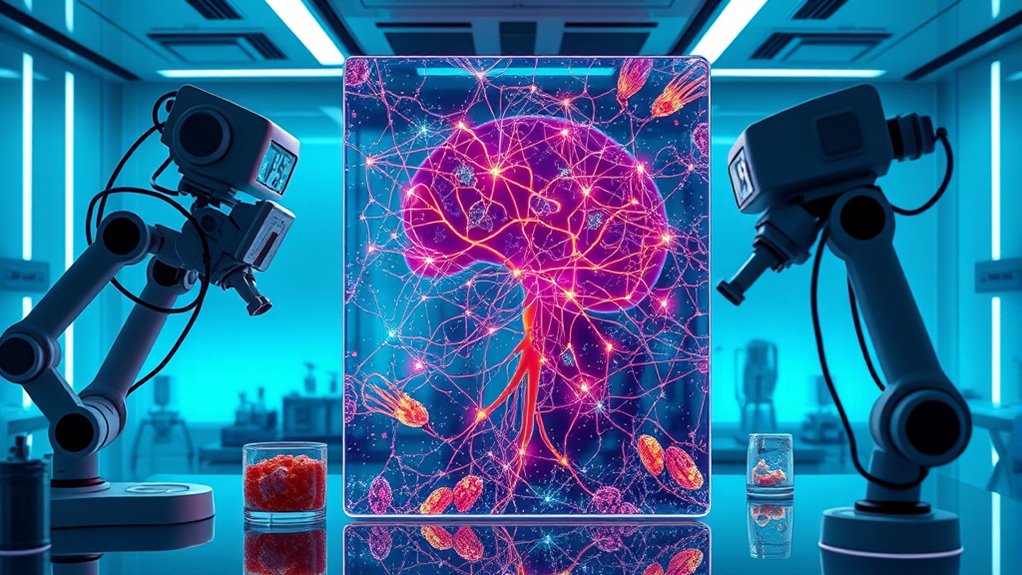

Neuroscience shows that your brain uses complex neural circuits to decode taste and visual desire. Specific regions like the gustatory cortex and insular cortex form neural maps that interpret signals from taste receptors and visual cues, transforming sensory input into preferred responses. These circuits integrate internal states like hunger or mood, influencing what you crave or find attractive. If you keep exploring, you’ll discover how these intricate algorithms shape your preferences and behaviors more deeply.
Key Takeaways
- Neural circuits in the gustatory cortex use distributed ensemble coding to decode taste preferences and differentiate stimuli.
- Specific neural hotspots in the brain are tuned to basic tastes, with spatial organization influencing attraction and aversion.
- Internal factors like neurosteroids and emotional states modulate taste perception through interconnected brain regions.
- Brain imaging reveals distinct activation patterns associated with taste and visual desire, reflecting complex neural decoding.
- Neural plasticity allows taste perception and desire to adapt based on internal states, learned experiences, and sensory integration.

Understanding human taste and visual desire involves unraveling complex neural processes that go beyond simple sensory detection. When you taste something, the sensation isn’t confined to your tongue; instead, it’s processed mainly in your brain. The five basic tastes—sweet, sour, salty, bitter, and umami—each activate specific receptors on your tongue, but the actual perception happens in the gustatory cortex. This region contains distinct neuron clusters, or hotspots, that respond to each taste. For example, the sweet and bitter hotspots are separated by about 2.5 millimeters, reflecting different behavioral responses—attraction versus aversion. Sour hotspots, however, are less clearly localized, hinting at a more complex processing system. Your brain doesn’t just detect tastes; it interprets them within a neural map, allowing you to distinguish and respond appropriately. Taste perception is primarily located in the brain, not just on the tongue. Neural circuits in the gustatory cortex are influenced by various factors, including neurosteroids like allopregnanolone. When these neurosteroids are elevated, your preference for sweet tastes diminishes, possibly affecting your eating habits. Mood and stress levels also modulate taste preferences through interconnected brain regions, especially those involved in regulating emotional states. In conditions like obesity, increased neurosteroid levels can alter taste sensitivity, potentially driving changes in eating behavior. Studies in animals reveal that specific neurons can switch taste perception—turning a sweet taste into bitter and vice versa—highlighting the plasticity of your taste system. Your taste perception is further shaped by neurons that respond to complex stimuli, integrating taste with other sensory cues and motor responses. Advanced imaging, like high-resolution fMRI, shows that your insular cortex encodes tastes with distinct activation patterns. These patterns are distributed across neural ensembles, suggesting your brain uses a combinatorial code rather than strict localization. Within this system, some neurons are specialized, while others respond broadly, allowing flexibility in taste perception. Your internal state also plays a vital role; hunger amplifies your sensitivity to certain tastes, like sweet or salty, to motivate food intake, whereas satiety dampens these responses. Brain regions beyond the gustatory cortex, including the hypothalamus, work together to align taste perception with your energy needs. This dynamic interplay ensures your taste system adapts to internal and external cues, guiding your food choices and influencing your overall desire.
Top picks for "algorithm decod human"
Open Amazon search results for this keyword.
As an affiliate, we earn on qualifying purchases.
Frequently Asked Questions
How Do Algorithms Adapt to Individual Taste Preferences Over Time?
You see, algorithms adapt to your taste preferences over time by continuously learning from your feedback and interactions. They incorporate new data from sensory evaluations, reviews, and sensor inputs, updating their models dynamically. This allows them to fine-tune recommendations based on your evolving likes or dislikes. By analyzing your historical preferences and adjusting accordingly, they guarantee personalized suggestions stay relevant, making your experience more enjoyable and tailored to your changing tastes.
Can Visual Desire Be Manipulated Through Targeted Advertising Algorithms?
Yes, targeted advertising algorithms can manipulate your visual desire like a puppeteer pulling invisible strings. They craft vivid, emotionally charged visuals that speak directly to your subconscious, making products seem irresistible. By analyzing your gaze and reactions in real-time, they fine-tune images to ignite craving and impulse. This digital dance subtly guides your preferences, turning everyday browsing into a magnet for desire — all behind a screen’s illusion of choice.
What Role Does Cultural Background Play in Decoding Human Taste?
Your cultural background shapes your taste by embedding specific foods, flavors, and textures into your identity. It influences what you find appealing or off-putting based on traditions, social practices, and religious norms. You’re likely to prefer familiar dishes and flavors from your culture, and your social environment reinforces these preferences. Understanding your cultural roots helps decode your taste, making food choices more meaningful and aligned with your cultural values.
Are There Ethical Concerns in Using Algorithms to Influence Human Desire?
Imagine you’re living in a Victorian era novel, where unseen hands steer your choices. Using algorithms to influence desire raises serious ethical concerns—you’re unknowingly manipulated, your autonomy compromised. These algorithms exploit biases, spread misinformation, and target your vulnerabilities for profit or control. Without transparency, you risk losing the ability to make free, rational decisions, making it crucial to question how much influence technology should have over your deepest wants and needs.
How Accurate Are Current Algorithms in Predicting Personal Aesthetic Preferences?
Current algorithms are quite accurate at predicting your personal aesthetic preferences, especially when they use the Predictive Aesthetic Model (PAM). They improve markedly with more personalized training data and active learning. You’ll find that these systems better match your taste over time, providing tailored recommendations quickly. However, their accuracy can decrease if your preferences diverge greatly from the dataset, and interpretability remains a challenge for some users.
Conclusion
Think of these algorithms as your personal taste detectives, uncovering what truly sparks your desires. They’re like a compass guiding you through a maze of preferences, revealing hidden patterns in your choices. As technology sharpens, you’ll find your desires mapped out with surprising clarity. Embrace this journey, because understanding your taste is like unveiling a secret garden—full of surprises waiting just for you. The future of your preferences is ready to be explored.