
TL;DR
Start with geo/daypart audience modeling and creative rotation on digital menu boards. Scale to labor prep and waste reduction when telemetry improves.
Top picks for "daypart smart sequenc"
Open Amazon search results for this keyword.
As an affiliate, we earn on qualifying purchases.
The state of play
Franchised networks, variable local demand, and tight throughput targets define QSR. Weather, events, and school calendars make daypart patterns predictable—but only if data is unified and timely.
Across the category, leaders face a common constraint: data that exists in abundance but remains scattered across incompatible systems. That fragmentation makes people skeptical about automation and forces teams to prove value in small, well‑instrumented steps. In practice, this means marketing‑first sequencing—where consented first‑party signals and owned channels allow tight experiments—followed by operations and product applications once governance and data pipelines stabilize.
Why marketing leads (and should)
Localized messaging across app, email, and boards can move volume quickly without
re‑architecting kitchen layouts or labor policies.
- Owned and operated channels provide faster feedback loops than deep operational changes.
- Audience, creative and offer tests can be isolated and measured with holdouts or geography splits.
- The underlying data—consented profiles, behavioral events, and product attributes—already flows through the stack.
- Risks are easier to manage via human‑in‑the‑loop review and pre‑approved claims libraries.
Near‑term AI wins for this vertical
- Trade‑area cohorts: Segment by neighborhood profiles (commuter, campus, suburban family) and tailor offers.
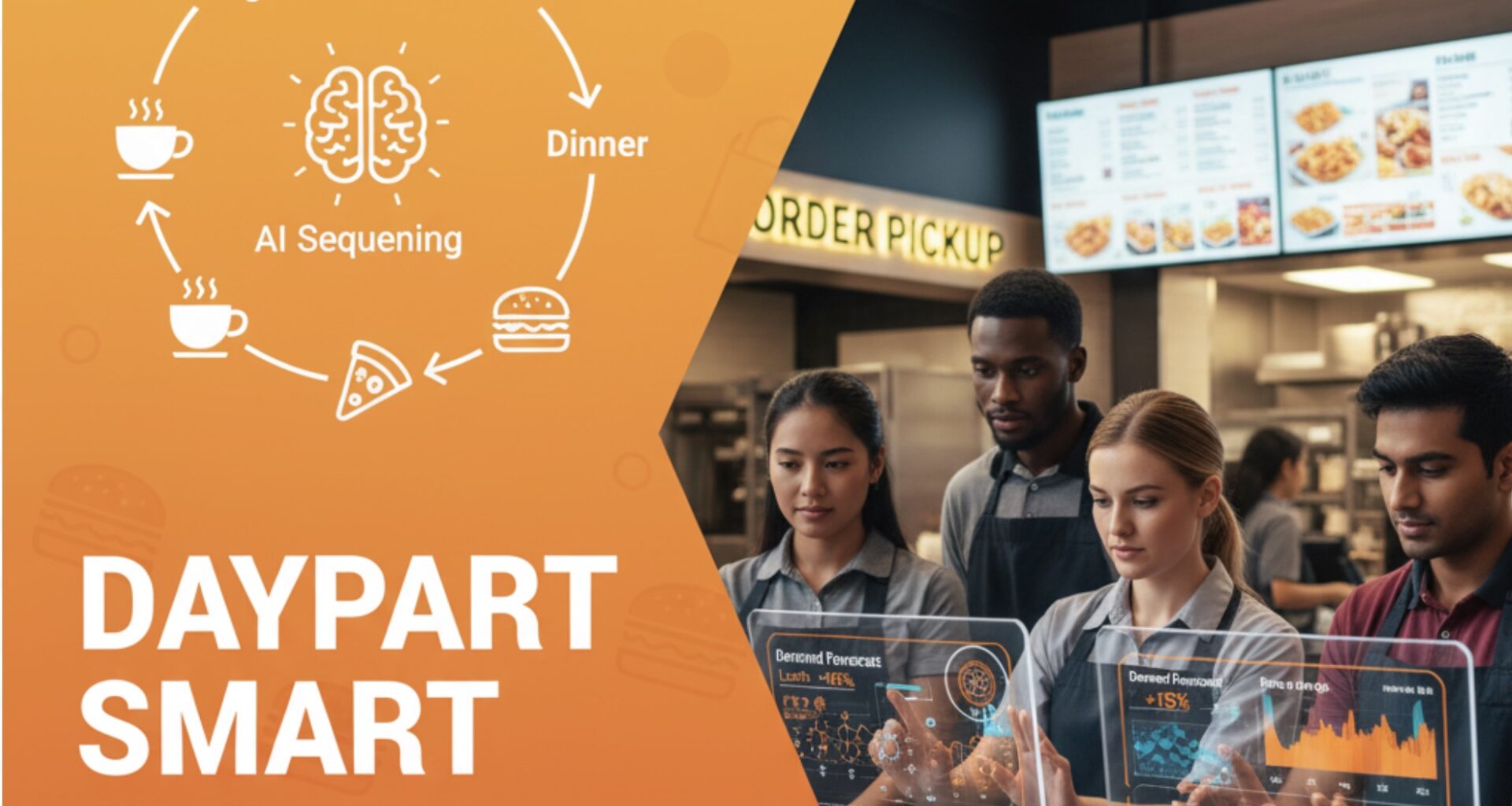
- Daypart creative rotation: Breakfast vs. late‑night require different imagery, bundles, and price cues.
- App upsell prompts: Rules‑based add‑ons (sauces, sides) at cart with throughput caps.
A 90‑day plan that turns interest into evidence
Days 1–15: Foundation and safeguards
Establish the minimum viable governance and data plumbing to run responsible tests. Document the single business question for each pilot, the KPI you will use to judge success, and what decision you will make if the test clears (or misses) its threshold.
- Store taxonomy (trade area, seating, drive‑thru lanes) and consented app profiles.
- Menu and offer templates with calorie and allergen disclosures.
- Telemetry to observe queue time and throughput during tests.
Days 16–45: Pilot two complementary use cases
1) Hyperlocal offers — Run matched‑market tests with neighborhood‑specific bundles; monitor ticket size and queue time.
2) Menu board experimentation — Rotate imagery and price cues by daypart; cap changes during rush to protect throughput.
Days 46–90: Test, measure, decide
Design clean experiments (audience or geography holdouts). Pre‑register success thresholds, instrument both media metrics and operational metrics, and decide to scale or shelve based on evidence—not vibes.
- Add‑to‑order and ticket size by time slot and channel.
- Waste percentage and prep timing variance during tests.
- Queue and order‑ready times from POS/kitchen systems.
Data and architecture: build once, reuse everywhere
AI impact scales when you design for reuse. The same identity resolution and clean taxonomies that power personalized messaging should also feed forecasting, supply/operations, and finance.
Below is a pragmatic data checklist tailored to this vertical.
Core data sources to unify
- POS and app events with consented profiles.
- Store telemetry: queue times, prep durations, station bottlenecks.
- Weather and event data joined to time slots.
Identity, features, and interoperability
Adopt stable IDs for people, products, locations, and time periods. Define a compact set of reusable features (signals) that any model can consume: recency/frequency, category affinity, channel responsiveness, price sensitivity, and supply constraints. Keep feature stores versioned and documented so marketing and operations draw from the same ground truth.
Governance, risk, and brand safety
Food safety, truthful pricing, and franchise fairness are non‑negotiable. Automations must never compromise safety checks or create inequitable promotions among franchisees.
- Location privacy: Respect user opt‑outs; aggregate when precision isn’t required.
- Throughput risk: Do not push complex bundles during rush; set operational guardrails.
- Franchise equity: Distribute tests fairly and rotate benefits to avoid perceived favoritism.
Measurement that executives can trust
Most pilots fail not because the idea is bad but because measurement is ambiguous. Tie each pilot to a guardrailed metric framework and instrument production processes—not just media.
Here’s a balanced scorecard we recommend for this vertical.
KPI scorecard
- AOV, add‑to‑order %, conversion in app, loyalty signup rate.
- Waste %, labor variance, prep accuracy, speed of service.
- Customer satisfaction, review velocity, offer redemption delay.
Experiment design and guardrails
Favor randomized controlled trials where possible. When you can’t randomize, use matched markets and pre/post with synthetic controls. Cap downside with spend limits, creative approvals, and suppression rules for vulnerable cohorts. Always log who approved what and when.
Tech stack: buy the plumbing, build the differentiation
Avoid bespoke everything. Buy durable plumbing (CDP/CRM, clean rooms, MLOps, workflow and DAM) and build the parts that express your category knowledge: domain‑specific features, prompt libraries, and taxonomy governance. Interoperability matters more than brand names.
Suggested stack components
- Consent‑aware app and CDP; POS integrations.
- Menu board CMS with variant scheduling and approvals.
- MLOps + feature store for daypart and neighborhood features.
Team, talent, and the operating model
Successful programs blend domain expertise with data craft. Give your marketers access to analysts, establish ‘human‑in‑the‑loop’ review for anything customer‑facing, and publish a living playbook that captures what works. Your first wins will come from culture and cadence as much as code.
- Local marketing lead with data analyst and ops partner.
- Franchise council for test selection and rotation.
- Food safety officer to clear templates and disclosures.
Three mini case vignettes (illustrative)
Campus late‑night bundle
A college‑area store ran a matched‑market test; late‑night AOV rose 17% with no throughput penalty.
Rainy‑day soup swap
Weather‑triggered creative lifted soup sales 22% but spiked waste; stock guards fixed it the next week.
Drive‑thru image sequencing
Image order matched prep complexity; queue time fell 6% during lunch.
Common pitfalls—and how to avoid them
- Over‑personalization — Keep offers cohort‑level; individual targeting on location can feel invasive.
- Kitchen blindness — Marketing must see station bottlenecks or offers will clog the line.
- Promotion addiction — Rotate value stories—taste and convenience—so discounts don’t become the only lever.
FAQ
Q: Can we target by precise location?
A: Use coarse cohorts unless users opt in; precise pings aren’t needed for most QSR tactics.
Q: Do menu boards need AI?
A: Not at first. Rules + schedule plus clear tests will teach you enough to justify models later.
Q: How do we protect franchisees?
A: Publish a rotation calendar and a benefit ledger so tests are transparent and balanced.
One‑page checklist
- Consent in app; store taxonomy documented.
- Menu/offer templates with safety and calorie disclosures.
- Two pilots with throughput guardrails and fairness rotation.
Bottom line
Dial in local demand with smart menu and offer tests, then reinvest the gains into labor and waste optimization.