📊 Full opportunity report: 5 Consumer Health And Safety Trends In Coverage Of Novo Nordisk on IdeaNavigator AI — validation score, market gap, and execution plan.

Get business pricing on tech for your team
- Business-only prices and quantity discounts
- Tax-exempt purchasing
- Multiple users, one account, clear invoices
TL;DR

IdeaNavigator AI proposes using a reported surge in global coverage of Novo Nordisk as a test case for a monitoring service aimed at consumer-health and food safety or compliance leads. The material describes a product idea and validation plan, not a confirmed safety incident or a measured increase in coverage; it provides no underlying coverage data or specific health finding.
IdeaNavigator AI has proposed a monitoring service that would track health, safety and contaminant reports for consumer-health and food-sector compliance teams, using “Novo Nordisk surges in global coverage” as a test example. The proposal is a product concept, not a report of a confirmed safety event involving Novo Nordisk; it does not provide figures or evidence substantiating the claimed coverage surge.
The proposed service would scan GDELT and similar feeds, then filter items for a particular audience: safety or compliance leads at consumer-health or food brands. Each item would be turned into a short brief covering what changed, why it matters and what action to take. The aim is to distinguish developments relevant to a person’s work from the wider stream of news, forums and filings.
IdeaNavigator AI describes the opportunity as a response to difficulty catching relevant developments early and translating them into decisions. It assigns the signal an 88/100 score, but the supplied material does not explain the scoring method, identify the measurement window or provide a comparison baseline. That number should be read as the proposal’s rating, not as a measure of news volume or risk.
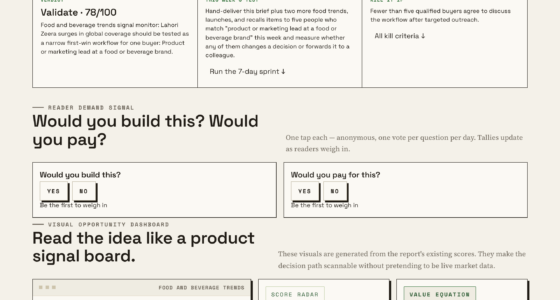
The suggested validation is deliberately small: deliver the example brief and two other health, safety or contaminant items to five people matching the intended job profile, then track whether a recipient changes a decision or forwards a brief to a colleague. The material presents this as a proposed test, not a completed exercise; it reports no participants, responses, customer commitments or results.
5 Consumer Health and Safety Trends in Coverage of Novo Nordisk
IdeaNavigator AI proposes a role-specific safety news monitor, using Novo Nordisk coverage as an example. The supplied material does not verify a coverage surge or identify a safety finding.
1. Built for a specific role
The concept targets safety and compliance leads at consumer-health and food brands.
Work-focused filtering
Sort health, safety and contaminant reports for the responsibilities of the intended reader.
Briefs with next steps
Explain what changed, why it matters and what action may be relevant.
2. Many feeds, one decision lens
The proposed monitor would scan GDELT and similar feeds, including news, forums and filings.
Collect health, safety and contaminant items from proposed feeds.
Connect relevant developments to consumer-health and food-sector compliance work.
Summarize the change, its possible relevance and a potential next action.
3. The example is not a safety finding
“Novo Nordisk surges in global coverage” is presented as a monitoring example.
- IdeaNavigator AI proposes a monitoring product.
- The phrase is used as an example signal.
- A measured increase in coverage.
- A specific hazard, finding or regulatory action involving Novo Nordisk.
4. A small pilot is proposed
The suggested test would put three briefs in front of five people matching the target role.
A Test of Role-Specific Safety Briefs
The idea addresses a practical information-management problem: professionals responsible for product safety and compliance may need to act on scattered, fast-moving information, while general news summaries may not indicate whether a development affects their responsibilities. A role-filtered brief could reduce the time spent sorting reports and make the connection between a news item and a possible work decision clearer.
For readers, the distinction between a monitoring proposal and a verified safety alert matters. The example’s reference to Novo Nordisk does not, on the supplied evidence, establish a product hazard, regulatory action or finding about the company. A functioning service would need to show that its filtering is accurate, that summaries preserve attribution and uncertainty, and that subscribers receive useful information without confusing attention or coverage with evidence of risk.
The commercial case is also untested. IdeaNavigator AI proposes a subscription for safety and compliance leads, but gives no pricing, customer research or evidence that prospective users would pay. Whether the service changes decisions, rather than simply delivering another alert stream, is central to the proposed validation.
Products Worth Considering

Logitech MX Master 4 Ergonomic Wireless Mouse with Haptic Feedback, Graphite

LG UltraGear 27G640A-B 27-Inch QHD IPS Gaming Monitor, 300Hz, 1ms, G-SYNC Compatible, FreeSync Premium, DisplayHDR 400, HDMI 2.1, USB-C, Adj

Bose QuietComfort Wireless Noise Cancelling Headphones, Ice Blue
As an affiliate, we earn on qualifying purchases.
How the Monitor Would Work
The proposal sits within the consumer health and safety market and focuses on a defined user rather than a general audience. Its proposed inputs include GDELT and similar feeds, with coverage spanning health, safety and contaminant findings across news, forums and filings. The intended output is a concise, decision-oriented brief rather than a broad roundup.
The supplied material identifies “Novo Nordisk surges in global coverage” as the example signal, but gives no dates, article counts, locations, outlets or underlying records. It does not say what prompted the attention, whether the coverage concerns a safety issue, or whether any finding has been independently checked. The phrase therefore serves as a proposed monitoring example, not a substantiated account of company-related news.
The suggested test would put the brief in front of five prospective users and include two additional items, then observe forwarding or decision changes. That would offer an initial indication of usefulness, but the proposal does not specify how relevance or decision impact would be measured, or how feedback would be compared across users.
Coverage Data and Safety Findings Missing
The material does not establish that global coverage of Novo Nordisk has increased, because it supplies no baseline, time period, count or dataset. It also does not identify a particular health, safety or contaminant finding behind the example. No conclusion about Novo Nordisk’s products, conduct or regulatory status can be drawn from the phrase alone.
It is also unclear how the proposed 88/100 rating was calculated, which other feeds would be monitored, and what rules would determine whether a report is relevant to a subscriber. The proposal contains no results from its suggested five-person test and no evidence of demand, accuracy, response time or commercial viability. These are open questions for the concept, not confirmed shortcomings of an operating service.
Five-User Pilot Would Test Demand
IdeaNavigator AI’s stated next step is to deliver the sample brief and two additional health, safety or contaminant items to five people who match the intended customer profile. The proposed measure is whether any recipient changes a decision or forwards an item to a colleague. The material does not give a schedule beyond saying the test should happen “this week,” and it does not report that the outreach has begun.
Any follow-up assessment would need to distinguish a useful, verified alert from an item that is merely widely discussed. Results on relevance, attribution, timeliness and user response would help show whether the monitor solves a real workflow need. Until those findings are available, the service remains a proposal awaiting validation, and the Novo Nordisk example should not be treated as confirmation of a safety development.
Source: IdeaNavigator AI
Key Questions
Is this a report of a Novo Nordisk safety incident?
No. The material presents a proposed monitoring product and uses “Novo Nordisk surges in global coverage” as an example. It does not identify or substantiate a specific safety incident.
What would the proposed monitor do?
It would scan GDELT and similar feeds, filter health, safety and contaminant items for consumer-health and food-sector compliance leads, and produce short briefs about what changed, why it matters and possible next steps.
What does the 88/100 score mean?
IdeaNavigator AI labels the opportunity an 88/100 signal, but provides no scoring method, measurement window or baseline. It should not be interpreted as a quantified increase in coverage or a measure of safety risk.
Has the proposed service been tested with customers?
No test results are reported. The proposal recommends delivering three items to five prospective users and tracking whether they change a decision or forward a brief.
What is still unknown about the Novo Nordisk example?
The material does not give the coverage data, dates, outlets or a comparison baseline, and it does not explain what specific health or safety finding the example refers to. The claimed coverage surge is not substantiated in the supplied details.
Source: IdeaNavigator AI