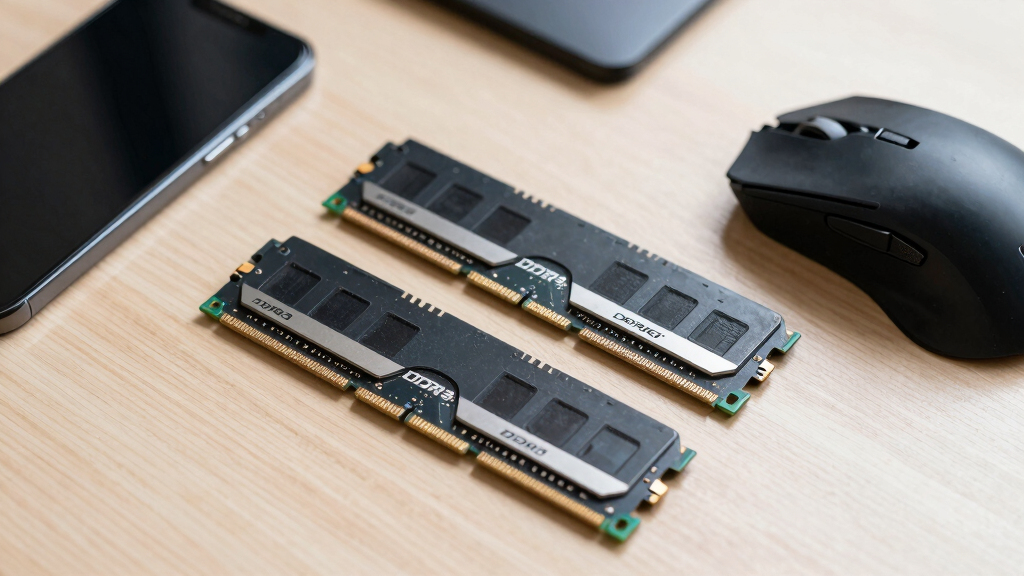

📊 Full opportunity report: DDR5 Now, DDR6 Soon: A Buyer’s Field Guide on ThorstenMeyerAI.com — validation score, market gap, and execution plan.

Get business pricing on tech for your team
- Business-only prices and quantity discounts
- Tax-exempt purchasing
- Multiple users, one account, clear invoices
TL;DR
In 2026, DDR5 remains the best choice for most buyers due to high prices and limited benefits from waiting. DDR6 is not yet ready for mainstream use, with significant costs and platform requirements. This guide explains what to buy now and why.
Manufacturers and industry experts agree that **DDR5 memory remains the recommended choice for most PC builders in 2026**, while DDR6 is still in early stages of development and not suitable for mainstream purchase. This confirms that consumers should prioritize DDR5 for current builds, as waiting for DDR6 would delay upgrades and incur higher costs.
Market forecasts indicate that **DDR5-6000 CL30 remains the sweet spot** for performance and price, with faster kits offering minimal real-world gains. Buying capacity should be tailored to workload needs, typically 32GB for gaming and general use, or 64GB for content creation, avoiding the temptation of 128GB modules which are unlikely to be fully utilized soon.
**DDR4 is no longer a viable option for new builds**; manufacturers have phased out DDR4 production, and its cost is now comparable to DDR5, which offers future-proofing. Building on DDR4 now would mean investing in obsolete technology with no upgrade path.
Regarding DDR6, it is still a roadmap technology, with initial launches in enterprise and AI markets in 2026–27, and broad adoption not expected until 2027–2030. DDR6’s architecture promises significant bandwidth improvements but requires new platforms, controllers, and modules, making early adoption costly and complex.
DDR5 now, DDR6 soon
A buyer’s field guide. The 20-year instinct — wait for prices to drop, or wait for the next generation — is broken this cycle. Buy the DDR5 you actually need now; don’t wait for DDR6. Here’s the reasoning.
Driven to end-of-life, production slashed. Same money, dead-end socket. Leave a working DDR4 box alone — but never start a new build on DDR4 to “save.”
A framework, not a gamble. Buy the DDR5 you need now, at the sweet spot, in the capacity you’ll actually use — don’t buy DDR4, don’t wait for DDR6. The two costliest mistakes in this market are the ones that feel prudent: waiting for a price drop that isn’t coming, and waiting for a next-gen part that launches dearer than what’s on the shelf. Next: The SSD Squeeze.
Why Buying DDR5 Now Is the Smarter Move
This matters because consumers and builders face high memory prices and confusing upgrade paths. Choosing DDR5 now avoids premature obsolescence, delays, and unnecessary expense, enabling better value and performance in the near term. Waiting for DDR6 could mean missing out on platform improvements and paying a premium for early adoption, which offers limited benefits at this stage.As an affiliate, we earn on qualifying purchases.
Market Trends and Development Timeline for DDR Memory
Historically, memory upgrades follow a cycle where new standards replace older ones every few years, with prices dropping after initial launches. DDR4’s transition from 2014 to 2018 exemplifies this pattern. DDR5 began mass adoption around 2022–23, with prices stabilizing but still high in early 2026. DDR6, announced as a future standard, is in early development, with initial server and enterprise releases expected in 2026–27, and mainstream availability delayed until around 2027–2030.
Manufacturers emphasize that DDR6 will require new hardware platforms, with no backward compatibility, and initial modules will be costly, with limited capacities. The slow adoption curve mirrors previous transitions, making early investment in DDR5 the practical choice for most users.
“DDR5-6000 CL30 offers the best balance of performance and price for most users today.”
— Hardware manufacturer representative
As an affiliate, we earn on qualifying purchases.
Unresolved Questions About DDR6 Adoption and Pricing
It remains unclear exactly when DDR6 will achieve widespread adoption and become cost-competitive. The timeline depends on platform development, manufacturing costs, and market demand. Early DDR6 modules are expected to be expensive, with capacities limited initially, and compatibility is restricted to new hardware platforms. The precise pricing trajectory and capacity availability are still uncertain, making early adoption risky for most consumers.
As an affiliate, we earn on qualifying purchases.
Next Steps for PC Builders and Upgraders in 2026
Consumers should focus on building or upgrading with DDR5-6000 CL30 memory, tailored to their workload needs. Monitoring JEDEC standard progress and motherboard compatibility lists will help identify when DDR6 becomes viable, likely around 2027–28. For now, prioritizing platform stability, capacity, and performance at current prices offers the best value. Waiting for DDR6 is generally not advisable unless building a specialized, long-term workstation or involved in bandwidth-intensive AI/ML tasks.
As an affiliate, we earn on qualifying purchases.
Key Questions
Should I buy DDR4 memory in 2026?
No. DDR4 is at end-of-life, and building on DDR4 now would mean investing in obsolete technology with no future upgrade path. DDR5 is the recommended standard for new builds.
Is DDR6 worth waiting for in 2026?
For most users, no. DDR6 is still in development, with broad adoption not expected until 2027 or later. Early modules will be costly and limited in capacity, making it impractical for mainstream use now.
What memory configuration should I buy today?
Buy DDR5-6000 CL30 modules suited to your workload—32GB for gaming and general use, 64GB for content creation. Avoid overspending on capacity you won’t use immediately.
When will DDR6 become mainstream?
DDR6 is expected to reach broad adoption around 2027–28, starting with enterprise and high-end platforms before becoming common in consumer desktops around 2030.
Source: ThorstenMeyerAI.com
Halloween Picks
halloween
As an affiliate, we earn on qualifying purchases.