TL;DR
Figures cited from the IEA show lower energy use per AI task alongside higher data center electricity use in 2025. The Jevons paradox describes how efficiency can encourage additional use and partly offset expected savings. The overall effect depends on changes in demand.
The International Energy Agency (IEA) says data center electricity use rose 17% in 2025, while use at data centers built for AI rose 50%. The report also says energy per AI task has fallen by at least an order of magnitude annually in recent years. It links efficiency improvements with wider adoption, a relationship discussed through the Jevons paradox. The figures show lower energy use per task alongside rising electricity use, but do not establish how much one trend contributed to the other.

Get business pricing on tech for your team
- Business-only prices and quantity discounts
- Tax-exempt purchasing
- Multiple users, one account, clear invoices
The IEA says energy used per AI task has dropped “by at least an order of magnitude annually in recent years,” describing the pace as “unprecedented in energy history.” Separately, it counted 485 terawatt-hours (TWh) of electricity use by data centers in 2025. That total covers data centers broadly; the cited report also gives a distinct 50% increase for data centers built for AI. These figures should not be read as measuring the same category.
The explainer cites Epoch AI for an estimate that the cost of a given level of AI performance has fallen about 13 times per year since 2023. It also cites Google token counts rising from 9.7 trillion in May 2024 to more than 3.2 quadrillion in May 2026. Those counts show more tokens processed over the stated months; the source provides no baseline for treating them as a percentage or multiple increase in energy use.
The IEA projects data center electricity consumption at about 950 TWh in 2030. That is a projection, not a measured outcome. The report says efficiency gains “are also fuelling broader adoption of AI services, a dynamic known as the Jevons paradox,” and that total electricity use from AI “is set to increase in the near term.” The explainer advises businesses to track budgets per completed task and pay attention to uses such as reasoning and agents, which can require more tokens.
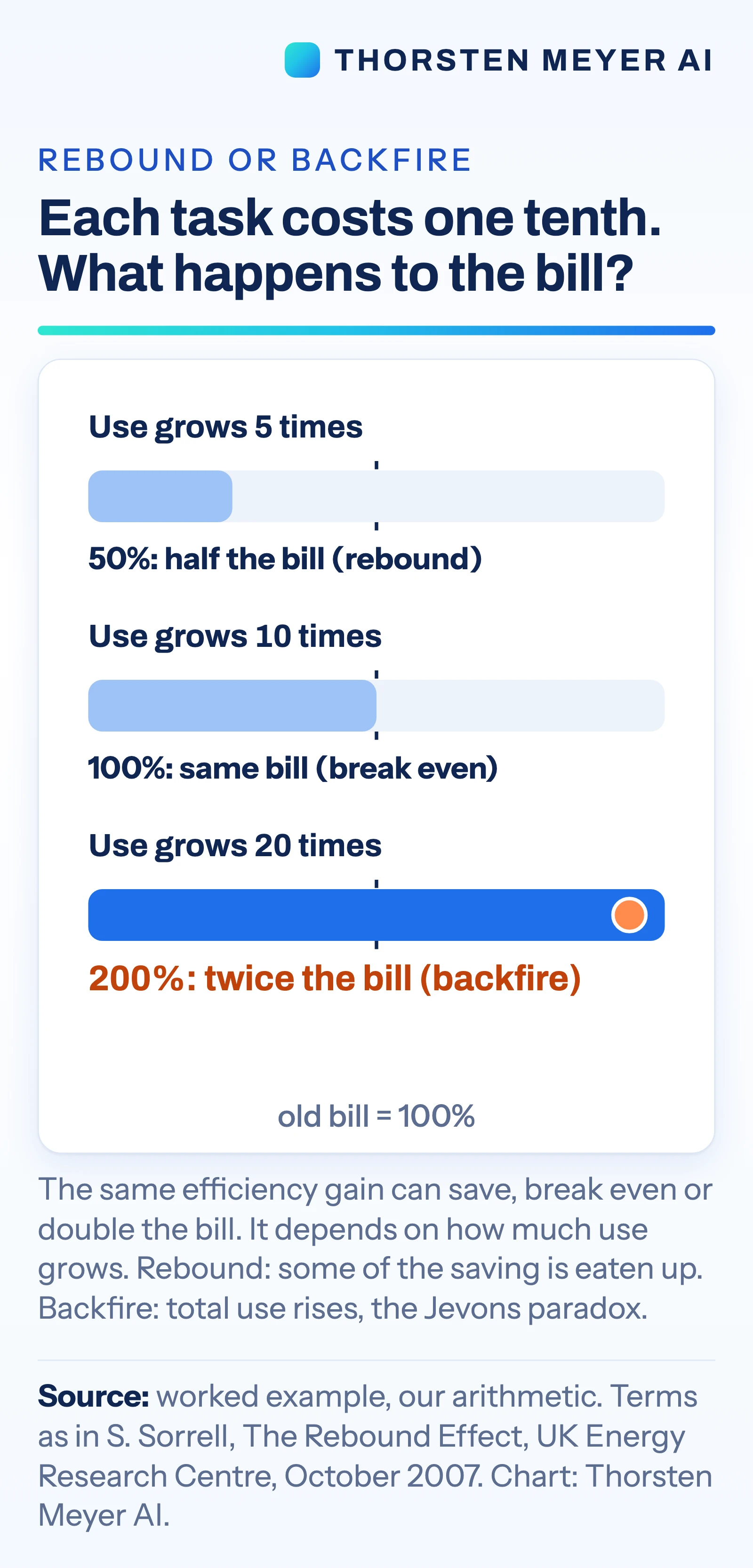
How Lower Costs Could Affect Demand
The Jevons paradox describes a possible effect, not a guaranteed result. When a technology becomes more efficient, its services may become cheaper, opening up new uses and encouraging existing users to consume more. If that added demand exceeds the efficiency savings, total resource use can rise. If demand grows less, use can still increase while overall consumption falls more slowly than expected.
For businesses, a lower price per token does not by itself show that an AI project is cheaper overall. The relevant cost depends on how much work is done, how many tokens or other resources each task uses, and whether the task delivers useful results. For electricity planners, the IEA figures show rising data center demand alongside efficiency improvements. The source does not attribute all of that increase to AI.
The effect also depends on how people use cheaper capacity. Simple text prompts use less energy than heavier applications such as video generation or agentic systems, according to the explainer. Aggregate demand can matter more to grid planning than the footprint of one ordinary prompt. The available figures do not quantify each use’s contribution.
Products Worth Considering

Samsung Galaxy Tab S11 128GB Wi-Fi Android Tablet with S Pen, Silver

Apple AirPods Pro 3 Wireless Earbuds with Active Noise Cancellation

EcoFlow Solar Generator DELTA 3 Classic with 2x100W Solar Panels, 1024Wh
As an affiliate, we earn on qualifying purchases.
From Coal Engines to AI
William Stanley Jevons set out the idea in The Coal Question, published in 1865. He considered whether improvements in industrial fuel efficiency would reduce Britain’s coal consumption. His answer focused on how lower production costs could expand output and attract investment, potentially outweighing the fuel saved by each improved process.
Jevons used ironmaking as an example: a more economical blast furnace could raise profits, draw in capital, lower iron prices and increase demand. He reported that coal use per ton of Scottish iron fell to less than one-third of its former amount, while total consumption rose tenfold. That historical example concerns a particular industry and period; it is not direct evidence about AI’s future energy demand.
A 2007 review for the UK Energy Research Centre, cited in the explainer, found that efficiency gains usually still save energy overall, although savings can be smaller than engineers expect. The review’s distinction is useful: rebound describes demand taking back part of the expected savings, while backfire describes demand growing enough to raise total consumption above its prior level.
““It is wholly a confusion of ideas to suppose that the economical use of fuel is equivalent to a diminished consumption. The very contrary is the truth.””
— William Stanley Jevons, The Coal Question (1865)
Limits of the AI Energy Data
The cited data do not isolate how much of the 17% rise in all data center electricity use came from AI. The separate 50% figure applies to data centers built for AI, but the source does not provide their share of total electricity use or a breakdown by application. It also does not show whether the change in token counts maps directly to electricity consumption.
The 2030 figure is an IEA projection, and the source does not give the assumptions behind it here. Nor does it establish that AI efficiency gains will produce backfire in every market. Demand, prices, hardware, workloads and electricity sources may all shape the outcome. The available account does not quantify how much power use might have been higher without efficiency gains.
What to Track Through 2030
The next useful comparison is whether measured data center and AI electricity use continues to rise as the cost of AI tasks falls. Future IEA reporting can show how actual consumption compares with its projection of about 950 TWh in 2030 and whether growth is concentrated in AI-focused facilities.
For business buyers, tracking spending and energy per completed task alongside total task volume can clarify whether efficiency is lowering overall resource use or enabling substantially more activity. The figures cited so far show falling task costs alongside rising data center use, but they do not settle how much each trend causes the other.
Key Questions
What is the Jevons paradox?
It is the possibility that an efficiency improvement lowers the effective cost of a service, encourages more use and causes total resource consumption to rise. It does not happen in every case.
What did the IEA report about electricity use?
The figures cited say data center electricity use rose 17% in 2025, with a 50% rise at data centers built for AI. The IEA projects about 950 TWh of data center use in 2030.
Does the data prove that AI efficiency raises total energy use?
No. The figures show falling energy per task alongside rising data center electricity use, but they do not establish how much of the overall increase is caused by AI or by efficiency-driven demand.
What should businesses measure?
They can track cost and resource use per completed task together with total task volume. That gives a clearer view of whether lower unit costs are reducing total spending or enabling more use.
Source: Thorsten Meyer AI