
TL;DR
Palo Alto Networks agreed on November 18, 2026, to acquire Applied Compute in an all-stock deal valued at $4.5 billion, subject to adjustments and regulatory clearance. The proposed purchase would give the cybersecurity company a platform for adapting and running open-weight AI models, extending its business closer to the models themselves. The deal has not closed, and its financial adjustments and integration plans have not been disclosed.
Palo Alto Networks agreed on November 18, 2026, to acquire Applied Compute in an all-stock transaction valued at $4.5 billion, subject to adjustments. The proposed purchase would add technology for training and running open-weight AI models to the cybersecurity company’s portfolio, taking it into a layer of enterprise AI that sits beyond monitoring and securing AI traffic.

Get business pricing on tech for your team
- Business-only prices and quantity discounts
- Tax-exempt purchasing
- Multiple users, one account, clear invoices
Palo Alto described Applied Compute as a platform for post-training and inference of open-weight models. Post-training means adapting a model after its initial development, including for a company’s specific needs; inference is the process of running a model to produce outputs. Applied Compute calls itself “the AI superCloud for open models” on its website. The companies’ announcement does not provide further technical detail about the platform’s features or infrastructure.
The deal is all stock, rather than a cash purchase. Palo Alto’s release says the transaction is valued at $4.5 billion “subject to adjustments,” but does not specify those adjustments. Closing depends on customary conditions, including regulatory clearance. Palo Alto expects the deal to close in its fiscal third quarter of 2027, which falls between February and April 2027 based on the company’s fiscal calendar.
Applied Compute’s team is expected to join Palo Alto Networks after closing. Its chief executive, Yash Patil, is to become Co-Chief AI Officer. The release does not identify who else would hold that title. Palo Alto says Applied Compute will continue serving AI-native companies, digital businesses and large enterprises, while Palo Alto plans to offer the platform to its global customer base.
Palo Alto Moves Closer to AI Models
The agreement would broaden Palo Alto Networks’ role in enterprise AI. Security products can monitor or govern how organizations use AI; Applied Compute’s stated focus is helping them adapt and run models. If the acquisition closes and the platform is integrated as described, Palo Alto could offer customers services across more parts of their AI systems, from model deployment to security.
That could make procurement simpler for businesses seeking a combined AI and security stack, while concentrating more of those services with one supplier. The practical trade-off is greater vendor dependence: customers may need to weigh the convenience of an integrated offering against their ability to move data, workloads or contracts elsewhere. The announcement does not say whether existing customers will face changes to pricing, service terms or product choices.
Palo Alto’s strategic case rests partly on its expectation that many enterprises will use open-source or open-weight models. The company also said it believes large providers are not delivering those models securely. These are company views about market demand and competition, not independently established findings in the announcement. The transaction’s value reflects a substantial commitment to that strategy, but does not establish that the market will develop as Palo Alto predicts.
Products Worth Considering

Samsung Galaxy Tab A11+ Tablet (6GB RAM, 128GB Storage, Gray)

Bose QuietComfort True Wireless Earbuds with Active Noise Cancellation, Bluetooth 5.3, USB-C Charging, IPX4, Black

Apple AirPods Pro (2nd Generation) Wireless Earbuds with USB-C MagSafe Charging Case
As an affiliate, we earn on qualifying purchases.
Three AI Deals in 2026
The Applied Compute agreement follows two other AI-related deals Palo Alto announced in 2026. The company said its acquisition of Portkey, an AI gateway for monitoring and governing agent traffic, closed on May 29. It announced the acquisition of Console, an AI agent platform, on September 1. Applied Compute would add a further layer: tools for post-training and inference of open-weight models.
Together, the transactions indicate a strategy that reaches from managing AI traffic and agents toward the systems used to prepare and run models. That sequence is based on the companies’ descriptions of the products and deal announcements; it does not by itself show how the tools will be combined or whether customers will adopt them as one platform.
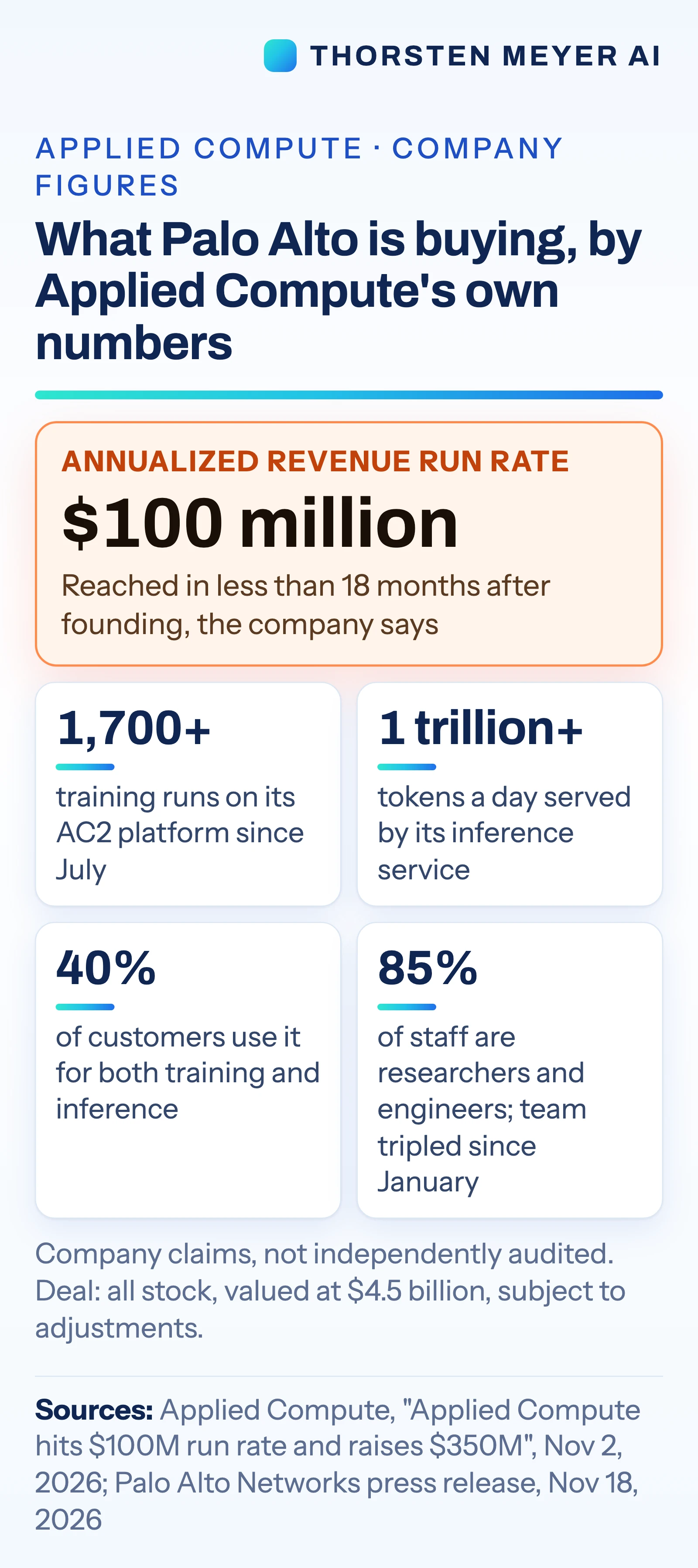
Palo Alto announced the Applied Compute agreement on the same day as its quarterly results and said it would provide further transaction details on its earnings call. The company describes itself as serving more than 70,000 customers. Applied Compute’s own description of its product and Palo Alto’s stated customer reach frame the potential distribution opportunity, but the announcement gives no customer, revenue or adoption figures for Applied Compute.
““If it works, I think this will dwarf the ability that we have in cybersecurity.””
— Nikesh Arora, Palo Alto Networks chief executive, as quoted by CNBC
Deal Terms and Integration Remain Open
The agreement remains subject to regulatory clearance and other customary closing conditions. Palo Alto expects a fiscal third-quarter 2027 close, but the announcement does not identify specific regulatory reviews, describe their status or guarantee that the transaction will be completed on that timetable.
The stated $4.5 billion valuation is subject to adjustments, with no explanation of how they are calculated. The announcement also does not spell out how the platform will be integrated with Palo Alto’s existing products, what role Applied Compute’s team will play beyond Patil’s announced appointment, or whether current customers will see changes to service or contract terms.
Palo Alto argues that enterprises will increasingly run open-weight models and that large providers are not delivering them securely. Independent demand figures and supporting comparisons were not included in the provided announcement materials. The scale of potential revenue, customer adoption and any effect on Palo Alto’s business are not yet clear.
Regulatory Review Sets the Timeline
The immediate milestone is completion of the required regulatory and customary reviews. Palo Alto’s stated target is to close in its fiscal third quarter of 2027, corresponding to February through April 2027 on its fiscal calendar. The agreement’s progress and any changes to that expected timing will determine when the teams can begin operating under the proposed arrangement.
After closing, Applied Compute’s team is expected to join Palo Alto, with Patil taking the Co-Chief AI Officer role. Palo Alto has said it plans to bring the platform to its global customer base while Applied Compute continues serving its existing customer categories. Further transaction details, including the valuation adjustments and the product integration plan, would help businesses assess the proposed combined offering.
Key Questions
What did Palo Alto Networks agree to acquire?
Applied Compute, a company whose platform is described as supporting post-training and inference of open-weight AI models. The agreement was announced November 18, 2026.
How much is the transaction worth?
Palo Alto says the all-stock transaction is valued at $4.5 billion, subject to adjustments. The announcement does not specify those adjustments.
Has the acquisition closed?
No. Closing remains subject to customary conditions, including regulatory clearance. Palo Alto expects it in its fiscal third quarter of 2027.
What is Applied Compute’s platform intended to do?
Palo Alto describes it as a platform for post-training and inference of open-weight models: adapting models after initial development and running them to produce outputs. The announcement does not give a full feature or infrastructure description.
What happens to Applied Compute’s team and customers?
Palo Alto says the team will join after closing and that CEO Yash Patil will become Co-Chief AI Officer. The company says Applied Compute will continue serving AI-native companies, digital businesses and large enterprises; further service or contract terms have not been announced.
Source: Thorsten Meyer AI