
Past education tech failures show that rushing to adopt new tools without considering pedagogy, equity, or support can backfire. You might find that when technology is prioritized over meaningful engagement, learning suffers and gaps widen. AI holds promise, but only if you address these mistakes by integrating it thoughtfully with strong teaching strategies and ensuring access for all. Continuing your exploration will reveal how to align AI’s potential with proven educational practices.
Key Takeaways
- Past emergency tech fixes prioritized speed over effective pedagogy, highlighting AI’s need for thoughtful, integrated educational strategies.
- Overreliance on digital tools without addressing equity can deepen disparities, emphasizing AI’s importance in equitable access.
- Lack of educator support and training in tech use shows AI’s success depends on proper implementation and human-AI collaboration.
- Crises revealed that technology alone cannot replace meaningful human interaction vital for deep learning and engagement.
- Lessons from failed ed-tech initiatives warn that AI must complement pedagogical goals rather than serve solely efficiency or market interests.
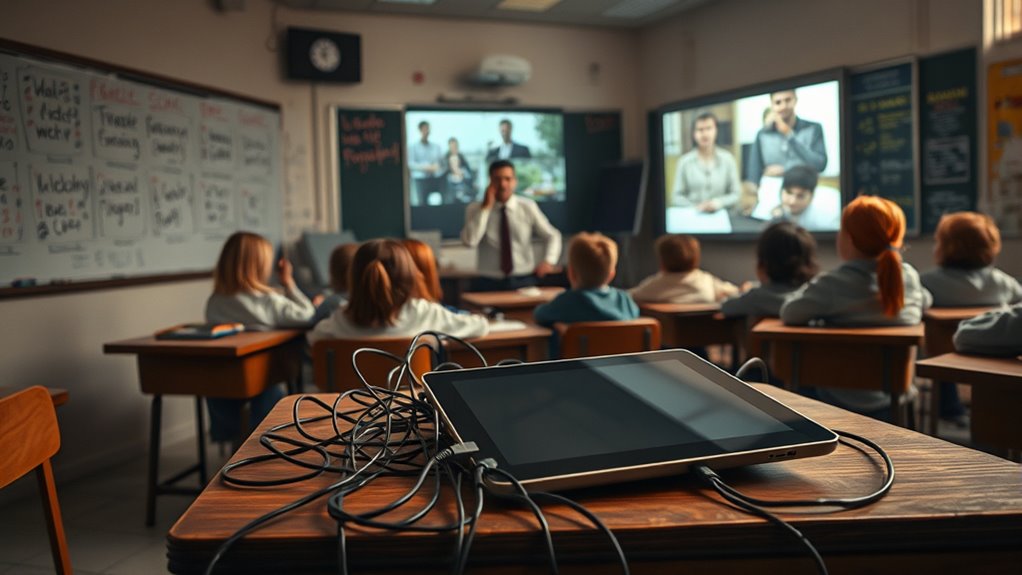
The rapid adoption of education technology during crises like the COVID-19 pandemic revealed significant flaws in how we integrate digital tools into learning. While the shift was necessary, it exposed deep gaps in our readiness and understanding of effective ed-tech use. Historically, crises such as the 1937 polio outbreak prompted the use of radios and televised lessons, but these emergency measures were often quick fixes that overlooked pedagogical quality. During COVID-19, many efforts prioritized rapid deployment over meaningful engagement, leaving large groups of students behind despite device access. Early hopes for self-directed, internet-based learning fell flat, as most students still needed significant help, highlighting overoptimistic assumptions about independence and motivation.
Rapid ed-tech adoption during crises exposes readiness gaps and overreliance on quick fixes over meaningful engagement.
Technology-first approaches during the pandemic often reduced essential in-person interactions, which diminished learning quality despite technological availability. Many initiatives failed to address equity concerns, as students without reliable internet or devices couldn’t participate fully, deepening existing disparities. Relying heavily on software for instruction, like rote-learning platforms, improved memorization but neglected critical thinking and reasoning skills. The promise of autonomous, personalized learning didn’t materialize at the expected scale, leading to dissatisfaction among students, teachers, and parents alike. The quick pivot to digital tools also revealed that engagement and user support are just as *essential* as access; when these were lacking, motivation and participation declined.
Economic and institutional pressures further complicated the picture. Cost-cutting motives pushed schools toward tech solutions that reduced instructor reliance, often at the expense of quality. Large-scale implementations prioritized efficiency and scalability over individual needs, sometimes influenced by philanthropic and corporate interests more concerned with market gains than pedagogy. Overhyped forecasts and unrealistic expectations fueled disappointments and skepticism. Industry-driven investments, especially in surveillance and monitoring tools, raised concerns about privacy and long-term educational value. Moreover, the importance of training and support for educators in using these new tools was often underestimated, leading to ineffective implementation.
All these failures expose a *crucial* lesson: technology alone isn’t enough. The digital divide, lack of support, and pedagogical weaknesses hindered progress during crises, revealing that AI’s promise depends on addressing these fundamental issues. As we look ahead, understanding these past mistakes helps us build smarter, more equitable, and effective educational solutions that leverage AI’s potential without repeating the same errors.
Top picks for "yesterday education tech"
Open Amazon search results for this keyword.
As an affiliate, we earn on qualifying purchases.
Frequently Asked Questions
How Can Future Education Tech Avoid Past Mistakes?
To avoid past mistakes, you should prioritize equitable access, ensuring all students and teachers have reliable devices and internet. Focus on designing AI tools that support meaningful pedagogy, engagement, and teacher roles, rather than just automation. Invest in ongoing professional development, involving teachers in the design process. Balance cost-efficiency with educational quality, and keep the human element at the core, fostering genuine support and tailored learning experiences.
What Ethical Concerns Surround AI in Education?
You should be aware that AI in education raises ethical concerns around privacy, bias, and academic integrity. You might worry about data security, as sensitive student info can be mishandled or misused. Bias in algorithms can reinforce inequalities, while overreliance on AI risks cheating and stifles critical thinking. Ensuring transparency, fairness, and equitable access is essential to ethically integrate AI and protect students’ rights and learning outcomes.
How Do AI Failures Impact Student Trust?
AI failures shake your trust when it provides false or misleading information, making you question its reliability. Frequent errors, biased outputs, and lack of transparency make you doubt whether AI can be a dependable learning tool. When AI can’t consistently deliver accurate, unbiased content, you may feel less confident in its support, leading to hesitation in relying on it for your educational needs and diminishing your overall trust in the technology.
What Role Do Educators Play in AI Integration?
You play a crucial role in AI integration by acting as a bridge between technology and students. You use AI to automate routine tasks, freeing up time for personalized instruction and mentorship. You also guide students in responsible AI use, address ethical concerns, and provide feedback on AI’s effectiveness. Your awareness and control guarantee AI enhances learning experiences while maintaining human connection, making you a vital part of successful AI adoption.
How Is AI Customization Improving Learning Outcomes?
You see, AI customization boosts learning outcomes by tailoring content to individual needs, leading to a 25% improvement in student performance. You benefit from personalized pathways that adapt in real-time, providing immediate feedback and addressing gaps. This targeted approach keeps you engaged and motivated, making complex topics easier to grasp. As a result, you experience higher grades, increased confidence, and more inclusive learning environments that accommodate your unique strengths and challenges.
Conclusion
Yesterday’s education tech missteps gently remind you that even the brightest ideas need time to shine. While the journey may have taken a few unexpected turns, it’s clear that AI’s true promise lies ahead, quietly unfolding with each lesson learned. Embrace these moments as subtle nudges guiding you toward a future where technology truly elevates learning. After all, every stumble is just a delicate step closer to the innovative horizon awaiting you.