
TL;DR

Get business pricing on tech for your team
- Business-only prices and quantity discounts
- Tax-exempt purchasing
- Multiple users, one account, clear invoices
The Qwen 3.8 27B language model is now available on Cerebras systems, achieving a processing speed of 1500 tokens per second. This marks a significant development in AI hardware deployment, though details remain limited.
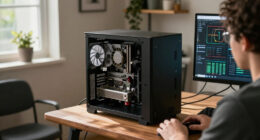
The Qwen 3.8 27B language model is now accessible on Cerebras hardware, achieving a processing speed of 1500 tokens per second, according to sources familiar with the deployment. This development is significant for AI researchers and industry stakeholders, as it demonstrates the model’s compatibility with high-performance computing systems and highlights advancements in processing efficiency. You can see a practical example of this in RTX 5080 and RTX 3090 setup.
Sources indicate that the Qwen 3.8 27B model has been made available on Cerebras’ AI hardware platform, with confirmed processing speeds reaching 1500 tokens per second. This speed represents a notable benchmark in the deployment of large language models on specialized hardware, enabling faster inference times for practical applications. For more on AI hardware, visit our reverse-engineering project.
The announcement appears to be based on industry signals and preliminary disclosures, with no official press release from Cerebras or the model’s developers. The deployment is believed to utilize Cerebras’ wafer-scale engine technology, which is designed to handle large-scale AI models efficiently.
It is important to note that details about the deployment environment, such as the specific hardware configuration or the version of Cerebras’ software stack used, remain unconfirmed. Furthermore, the broader availability of the model to external users has not been officially announced, and the speed metric may vary depending on the specific setup.
Impact of High-Speed Model Deployment on AI Industry
This development underscores a growing trend toward integrating large language models with specialized AI hardware to achieve faster processing speeds. The ability to run Qwen 3.8 27B at 1500 tokens per second could significantly reduce inference latency, enabling more efficient deployment in real-time applications such as chatbots, content generation, and enterprise AI solutions.
For industry players, this signals a potential shift in how large models are utilized at scale, emphasizing hardware acceleration as a key factor in operational performance. It could also influence future hardware design and optimization strategies for AI models, fostering competition among hardware providers.
However, as the details are still emerging, the full impact on the AI ecosystem and broader adoption remains to be seen, especially considering the lack of official confirmation or detailed technical specifications.
As an affiliate, we earn on qualifying purchases.
Recent Trends in AI Hardware and Model Deployment
Over the past year, there has been increasing interest in deploying large language models on high-performance hardware platforms, driven by the need for faster inference and more scalable solutions. Companies like Cerebras, NVIDIA, and others have been advancing their hardware offerings to support these models.
The release of models like Qwen 3.8 27B on specialized hardware is part of this broader trend, reflecting both technological progress and rising demand for real-time AI applications. Search interest and coverage about AI hardware accelerators and large models have spiked recently, although specific announcements often lack detailed technical disclosures, making some developments speculative.
It is worth noting that the trigger for this particular news appears to be an industry signal and market interest, with no official statement confirming the deployment or speed metrics from the involved parties.
large language model inference server
As an affiliate, we earn on qualifying purchases.
As an affiliate, we earn on qualifying purchases.
Unconfirmed Details About Deployment Environment
Details about the specific hardware setup, software environment, and whether the 1500 tokens per second speed applies to real-world applications or benchmark tests are not publicly confirmed. The official availability to external users has not been announced, and the reported speed may vary depending on the deployment conditions.
As an affiliate, we earn on qualifying purchases.
Next Steps in Model and Hardware Integration
Further official disclosures from Cerebras and the model developers are expected, including detailed technical specifications and deployment scenarios. Industry observers will monitor whether this speed benchmark is consistent across different use cases and hardware setups.
Future developments may include wider availability of the model to external clients, comparative performance evaluations with other hardware platforms, and the development of software tools optimized for Cerebras systems.
Ongoing research may also lead to improvements in inference speed and hardware efficiency, influencing future AI deployment strategies.
As an affiliate, we earn on qualifying purchases.
Key Questions
What is Qwen 3.8 27B?
Qwen 3.8 27B is a large language model with 27 billion parameters, designed for natural language processing tasks and capable of generating human-like text.
What does 1500 tokens per second mean for AI applications?
This speed indicates how many words or tokens the model can process in one second, impacting the responsiveness and real-time usability of AI systems in applications like chatbots or content creation.
Is this deployment publicly available?
There has been no official confirmation of broad public availability. The deployment appears to be in an early or controlled phase based on industry signals.
How does this compare to other hardware platforms?
While direct comparisons are not yet available, 1500 tokens per second is considered a high throughput rate for large language models, suggesting competitive performance on Cerebras hardware, but more data is needed for definitive comparisons.
What are the implications for AI hardware development?
This milestone highlights the importance of specialized hardware in scaling AI inference, potentially influencing future hardware designs and standards for deploying large models.
Source: hn
Evergreen bestsellers Picks
bestsellers
As an affiliate, we earn on qualifying purchases.