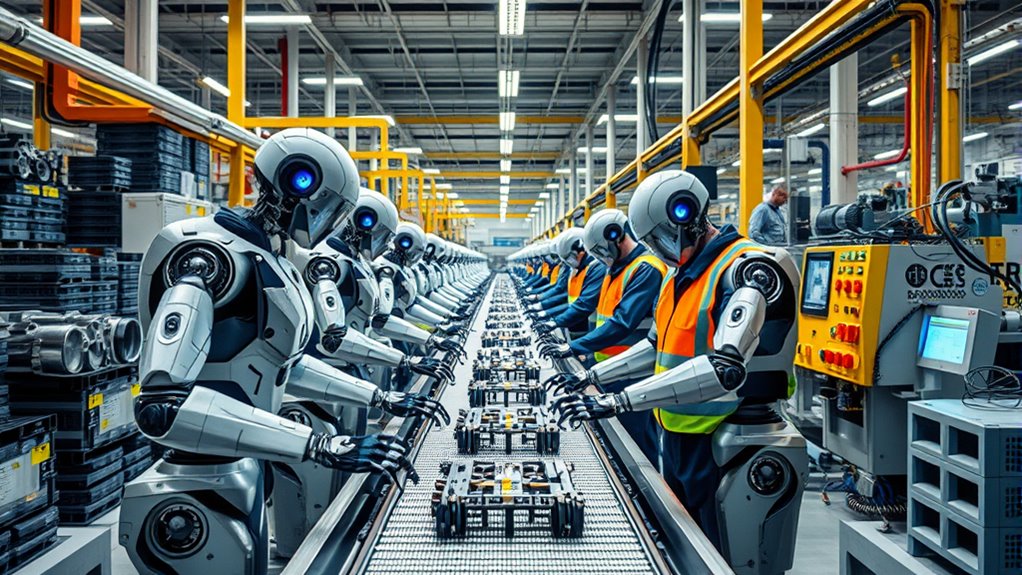

Cobots work alongside human workers on factory floors, enhancing safety, flexibility, and productivity. They’re designed to share workspace without safety cages, using sensors and force limits to prevent injuries. Cobots handle repetitive tasks quickly and accurately, freeing you to focus on more complex work. They’re easy to reprogram, so your operations stay agile and responsive to market shifts. Continue exploring how cobots transform manufacturing, making work safer and more efficient for everyone.

Get business pricing on tech for your team
- Business-only prices and quantity discounts
- Tax-exempt purchasing
- Multiple users, one account, clear invoices
Key Takeaways
- Cobots are designed to work safely alongside humans without safety cages, using advanced sensors and safety features.
- They enhance productivity by automating repetitive tasks while humans focus on complex, value-added activities.
- Safety features like force-limiting technology enable cobots to detect human presence and minimize injury risks.
- Cobots are easily reprogrammable and adaptable, supporting flexible manufacturing and quick response to market changes.
- The collaboration between humans and cobots improves operational efficiency, safety, and overall manufacturing agility.

Collaborative robots, or cobots, are transforming factory floors by working alongside human operators to increase efficiency and safety. Unlike traditional industrial robots that operate behind safety cages, cobots are designed to share workspace with people, making their integration seamless and more adaptable. Your focus on collaborative safety ensures that while these robots boost productivity, they do so without compromising worker well-being. You’ll find that cobots are equipped with advanced sensors and safety features that detect human presence and adjust their movements accordingly, minimizing the risk of accidents. This ability to work safely side-by-side encourages a more dynamic workflow, where humans can focus on tasks that require critical thinking, while cobots handle repetitive or physically demanding duties. The result is a significant productivity enhancement because the combination of human judgment and robotic precision maximizes output without sacrificing safety standards.
With cobots taking over monotonous tasks, you’ll notice a smoother production line. They can perform tasks like assembly, packaging, or quality inspection with high consistency, reducing errors and waste. This consistency leads to faster turnaround times and higher quality products, directly impacting your bottom line. Furthermore, since cobots are generally easy to program and reconfigure, you can quickly adapt them to new tasks or changes in production demands. This flexibility means your factory can respond swiftly to market shifts, giving you a competitive advantage. By freeing up skilled workers from repetitive chores, cobots enable your team to concentrate on more complex, value-added activities, which further amplifies productivity. Their presence fosters a collaborative environment where human skills and robotic capabilities complement each other, leading to smarter manufacturing processes.
You’ll also appreciate how cobots contribute to a safer workspace through their collaborative safety features. They’re designed with force-limiting technology, meaning they stop or slow down upon contact with a person. This reduces the chance of injuries and creates a safer environment for everyone in your factory. As a result, you can maintain high safety standards without the need for extensive safety barriers. This focus on collaborative safety not only protects workers but also reduces downtime caused by accidents, keeping production running smoothly. Additionally, the integration of cobots often involves advanced sensors, which enhance their ability to detect and respond to environmental changes quickly. Overall, cobots are revolutionizing factory operations by combining safety and productivity enhancement, allowing you to optimize resources and improve operational efficiency. When humans and robots work together harmoniously, the manufacturing process becomes more agile, safer, and more productive—setting your factory up for sustained success in a competitive marketplace.
collaborative robots for manufacturing
As an affiliate, we earn on qualifying purchases.
As an affiliate, we earn on qualifying purchases.
Frequently Asked Questions
How Do Cobots Adapt to Different Factory Tasks?
You can make cobots adapt to different factory tasks by programming them with adaptive algorithms. These algorithms enable cobots to learn from their environment and adjust their actions accordingly. This task flexibility allows you to switch between various operations quickly, boosting productivity. As a result, cobots become versatile team members, seamlessly handling multiple roles and enhancing your factory’s efficiency without needing extensive reprogramming.
What Safety Standards Govern Cobots Working Alongside Humans?
Imagine you’re in a sci-fi movie, but it’s real. Safety standards for cobots working alongside humans are governed by strict safety regulations and guidelines, like ISO 10218 and ANSI/RIA R15.06. These guarantee safe human-robot interaction by setting limits on speed, force, and workspace. You can trust that these standards protect workers, making collaborative environments secure while allowing humans and robots to work side by side efficiently.
How Do Cobots Impact Factory Productivity and Efficiency?
You’ll see that cobots boost factory productivity and efficiency by streamlining collaborative workflows and reducing manual effort. They work alongside humans, handling repetitive tasks quickly and accurately, freeing workers for more complex duties. Additionally, ergonomic enhancements from cobots help decrease fatigue and injuries, leading to less downtime. Overall, integrating cobots results in faster production, higher quality, and a safer, more efficient work environment.
What Training Is Required for Workers to Operate Cobots?
You need to undergo specific training to operate cobots effectively. Studies show that companies investing in worker skill development see a 20% boost in productivity. The training requirements focus on safety protocols, basic programming, and maintenance procedures. By mastering these skills, you guarantee smooth collaboration with robots, reduce downtime, and improve overall efficiency. Continuous learning is essential as cobot technology advances, keeping you adaptable and proficient on the factory floor.
How Cost-Effective Are Cobots Compared to Traditional Automation?
You find cobots cost-effective because they offer significant cost savings over traditional automation, especially with faster deployment and easier programming. When you perform an ROI analysis, you’ll see reduced labor costs, increased productivity, and minimal downtime. While initial investments might be higher, the long-term benefits outweigh the costs, making cobots a smart choice for improving efficiency and profitability on your factory floor.
As an affiliate, we earn on qualifying purchases.
Conclusion
As you watch cobots and humans working side by side, it’s clear they’re like two gears turning in harmony. Together, they boost productivity and safety, transforming the factory floor into a well-oiled machine. Embracing this teamwork means you’re not just adapting to change—you’re shaping the future of manufacturing. By blending human ingenuity with robotic precision, you create a symphony of efficiency that’s only just beginning to play.
reprogrammable industrial cobots
As an affiliate, we earn on qualifying purchases.
As an affiliate, we earn on qualifying purchases.
As an affiliate, we earn on qualifying purchases.
Fall Picks
fall essentials
As an affiliate, we earn on qualifying purchases.