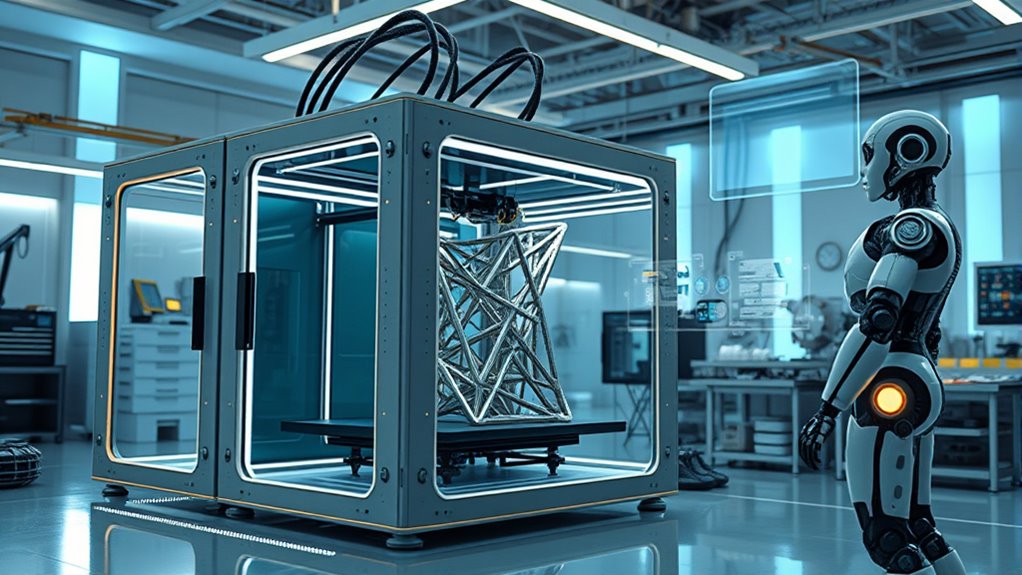

By 2026, AI will revolutionize additive manufacturing by enabling faster, more flexible, and highly customized production processes. You’ll see smarter design, real-time quality control, and predictive maintenance that reduce downtime and waste. AI-driven automation will make mass customization practical, while supply chains become more resilient with smarter logistics. If you want to understand how these innovations will reshape industries and what’s next, there’s more to explore.
Key Takeaways
- AI enables real-time data analysis and predictive maintenance, boosting efficiency and reducing downtime in additive manufacturing by 2026.
- Integration of AI-driven automation allows for high-volume, customized production, transforming industries like automotive and healthcare.
- Supply chain resilience is enhanced through AI-enhanced visibility, demand forecasting, and blockchain traceability.
- AI-powered design optimization and quality control improve part performance, reduce scrap, and accelerate development cycles.
- The convergence of AI and additive manufacturing fosters industry competitiveness through increased flexibility, innovation, and market responsiveness.
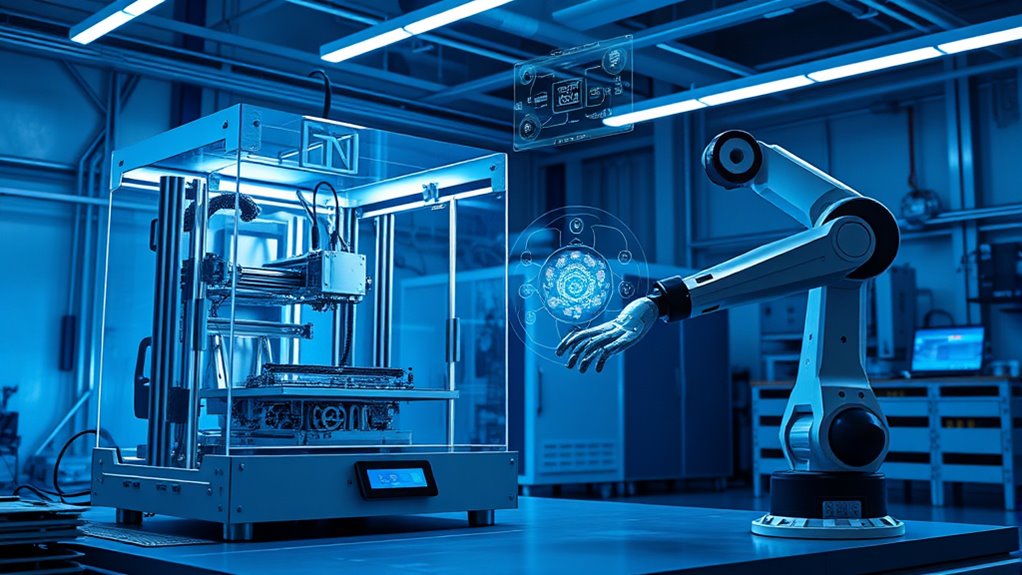
By 2026, AI has become a pivotal driver of growth in additive manufacturing, transforming how industries design, produce, and manage their supply chains. You’ll find that over 80% of manufacturing executives view AI as essential for staying competitive, with many seeing significant returns on investment—especially in supply chain management, procurement, and quality control. AI’s ability to analyze real-time data enables predictive maintenance, reducing costly downtime, and catching defects early in the process. This means fewer surprises, higher quality parts, and faster turnaround times. Generative design tools powered by AI push the boundaries of traditional manufacturing, helping you create complex, optimized 3D structures that were once impossible or too costly to produce.
Automation driven by AI accelerates workflows, increasing throughput without sacrificing customization. You can now produce high volumes of unique, tailored products efficiently, supporting industries like automotive and medical devices that thrive on mass customization. AI also allows you to analyze customer data deeply, enabling hyper-personalization of 3D printed items. This means you can meet individual demands quickly and precisely, offering bespoke solutions that enhance user experience. Factories are gearing up with localized materials and on-demand production capabilities, reducing inventory costs and lead times while responding swiftly to market changes.
Supply chains benefit enormously from AI integration, offering greater visibility by connecting multiple supplier systems. You’re empowered to reshore operations, supported by digital workflows that improve agility and resilience. Combining AI with blockchain enhances traceability, ensuring transparency in sourcing and production of 3D printed components. Predictive demand forecasting and inventory optimization become standard practices, helping you avoid disruptions and manage materials efficiently. Advanced AI models also anticipate risks early, rerouting schedules around potential delays. This integration of AI into supply chains significantly improves overall efficiency and responsiveness, enabling manufacturers to adapt swiftly to dynamic market conditions.]
In quality control, machine learning algorithms analyze multisensor data—such as vibrations, images, and sounds—in real time to detect defects during printing. AI-powered simulations predict how parts will perform under various conditions, allowing you to optimize parameters before printing begins. Inline AI inspection reduces scrap and ensures consistent quality, even for complex geometries. Generative AI explores multiple design variables rapidly, shortening development cycles. When combined with digital twins, AI offers continuous monitoring and improvement, making additive manufacturing more reliable, flexible, and innovative than ever before.

AOSEED 3D Printer for Kids, AI-Powered Fully Assembled 3D Printer with Up to 400mm/s Speed, Auto Leveling, 1500+ Models & 16+ Modules, Includes 8 PLA Filaments for Home and School Use, X-MAKER JOY AI+
AI-Powered Creativity Made Easy: The AOSEED X-MAKER JOY AI+ is an AI 3D printer that helps kids bring…
As an affiliate, we earn on qualifying purchases.
As an affiliate, we earn on qualifying purchases.
Frequently Asked Questions
How Will AI Improve the Safety of Additive Manufacturing Processes?
AI improves the safety of additive manufacturing by continuously monitoring your equipment and processes, detecting anomalies early. It enables real-time adjustments to prevent defects and equipment failures, reducing hazards. AI-powered robots handle dangerous tasks, minimizing human exposure. It also enhances quality control through automatic defect detection, ensuring safer parts. By predicting maintenance needs and optimizing workflows, AI helps you operate more securely, reducing risks and safeguarding your team and environment.
What Ethical Concerns Arise From Ai-Driven 3D Printing?
Think of AI-driven 3D printing as a double-edged sword—its power can shape a better future or cut deeply into ethics. You face concerns like privacy breaches from sensitive data, biases perpetuating discrimination, and accountability muddled when things go wrong. Plus, societal impacts loom large, risking inequality and safety. It’s crucial you address these ethical challenges now, ensuring technology serves all fairly, not just a privileged few.
Can AI Customize 3d-Printed Products for Individual Needs?
Yes, AI can customize 3D-printed products for individual needs. You can input specific requirements, and AI instantly generates unique designs tailored to those preferences. This process enables you to create personalized medical implants, automotive parts, or consumer goods efficiently and cost-effectively at scale. By automating design adjustments, AI helps you meet individual demands quickly, offering highly customized solutions without the traditional time and cost barriers of manual design.
How Will AI Impact the Cost of Additive Manufacturing?
AI acts like a master chef in your factory kitchen, stirring efficiency into every pot. It slashes costs by optimizing designs, reducing waste, and cutting material use. Real-time monitoring catches defects early, saving rework expenses. Predictive maintenance keeps machines humming smoothly, while smarter scheduling maximizes output. All these ingredients blend to lower your overall manufacturing bills, making additive processes faster, cleaner, and more affordable—helping you stay ahead in the competitive landscape.
What Are the Environmental Implications of Ai-Enhanced 3D Printing?
AI-enhanced 3D printing reduces waste and improves resource efficiency, lowering environmental impact. It helps develop eco-friendly materials, minimizes energy use during production, and optimizes designs to cut emissions. However, the increased computational power required for AI can raise carbon footprints, and improper disposal of microplastic particles from polymer powders may harm ecosystems. Overall, with proper management, AI-driven additive manufacturing can promote sustainability and reduce pollution.

Machine Reliability and Condition Monitoring: A Comprehensive Guide to Predictive Maintenance Planning (Maintenance Strategy & Reliability Series)
As an affiliate, we earn on qualifying purchases.
As an affiliate, we earn on qualifying purchases.
Conclusion
By 2026, over 70% of manufacturing processes will integrate AI with additive manufacturing, transforming how you create and innovate. Imagine designing complex parts in hours instead of days, all thanks to intelligent machines. This shift not only boosts efficiency but also opens up endless possibilities for customization and sustainability. As you embrace this tech revolution, you’ll be at the forefront of a future where smarter, faster, and more sustainable manufacturing becomes the new norm.

Generative AI Design Patterns: Solutions to Common Challenges When Building GenAI Agents and Applications
As an affiliate, we earn on qualifying purchases.
As an affiliate, we earn on qualifying purchases.

Teslong Two-Way Articulating Borescope with Light, Industrial Endoscope Inspection Camera with Articulated Probe, Flexible Mechanic Fiber Optic Snake Scope Cam for Wall Automotive Engine Inspect-5FT
Easily Maneuver Your View: Tired of struggling with hard-to-reach areas during inspections? This two-way articulating borescope effortlessly navigates…
As an affiliate, we earn on qualifying purchases.
As an affiliate, we earn on qualifying purchases.