
TL;DR

Get business pricing on tech for your team
- Business-only prices and quantity discounts
- Tax-exempt purchasing
- Multiple users, one account, clear invoices
Google opened Gemini 4 Carbon to paying customers on November 10, the same day it introduced the MKA benchmark with Artificial Analysis. Carbon scored 54.3% on MKA, behind Claude Fable 5.2 at 56.6%, while Google DeepMind reported a cost of $5.63 per Carbon task versus $35.28 for Fable. The benchmark was co-developed by Google, and its private tasks cannot be independently inspected.
Google opened Gemini 4 Carbon to paying developers, businesses and Google AI Ultra subscribers on November 10, the same day Google DeepMind and Artificial Analysis published results for their new MKA benchmark. Carbon scored 54.3%, placing second behind Anthropic’s Claude Fable 5.2 at 56.6%; Google DeepMind’s report put Carbon’s cost at $5.63 per task, about one-sixth of Fable’s reported $35.28.
Carbon is available through the paid Gemini API, Google AI Studio and Gemini for business. In the Gemini app and AI Mode in Search, Google limits access to AI Ultra subscribers. Google set introductory API prices of $2 per million input tokens and $10 per million output tokens through November 30. From December 1, those rates are scheduled to rise to $4 and $20, respectively.
MKA tests agents on 200 expert-built tasks across 10 sectors, using material such as blueprints, scans and charts rather than only plain text. The published results put Claude Fable 5.2 at 56.6%, Carbon at 54.3% and Claude Opus 5.5 at 53.0%. The report says the top three results are within the benchmark’s margin of error, so the small score gaps should not be read as a decisive ordering.
The reported task costs were $5.63 for Carbon and $35.28 for Fable 5.2. These figures come from Google DeepMind’s report; the source material does not provide the full calculation details needed to compare costs across every possible task or customer workload. MKA’s tasks are private, and Google helped develop the benchmark, limiting outside scrutiny of the test set and its scoring.
Cost and Capability for Agent Tasks
MKA is aimed at work where an AI system must interpret information presented in different formats, a common feature of professional tasks involving documents, diagrams and data displays. A result near the top of the published table gives businesses a new point of comparison for models intended to handle that kind of work.
The price difference reported by Google DeepMind could matter to organizations that run many agent tasks, if the benchmark’s cost figures translate to their own workloads. The result does not establish that Carbon will be cheaper for every use case or that it will perform equally well on a company’s own materials. The close scores, stated margin of error and limited visibility into MKA’s private tasks all constrain what can be inferred from the ranking.
Products Worth Considering

LG UltraGear 25G590B-B 25-Inch Full HD 1000Hz Gaming Monitor

Bose QuietComfort Headphones (2nd Gen), Wireless Over-Ear Noise-Cancelling Headphones, Black

Apple Watch SE 3 GPS 40mm Smartwatch
As an affiliate, we earn on qualifying purchases.
A Model Built for Harder Tasks
Google describes Carbon as its top-tier model, built on Gemini 4 Argon and intended for tasks that test a model’s capabilities, including complex coding and open-ended research. According to Google’s model card, Carbon uses more thinking tokens than Argon to examine possible answers and carry out extended checks. Google says Argon remains its recommended choice for most software engineering and knowledge work, positioning Carbon for harder cases.
The model accepts text, images, audio and video, and produces text. Google lists a context window of up to 1 million tokens for input and output combined and a March 2026 knowledge cutoff. Its model card also identifies hallucinations, occasional slowness or timeouts, and higher token use at higher thinking levels as limitations.
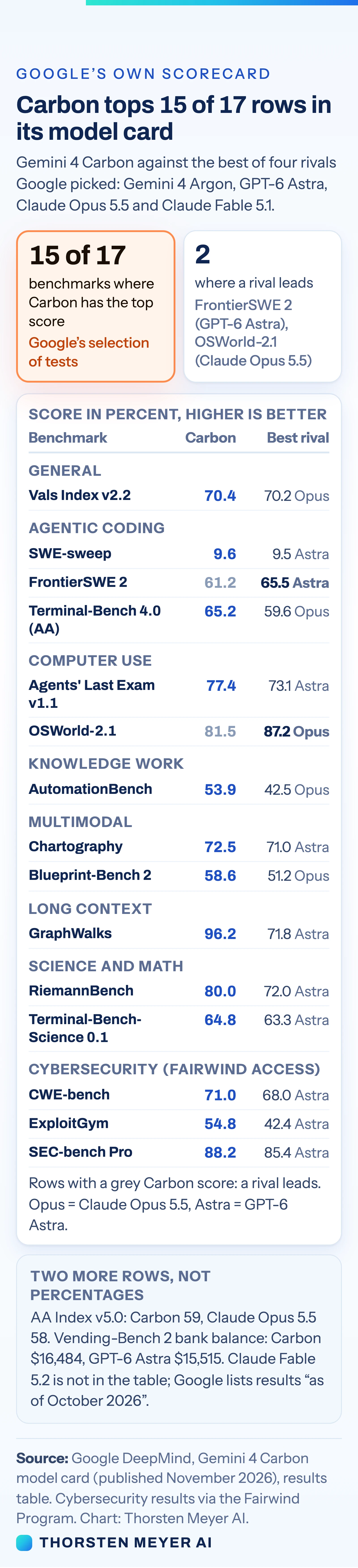
Google’s model card reports that Carbon led on 15 of 17 benchmarks selected by Google, with GPT-6 Astra ahead on FrontierSWE 2 and Claude Opus 5.5 ahead on OSWorld-2.1. That comparison predates Claude Fable 5.2’s November 9 release. A separate Artificial Analysis Intelligence Index v5.0.1 score listed Carbon at 60, below Fable 5.2 at 65 on its maximum setting and 62 at high. The different assessments use different tests, so their rankings describe separate measurement systems.
““tasks that test the limits of a model’s intelligence””
— Google DeepMind, Gemini 4 Carbon model card
Limits of the MKA Comparison
Google DeepMind and Artificial Analysis have not made MKA’s tasks public, so outside researchers cannot inspect the full test set or reproduce the results from those tasks. Google’s role in developing the benchmark is also relevant when weighing a result that places its model near the top. The available source material does not describe enough about the cost calculation to establish how closely the reported per-task prices match different real-world workloads.
Carbon’s 54.3% score is close to Fable 5.2’s 56.6%, and the report says the leading results fall within the margin of error. It is not clear from the published summary how future benchmark versions, additional models or independent testing would affect the ranking. Google also lists potential hallucinations, slowness, timeouts and high token use as model limitations.
Pricing Changes in December
Developers and businesses can access Carbon through Google’s paid developer and business services, while access through the Gemini app and Search AI Mode requires Google AI Ultra. The next announced pricing milestone is December 1, 2026, when the API rates are scheduled to rise from the introductory $2 per million input tokens and $10 per million output tokens to $4 and $20.
Further independent comparisons may clarify how Carbon performs on agent tasks beyond MKA and whether its reported cost advantage holds across other workloads. For now, the published MKA results offer a close benchmark comparison, with the test’s private task set and Google’s role in its development remaining important limits.
Key Questions
What was Gemini 4 Carbon’s MKA score?
Carbon scored 54.3% on MKA, behind Claude Fable 5.2 at 56.6% and ahead of Claude Opus 5.5 at 53.0%. The report says the top three results are within the margin of error.
How much does Gemini 4 Carbon cost?
Through November 30, Google lists API prices of $2 per million input tokens and $10 per million output tokens. From December 1, the listed rates are scheduled to be $4 and $20. Google DeepMind reported a cost of $5.63 per Carbon task on MKA.
Who can use Gemini 4 Carbon?
Google made Carbon available through the paid Gemini API, Google AI Studio and Gemini for business. In the Gemini app and AI Mode in Search, it is limited to Google AI Ultra subscribers.
What does MKA test?
MKA consists of 200 expert-built tasks across 10 sectors. It assesses AI agents working with materials such as blueprints, scans and charts, according to the benchmark announcement.
Can the MKA results be independently checked?
The benchmark’s tasks are private, so outsiders cannot inspect the full test set. Google DeepMind co-developed MKA with Artificial Analysis, a factor readers should keep in mind when interpreting Carbon’s result.
Source: Thorsten Meyer AI