
TL;DR

Get tech for your team delivered free — and shop member deals
- Fast, free delivery on millions of items
- Access to Prime Big Deal Days deals on October 6–7
- Prime Video, Amazon Music and more included
A cluster randomized trial in 18 Tennessee middle schools found that assigning students to use Khan Academy with Khanmigo during remedial math sessions raised achievement by 1.3 national percentile ranks per term. The study authors say the gains resembled those from Khan Academy practice without AI, while students used the tutor infrequently.
A two-year randomized trial in 18 Tennessee middle schools found that students assigned to use Khan Academy with its AI tutor, Khanmigo, during remedial math sessions gained 1.3 national percentile ranks per term. The August 2026 working paper says the gains were similar to those associated with Khan Academy practice without AI, raising questions about how much classroom benefit the tutor adds when student use is limited.
The study used a cluster randomized design: students were randomly assigned to use Khan Academy with Khanmigo in existing daily remedial mathematics sessions. The tutor was configured to coach students rather than provide answers. The report describes the trial as among the first large-scale experimental studies of AI tutoring in schools.
Assignment to the Khanmigo-supported program raised achievement by 1.3 national percentile ranks per term. The authors translate this to about 0.06 to 0.08 standard deviations over a school year. They also estimate an effect of 0.14 standard deviations for a full year of active participation; this is an implied effect, distinct from the reported result for assignment to the program.
Access did not mean frequent use. Although 96 percent of students tried Khanmigo at least once, the median student messaged it on only one-third of the days they practiced. Students used the tutor in just 17 percent of exercise sessions in which they made a mistake. The authors report that many messages were bare answers or clicks on suggested prompts, rather than substantive mathematical dialogue.
Student Use Shaped the Results
The findings suggest that providing access alone may not be enough to produce the gains often expected from AI tutoring. In this trial, most students tried Khanmigo at least once, but the typical student used it on only a portion of practice days and rarely turned to it after an error. The authors identify engagement as a constraint on realizing the tutor’s potential.
The comparison with Khan Academy practice without AI also matters for schools weighing digital learning tools. The reported gains resembled those from practice without AI assistance, so this study does not establish that Khanmigo itself produced an additional achievement benefit. It reports an effect of assignment to a program that included the tutor, within a specific remedial math setting.
For educators and administrators, the results put attention on how students interact with a tutoring system during routine lessons. A tool can be available and still play a limited role if students do not ask it for help when they struggle or do not engage with its guidance. The paper points to student use as a practical issue for schools considering AI-supported practice, while leaving open which changes to instruction or product design might increase meaningful engagement.
AI math tutoring software for middle school
As an affiliate, we earn on qualifying purchases.
As an affiliate, we earn on qualifying purchases.
An AI Tutor in Remedial Math
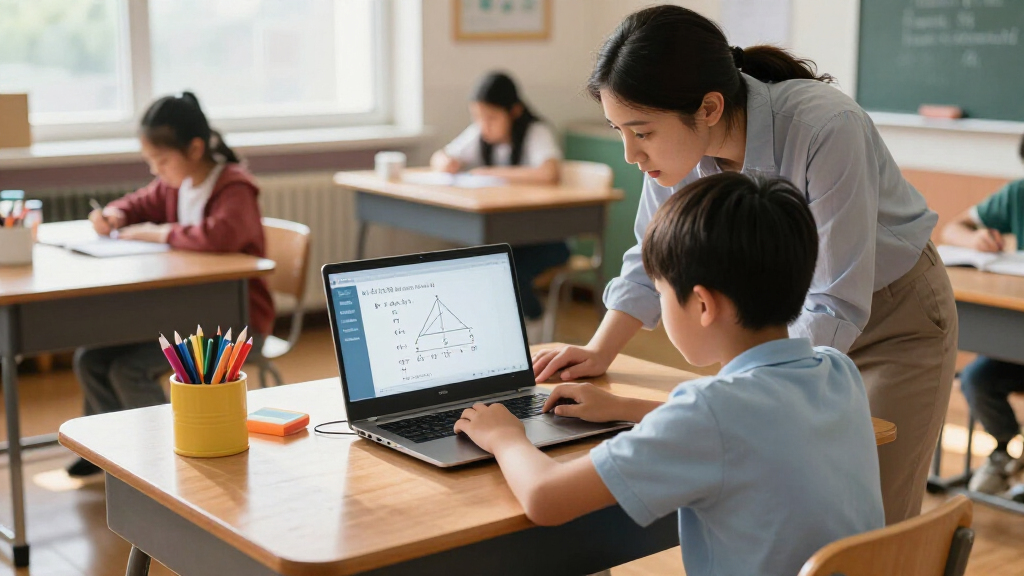
Generative AI has been promoted as a way to give students access to individualized tutoring. This study examined Khanmigo, Khan Academy’s AI tutor, in a defined school activity: daily remedial mathematics sessions already taking place at participating middle schools. It therefore addresses use within an existing intervention period, rather than replacing classroom teaching or evaluating AI tutoring across every subject and grade.
The tutor was set up to coach instead of giving answers, and students practiced on Khan Academy. That distinction is relevant to interpreting the engagement results: the experiment concerned a guided practice arrangement, and the report describes student messages as often brief or prompted. The study’s findings speak to this implementation and population; the supplied report does not establish whether the same results would apply to other AI tutors, subjects, or school schedules.
The working paper, identified as EdWorkingPaper 26-1551, was published in August 2026 and lists DOI 10.26300/kner-hv33. Its authors present the trial as experimental evidence on school use of an AI tutor, while comparing the observed achievement gains with those from Khan Academy practice without AI assistance.
“configured to coach rather than give answers”
— The study authors
As an affiliate, we earn on qualifying purchases.
Limits of the Evidence
The reported comparison does not show that Khanmigo delivered gains beyond Khan Academy practice without AI; the authors say the gains resembled those from that practice. The supplied summary also does not give the study’s sample size, the precise comparison-group arrangements, or details about how achievement was measured, so those aspects cannot be assessed from the available material.
The 0.14 standard deviation figure is described as an implied effect for a full year of active participation. It should not be read as the observed effect for every student assigned to the program: reported engagement was limited, and the summary does not explain the estimation method behind that implication. It is also unclear whether more frequent use would lead to larger gains, or what would prompt more students to seek and engage with the tutor’s help.
The report covers 18 middle schools in Tennessee and remedial mathematics sessions. The available source does not establish whether results generalize to other ages, subjects, locations, or forms of AI tutoring. The supplied material identifies the work as a working paper but does not state whether it has undergone peer review.
As an affiliate, we earn on qualifying purchases.
The Engagement Question Ahead
The working paper adds experimental evidence to discussion about AI tutoring in schools, but the reported results leave a practical question for educators: how can students be encouraged to use a tutor meaningfully when they encounter difficulty? The authors argue that access needs to be accompanied by student engagement, but the supplied report summary does not specify a tested strategy for increasing it.
Further evidence would be needed to establish whether changes to classroom routines, prompts, or the tutor itself lead to more substantive exchanges and different achievement outcomes. The available source does not announce a follow-up trial, a policy decision, or a planned change by Khan Academy or the participating schools. For now, the reported conclusion is limited to this experiment: assignment to Khanmigo-supported practice produced modest gains, while students’ use of the tutor was often infrequent.
As an affiliate, we earn on qualifying purchases.
Key Questions
What did the Khanmigo school trial find?
In a two-year trial across 18 Tennessee middle schools, assignment to Khan Academy practice with Khanmigo raised math achievement by 1.3 national percentile ranks per term. The study authors say the gains resembled those from Khan Academy practice without AI assistance.
How often did students use Khanmigo?
96 percent tried it at least once, but the median student messaged the tutor on only one-third of practice days. Students used it in 17 percent of exercise sessions where they made a mistake.
Did Khanmigo outperform Khan Academy practice without AI?
The supplied report says the achievement gains resembled those from Khan Academy practice without AI. It does not establish an additional gain attributable specifically to the AI tutor.
Where and when was the study conducted?
The experiment took place in 18 Tennessee middle schools over two years, during existing daily remedial mathematics sessions. The working paper was published in August 2026.
Source: hn
Halloween Picks
halloween
As an affiliate, we earn on qualifying purchases.