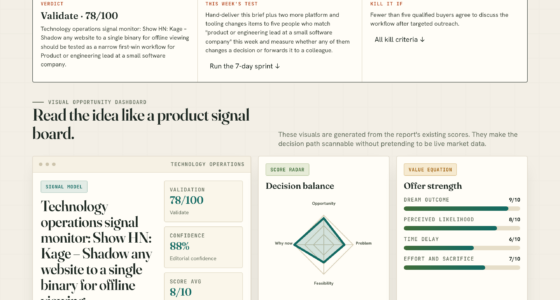

📊 Full opportunity report: The Case For Owning Your AI Model With Mistral Forge Over API Subscription on ThorstenMeyerAI.com — validation score, market gap, and execution plan.

Get business pricing on tech for your team
- Business-only prices and quantity discounts
- Tax-exempt purchasing
- Multiple users, one account, clear invoices
TL;DR
Mistral announced Forge at Nvidia GTC 2026, advocating for companies to develop and own their AI models instead of relying on third-party APIs. This approach targets organizations with proprietary, sensitive data, emphasizing sovereignty and customization.
Mistral has introduced Forge, a comprehensive platform that allows organizations to develop and operate their own AI models, moving away from traditional API-based models. This shift aims to give companies greater control over their proprietary data and AI capabilities, especially for sensitive or specialized use cases. The announcement was made at Nvidia’s GTC conference in March 2026, marking a significant development in AI sovereignty and enterprise AI strategy.
Forge is an end-to-end lifecycle platform that supports data preparation, large-scale training, alignment, evaluation, and deployment of custom AI models. Unlike simple fine-tuning or retrieval-augmented generation (RAG), Forge creates models that fundamentally change how the AI reasons, tailored to specific organizational knowledge, rules, and workflows. It includes features like synthetic data generation, multimodal training, and lifecycle management, with deployment options on private clouds or on-premises infrastructure.
Key differentiator is the embedded consulting model: Forge ships with dedicated engineers who work directly with client teams, making it a managed service rather than a self-service tool. The base models are open-weight checkpoints from Mistral, which are then extensively trained and specialized for each organization’s needs. This approach targets organizations with complex, sensitive data, such as aerospace, government, or high-security sectors, where model ownership and data sovereignty are critical.
Mistral Forge: owning the model, not just renting the API
Europe’s most valuable AI company is betting the next sovereignty fight isn’t which API you call — it’s whether you own the model at all. Forge builds a model adapted to your data, terminology & rules, run inside your own walls. A leap for the right buyer; overkill for most.
Your proprietary knowledge changes how the model reasons — engineering/code, industrial constraints, government language & law, security telemetry, agentic tool-use by your rules. High-consequence, data-mature, sovereignty-bound.
You want a knowledge assistant, doc search or support bot — RAG or light fine-tuning wins on cost, speed & updatability. Analysts warn most enterprises lack the clean, governed data Forge assumes.
Train on your data, in your jurisdiction, on infrastructure you control, with a non-US vendor — air-gapped if needed, keeping the models, infra & knowledge. In a year when model access proved to be a geopolitical variable, owning the model stops being philosophy and becomes a hedge. (US labs offer custom models too; Forge’s moat is the combination — full pre-training + EU residency + on-prem, one platform.)
Forge packages what used to require an in-house AI research team — deep adaptation, sovereign deployment, full lifecycle, with embedded engineers. For big, regulated, data-rich orgs with high-consequence use cases, that’s a real leap, and the European framing is a feature. For everyone else it’s a heavier commitment than the problem needs — climb the ladder (RAG → fine-tune → Forge) and demand proof, not marketing. The deeper signal: enterprise sovereignty is shifting from “which API?” to “do I own the model?”
Why Model Ownership Matters for Sensitive Data
This development signals a strategic shift for enterprise AI, emphasizing sovereignty, data privacy, and customization. Organizations with proprietary knowledge, strict security requirements, or specialized workflows can now develop AI models that align closely with their internal processes. This reduces reliance on external API providers, mitigates risks related to data leaks, and enhances control over AI behavior and updates.
However, the approach also entails significant technical and organizational commitments. Only companies with mature data practices and the capacity for AI development are likely to benefit immediately. For most enterprises, lighter approaches like RAG or targeted fine-tuning remain more practical and cost-effective.
As an affiliate, we earn on qualifying purchases.
The Evolution of Enterprise AI Strategies
For two years, enterprise AI has largely revolved around using large, general-purpose models via APIs, with companies customizing responses through prompts, retrieval pipelines, and governance layers. Mistral’s Forge challenges this paradigm by advocating for in-house model development and ownership, aligning with broader trends toward AI sovereignty and data control. Announced at Nvidia GTC 2026, Forge builds on the company’s expertise in large models and aims to serve organizations with complex, sensitive data needs.
Previous approaches like retrieval-augmented generation (RAG) and fine-tuning have been popular because they are less costly and faster, suitable for less sensitive tasks. Forge, by contrast, offers a comprehensive, model-level adaptation process that involves extensive training, alignment, and lifecycle management, requiring more technical resources and data maturity. Early adopters include organizations like the European Space Agency and ASML, which have high demands for security and proprietary knowledge.
“Forge is designed to embed directly with customer teams, providing a full lifecycle management platform for creating and operating domain-specific models.”
— Mistral spokesperson
enterprise AI model deployment tools
As an affiliate, we earn on qualifying purchases.
As an affiliate, we earn on qualifying purchases.
Market Readiness and Data Maturity Challenges
It remains unclear how broadly Forge will be adopted outside of high-security sectors. The platform requires significant technical expertise, structured data, and organizational capacity for training and lifecycle management. Critics like Futurum analysts suggest that many enterprises lack the data maturity or resources needed to leverage Forge effectively, potentially limiting its market to a niche of well-resourced organizations.
Additionally, the long-term cost and complexity implications of maintaining in-house models versus API subscriptions are still being evaluated, especially as model architectures and training techniques evolve rapidly.
As an affiliate, we earn on qualifying purchases.
Next Steps for Adoption and Market Expansion
Following the announcement, Mistral is expected to engage with early adopters for pilot projects and case studies, demonstrating Forge’s capabilities in real-world settings. The company may also expand its support for different deployment environments and continue refining its lifecycle management tools. Broader market adoption will depend on how effectively organizations can build internal AI expertise and manage data maturity.
Further developments may include more streamlined onboarding, reduced training costs, and integrations with existing enterprise data systems. Monitoring how Forge compares with lighter customization options like RAG and fine-tuning will be key for potential clients evaluating their AI strategies.
synthetic data generation software
As an affiliate, we earn on qualifying purchases.
As an affiliate, we earn on qualifying purchases.
Key Questions
Who are the ideal candidates for using Mistral Forge?
Organizations with sensitive, proprietary, or highly specialized data, such as aerospace, government, or security agencies, are the primary candidates. They require in-house control over AI models to ensure data sovereignty and tailored reasoning capabilities.
What are the main technical requirements for adopting Forge?
Adopters need mature data practices, a capable AI development team, and infrastructure for large-scale training, evaluation, and deployment. The platform includes embedded engineers to assist with integration and lifecycle management.
How does Forge compare cost-wise to API-based models?
Forge involves higher upfront investment due to training, data preparation, and organizational capacity. However, it may offer cost savings over time for organizations with ongoing, high-volume, proprietary AI needs, by eliminating API subscription fees and enabling model ownership.
When should an organization consider Forge over simpler customization options?
When proprietary knowledge significantly influences model reasoning, and when data security, sovereignty, or compliance requirements outweigh the costs and complexity of developing an in-house model.
What are the main limitations or risks of adopting Forge?
The approach requires substantial technical expertise, mature data infrastructure, and ongoing management. Without these, organizations risk ineffective deployment or high costs, making lighter options more suitable for many.
Source: ThorstenMeyerAI.com
Fall Picks
fall essentials
As an affiliate, we earn on qualifying purchases.