
📊 Full opportunity report: The Eye Over the City: How Wide-Area Motion Imagery Works — and Where It Goes Blind on ThorstenMeyerAI.com — validation score, market gap, and execution plan.
TL;DR
Wide-Area Motion Imagery (WAMI) allows monitoring entire cities simultaneously, offering detailed tracking and forensic analysis. Its capabilities are expanding, but it faces physical and operational limits. The technology’s future involves integration with radar systems for comprehensive coverage.
Wide-Area Motion Imagery (WAMI) provides a comprehensive view of entire cities from airborne platforms, tracking all moving objects in real-time and recording data for later analysis. This technology significantly enhances surveillance capabilities for military, security, and emergency response agencies, making it one of the most impactful tools of the last two decades.
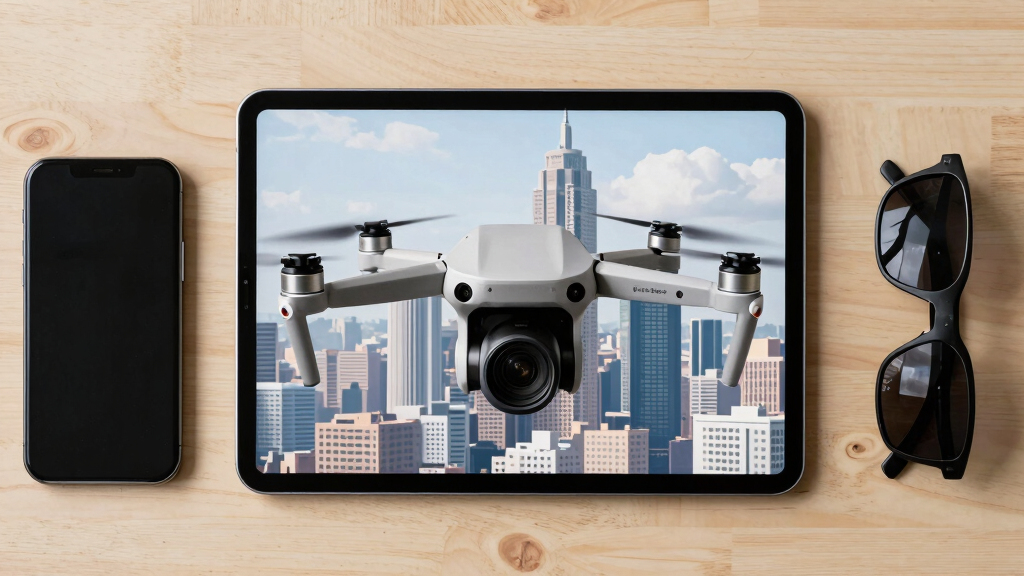
WAMI systems use an array of high-resolution cameras stitched into a single, gigapixel image, capable of covering several square kilometers from high altitudes. DARPA’s ARGUS-IS, a prominent example, employs 368 cameras to produce images where objects as small as six inches can be identified across a cityscape, such as Manhattan. The captured data is processed to stabilize the background, detect moving objects, track them across frames, and archive everything for forensic review.
Because of the enormous data rates, WAMI relies heavily on automation and artificial intelligence (AI) for real-time analysis. It is mounted on various platforms, including manned aircraft, drones, blimps, and helicopters, enabling persistent surveillance over urban areas and borders. Its primary use cases include military network discovery, border security, and disaster response, such as wildfire mapping and infrastructure assessment after natural calamities.
However, WAMI has notable physical limitations. It is optical-based, making it vulnerable to weather conditions like fog, smoke, and darkness. It requires platforms to loiter above targets, which can be contested or denied in hostile environments. Additionally, the high operational costs and bandwidth requirements restrict its deployment in some scenarios. To address these issues, radar systems like synthetic aperture radar (SAR) are increasingly integrated to provide all-weather, day-and-night coverage, complementing WAMI’s optical capabilities.
The eye over the city: how Wide-Area Motion Imagery works — and where it goes blind
A normal drone sees through a soda straw. WAMI watches an entire city at once, tracks every mover, and records it all for forensic rewind. Immense reach — with hard limits that make radar and AI its necessary partners.
- City-scale motion, fine detail
- Forensic rewind
- Cloud / smoke / dark degrade it
- Needs a platform loitering overhead
sensing
+ AI
- Sees through cloud & total dark
- Tasked over denied airspace
- Persistent, wide-area from orbit
- Sovereign · on-prem · air-gap
The same archive that traces a bomber to a safe house can trace anyone home — retroactively, without prior suspicion. Baltimore’s secret 2016 deployment led to a 2021 federal ruling that persistent aerial tracking violated the Fourth Amendment. The security value is real; so is the mass-surveillance risk. Who owns the sensor, the archive, and the AI is the accountability question.
WAMI’s power is the archive and the AI reading it; its weakness is weather, airspace, and oversight. The mature posture isn’t optical-vs-radar or capability-vs-liberty — it’s layered sensing (optical WAMI + all-weather SAR), AI-enabled exploitation, and sovereign, auditable control of the whole chain. WAMI shows what a persistent eye can do with clear skies and owned airspace; for the cloud, the night, and the denied area, the radar layer is where the resilient coverage lives.
Implications for Surveillance and Security Operations
WAMI’s ability to monitor entire urban areas with high detail transforms surveillance, enabling detailed forensic investigations and real-time tracking of multiple objects simultaneously. Its integration with radar systems promises more resilient and comprehensive coverage, crucial for national security, border control, and disaster management. However, its extensive data collection raises privacy and governance concerns, prompting ongoing legal debates about oversight and use.

DroneMobile XC-LTE 2K QHD 1440p 30fps Dash Cam with XC-RC1 Rear Camera – Ideal for Car Security and Surveillance
- Security Sensors: Dual shock and glass-break sensors with alarm
- High-Resolution Recording: 2K QHD 1440p at 30fps with IMX335 sensor
- Live Streaming: LTE and Wi-Fi live streaming with parking modes
As an affiliate, we earn on qualifying purchases.
As an affiliate, we earn on qualifying purchases.
Evolution and Current Use of WAMI Technology
Developed in the early 2000s through programs like Lawrence Livermore’s Sonoma, WAMI transitioned into military applications with systems like DARPA’s ARGUS-IS and the US Air Force’s Gorgon Stare. These systems have been deployed on drones and aircraft in conflict zones, primarily for battlefield intelligence and border security. Recent years have seen a broader application scope, including wildfire mapping and disaster response, as agencies recognize its forensic and real-time tracking advantages.
As an affiliate, we earn on qualifying purchases.
Technical and Governance Challenges Facing WAMI
While WAMI’s technical capabilities are well-documented, questions remain about its operational costs, scalability, and the legal frameworks governing its use. The extent of its deployment in civilian contexts and the potential for misuse or privacy violations are subjects of ongoing debate and investigation. Additionally, the integration with radar and other sensors is still evolving, with technical and logistical hurdles to overcome.

Blink Mini 2K+ (newest model) – Plug-in Home & Pet Indoor Security Camera with 2K video resolution, night vision, enhanced audio, motion detection – 2 cameras (Black)
- Compact Plug-in Design: Third-generation mini security camera
- High-Resolution Video: Sharp 2K video quality
- Enhanced Night Vision: Clear footage in low light
As an affiliate, we earn on qualifying purchases.
As an affiliate, we earn on qualifying purchases.
Future Directions for WAMI and Sensor Fusion
Advancements are expected in AI-driven analysis to improve real-time object detection and tracking. Efforts are underway to integrate WAMI with synthetic aperture radar (SAR) systems, creating layered sensing networks capable of all-weather, continuous monitoring. Policy and legal frameworks will likely evolve to address privacy concerns and oversight, shaping how these technologies are deployed in both military and civilian domains.

Defender AI Powered Sentinel 4K 8CH PoE Security Camera System, 8pcs NVR Metal Outdoor Surveillance Cameras, 1TB HDD, SMART AI Human Detection, Blue/Red Lights, Works w/Empower App
- Compatibility: Works with Defender Empower app only
- Build Quality: Professional-grade metal NVR and IP66 cameras
- Weather Resistance: Designed for extreme weather conditions
As an affiliate, we earn on qualifying purchases.
As an affiliate, we earn on qualifying purchases.
Key Questions
How does WAMI differ from traditional surveillance cameras?
WAMI provides city-wide coverage with high-resolution imagery, capable of tracking multiple objects simultaneously across several square kilometers, unlike traditional cameras that focus on narrow fields of view.
What are the main limitations of WAMI?
WAMI is optical-based, so weather conditions like fog and darkness impair its effectiveness. It also requires platforms to loiter overhead, which can be contested, and generates enormous data that needs advanced processing.
Can WAMI operate in all weather conditions?
No, it is limited by weather; cloud cover, smoke, and darkness reduce visibility. Radar systems are used in conjunction to mitigate this limitation.
What are the privacy concerns associated with WAMI?
The extensive data collection raises questions about surveillance overreach and privacy rights, prompting calls for regulatory oversight and legal frameworks.
What is the future of WAMI technology?
Future developments include integrating WAMI with radar and AI for layered, all-weather surveillance, alongside evolving policies to manage privacy and ethical use.
Source: ThorstenMeyerAI.com