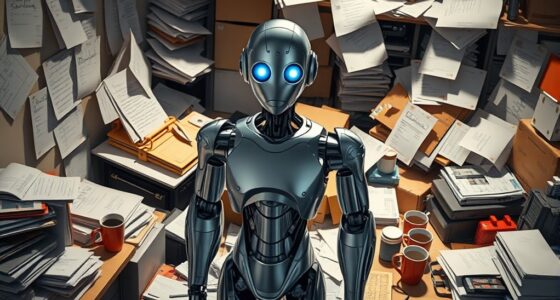

Automation is transforming many workplaces, but it’s unlikely every job will be fully replaced. Routine tasks like data entry and scheduling are most susceptible, but skills like creativity, problem-solving, and social intelligence remain human strengths. Limitations in current automation prevent complex, unpredictable work from being fully automated. As sectors adapt, new opportunities emerge, especially in roles that emphasize human-centric skills. To understand how automation balances with human work now and in the future, keep exploring these insights.
Key Takeaways
- Most automation targets repetitive, routine tasks; complex, strategic, and creative roles remain human-centric.
- High costs, integration challenges, and security concerns limit full automation of many complex processes.
- Human skills like creativity, empathy, and nuanced judgment are currently irreplaceable by machines.
- Automation is creating new roles and opportunities, emphasizing retraining for human-centric skills rather than replacing all jobs.
- Complete automation of every job is unlikely due to technical limitations, economic factors, and ethical considerations.

AI for Bookkeeping Automation and Workflows: Automate Data Entry, Receipts, Categorization, Reconciliation, and Month-End Reporting Using AI and No-Code Tools, Save Hours Every Week for Bookkeepers
As an affiliate, we earn on qualifying purchases.
As an affiliate, we earn on qualifying purchases.
The Scope of Automation Today

Today, automation is transforming industries at a rapid pace, with most businesses actively integrating new technologies. About 70% report increased productivity thanks to automation in 2025. You’ll notice automation mainly targets repetitive and routine tasks, freeing up employees to focus on more complex work. As a result, employee satisfaction often rises because mundane tasks are automated. Cost-cutting remains a key motivation behind adopting automation, driven by advances in AI and robotics. AI and information processing, used by 86% of companies, lead the way, while robotics and other technologies are leveraged by 58%. These innovations aren’t just in manufacturing—they’re spreading across sectors like healthcare, retail, and energy. Automation’s scope is broadening, but it primarily reshapes workflows rather than replacing entire jobs. Broadening digital access is expected to be the most transformative, and ongoing developments in trustworthiness of AI systems continue to influence how automation is adopted and perceived. Furthermore, the integration of advanced robotics is enabling more complex tasks to be automated, expanding the potential impact across industries. Additionally, understanding the limitations of current automation technology is crucial for managing expectations and preparing for future developments. Recognizing the importance of specialized skills and human oversight remains vital as automation becomes more sophisticated. Interestingly, some experts argue that philosophical insights on existence and ethics can help shape responsible automation policies that consider human values.

Robotic Process Automation Tools, Process Automation and Their Benefits: Understanding Rpa and Intelligent Automation
As an affiliate, we earn on qualifying purchases.
As an affiliate, we earn on qualifying purchases.
Tasks Most Likely to Be Automated
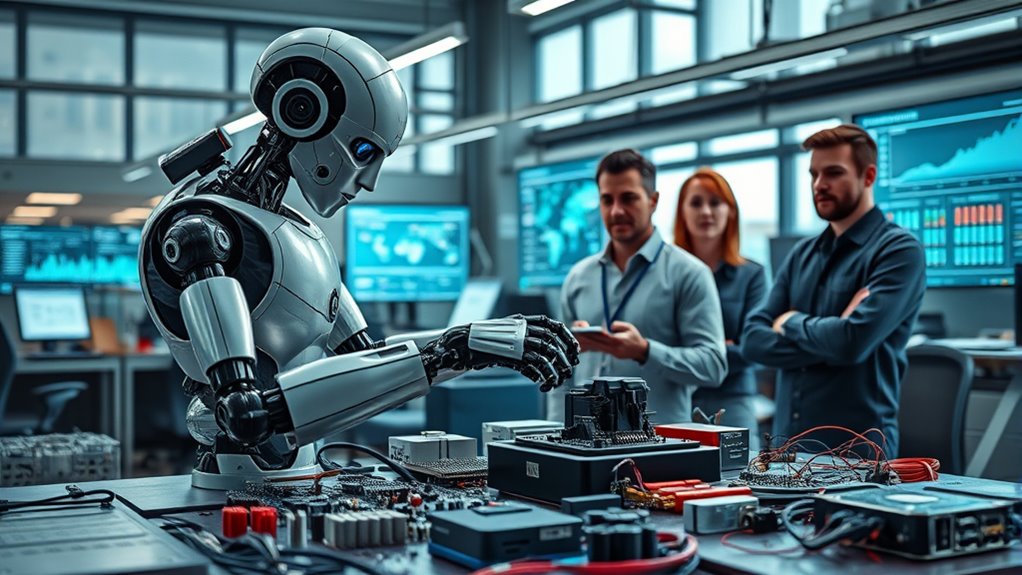
Tasks that involve routine processes, data handling, or repetitive workflows are most vulnerable to automation. You’ll find that activities like data entry, scheduling, and basic customer interactions can easily be managed by AI tools. As these tasks become automated, you’ll need to focus on adapting your skills for roles that require human judgment and creativity. Additionally, regular assessment and organization are crucial to stay ahead of automation trends and maintain efficiency. Developing emotional intelligence can help differentiate human roles from AI capabilities and ensure continued relevance in the workforce. Staying aware of support hours and scheduling in various industries can inform your understanding of where automation might impact customer service roles. Moreover, understanding the Pimple Patch market and how it’s evolving demonstrates the importance of staying informed about niche industries that may resist automation due to the need for personalized care. Recognizing areas where AI security vulnerabilities exist, such as in AI safety measures, can also help you understand which roles are less likely to be fully automated due to the need for oversight and human intervention.
Routine Task Automation
Repetitive and simple activities are the most likely to be automated because they require minimal decision-making and follow predictable patterns. Over half of employees spend at least two hours daily on tasks that can be easily automated, boosting productivity. Nearly all industries perform such tasks regularly, making automation a practical solution. These routine tasks tend to be straightforward, which makes them ideal candidates for workflow automation, capable of reducing manual effort by 60-95%. Automating these activities frees your time for more creative and strategic work, improving job satisfaction and overall efficiency. With advances like cloud-based platforms and AI integration, automation becomes more accessible and cost-effective. As more companies adopt these solutions, routine task automation will continue to be a key driver of operational improvements and competitive advantage. Additionally, the development of user-friendly automation tools is making it easier for organizations to implement these solutions without extensive technical expertise. Moreover, understanding spiritual energy can help individuals better manage their mental and emotional states, which can influence productivity and workplace harmony. Recognizing the importance of Gold IRA Rollovers can also be a strategic move for securing long-term retirement benefits amid economic fluctuations. Furthermore, integrating workforce analytics can optimize task allocation and enhance overall operational efficiency. Recent advancements in Glycolic Acid benefits demonstrate how targeted skincare can improve skin texture and appearance, highlighting the importance of routine care in overall well-being.
Data Processing Tasks
Data processing tasks, especially those involving data extraction, validation, and reporting, are prime candidates for automation because they involve routine, rule-based activities. Automation tools now use AI-powered OCR to extract data from various documents with high accuracy, reducing manual entry errors by up to 70%. Digitizing paper records frees you to focus on analysis instead of data entry. Automated validation workflows verify data accuracy in real-time, catching errors faster than humans. Research shows that integrating these systems with ERP and CRM platforms ensures consistency across platforms, speeding up workflows. Automated reporting software aggregates data from multiple sources, creating near real-time dashboards. You’ll see faster decision-making, improved data quality, and standardized reports, making automation a smart investment for handling these repetitive, rule-based data tasks. According to industry data, automating these processes significantly boosts operational efficiency and reduces costs. Additionally, implementing data management best practices can further optimize automation outcomes and ensure data integrity throughout the process. Incorporating data quality standards helps prevent errors and enhances overall reliability. Ensuring compliance with privacy policies helps maintain stakeholder trust while streamlining data handling and regulatory adherence is crucial for long-term success.
Repetitive Workflow Tasks
Automation is most effective when applied to routine, manual activities that happen frequently in your daily operations. Tasks like document routing, approvals, sending reminders, filing, and data entry are prime candidates for automation because they’re repetitive and time-consuming. In many organizations, these tasks make up a significant portion of daily workload—up to 94% of companies report spending substantial time on them. Automating these activities can reduce manual effort by 60–95%, boosting efficiency by 40–60% and saving up to 77% of your time on routine tasks. Additionally, automation greatly reduces human errors—by as much as 90%—and improves data accuracy. Automation has boosted departmental productivity by 14.5% This shift not only enhances productivity but also allows you to focus on strategic and value-added activities, benefiting your organization’s growth and quality. Integrating AI-driven content clustering can further optimize workflows by organizing information more effectively and supporting smarter decision-making processes.

The New Paradigm in Customer Service. Chatbots: Omnichannel, Customized, Automated, Exponential
As an affiliate, we earn on qualifying purchases.
As an affiliate, we earn on qualifying purchases.
Skills That Will Remain Human-Centric

Certain skills will continue to define human-centric work because they rely on qualities machines can’t replicate. These skills involve creativity, complex problem-solving, social intelligence, and manual dexterity. You excel in areas like artistic design, where originality and innovation are crucial. Tasks requiring deductive reasoning, strategic planning, or collaborative problem-solving also remain human-driven. Additionally, social and emotional skills, such as empathy, conflict resolution, and leadership, are inherently human. Physical skills like assisting vulnerable populations or handling delicate tasks demand tactile sensitivity and adaptability. For example, you might:
Skills like creativity, social intelligence, and manual dexterity define human-centric work that machines can’t replicate.
- Develop original artistic concepts
- Make complex decisions based on judgment
- Empathize and communicate with others
- Perform delicate manual tasks requiring finesse

300+ AI Prompts for Executive Assistants & Administrative Professionals: A Practical Guide to Using AI for Communication, Scheduling, Documentation, Project Support & Office Productivity
As an affiliate, we earn on qualifying purchases.
As an affiliate, we earn on qualifying purchases.
Limitations of Current Automation Technologies

You’ll find that current automation struggles with complex, unpredictable tasks, limiting its ability to fully replace humans. High costs and ongoing expenses make widespread adoption difficult, especially for smaller businesses. Additionally, integration challenges and security concerns slow down progress and raise questions about long-term reliability. Control systems’ capacity to adapt to diverse and unforeseen scenarios remains limited, further constraining automation’s reach.
Complex Tasks Remain Challenging
Despite rapid advancements, automating complex tasks remains a significant challenge because current technologies often lack the nuanced judgment and adaptability humans bring to the table. Tasks involving creativity, empathy, or multi-step decision-making are difficult for automation systems to handle consistently. You’ll find that:
- Complex tasks involve multiple, variable steps that are hard to program.
- AI still struggles to replicate human-like intelligence or intuition.
- These tasks require ongoing human oversight to ensure accuracy and ethical standards.
- Achieving seamless automation demands continuous technological development.
- Moreover, over 80% of managers are accelerating workflow automation, but many still encounter limitations in automating highly complex or unpredictable processes, highlighting the importance of human intervention. Automation limitations
While progress continues, automation systems aren’t yet capable of managing the unpredictable nature of many complex tasks without human help. This limitation highlights the ongoing need for human involvement in areas requiring flexibility and nuanced understanding.
High Implementation Costs
Implementing automation technologies often involves significant costs that can hinder widespread adoption. Technical challenges cause 90% of automation projects to fail, mainly due to integration issues and system complexity. The high expenses are a major barrier, affecting 37% of initiatives, with a single RPA bot costing $5,000 to $15,000, excluding licensing fees. Infrastructure setup demands costly hardware and software, while ongoing maintenance and renewal fees add to the financial burden. You also face substantial expenses for consulting, training, and third-party integrations. These costs impact your budget planning and can limit scalability, especially for smaller businesses. Despite potential long-term savings, initial investment remains a critical obstacle, making automation less accessible and delaying broader adoption across industries.
Integration and Security Hurdles
Integration and security hurdles substantially limit the effectiveness of current automation technologies. You’ll face challenges connecting new systems with existing infrastructure, often requiring complex, time-consuming work. Data compatibility issues can cause delays and errors, while the lack of universal standards hampers seamless integration. Cybersecurity adds another layer of difficulty, as automated systems are vulnerable to attacks and data breaches. Additionally, regular updates and ongoing maintenance are needed to keep everything running smoothly.
You must navigate:
- Complex system integration and interoperability gaps
- Compatibility issues across diverse platforms
- Security vulnerabilities and lack of standardization
- Maintaining security amid constant updates and threats
These hurdles make full automation difficult, slowing progress and increasing risks.
Impact on Different Job Sectors

Automation is transforming various job sectors in different ways, with some roles facing significant disruption while others evolve. In manufacturing, nearly 2 million jobs could be replaced by automation by 2025, with 1.7 million already lost. Industrial robots are now used globally, mainly for repetitive tasks, but manufacturing also offers opportunities for reskilling and new roles in tech. In retail, 41 million jobs might be at risk by 2040, especially in inventory, checkout, and customer service. Many routine tasks are replaced by self-service kiosks and online platforms, pushing workers toward digital skills and customer engagement. In energy, utilities, and mining, almost half of jobs could face automation by 2030, focusing on monitoring and safety, with new roles in oversight emerging. Overall, automation impacts each sector differently, creating both challenges and opportunities.
The Role of AI and Creativity

AI is reshaping creativity by helping humans focus on high-level ideas instead of routine tasks. It automates repetitive elements, freeing you to explore innovation and problem-solving. This shift opens new roles such as AI ethicist or designer, blending creativity with technical skills. As AI supports artistic fields like music and visual arts, it prompts questions about authorship and originality. You’ll see AI-assisted design tools offering suggestions based on data insights, enhancing your creative process. Collaboration between humans and AI becomes essential, with AI handling analysis while you drive creative direction. To stay relevant, developing skills that complement AI—like critical thinking and creativity—is essential. This integration promises to expand creative possibilities, even as it transforms traditional roles in the creative industries.
Preparing for a Hybrid Workforce Future

As more companies adopt hybrid work models, preparing for this shift becomes essential to stay competitive and meet employee expectations. Currently, 55% of the workforce uses hybrid setups, and hybrid job postings jumped from 9% in early 2023 to nearly 23% by late 2024. Fully remote roles have also increased, now representing over 15% of all jobs, with remote work three times more common than in 2020. Employees value flexibility—48% prefer hybrid roles, and 84% report higher productivity outside the office. Many companies have made their workspaces more adaptable, with 95% embracing flexible arrangements. Most employees favor working in the office on Tuesdays, Wednesdays, and Thursdays. To stay ahead, you must focus on flexible policies, employee input, and supporting remote-capable workers.
Balancing Automation With Human Value

With the rise of hybrid work models emphasizing flexibility and employee value, it’s important to contemplate how automation fits into the modern workplace. Balancing automation with human input involves recognizing its sector-specific impact and the need for new skills. For example, some industries like manufacturing face higher displacement risks, while green sectors offer new opportunities. You should focus on developing skills like creativity and empathy, which machines can’t replicate. Consider these points:
- AI is being integrated into healthcare, finance, and education, changing roles.
- Automating half of current tasks could take decades, varying by sector.
- Worker retraining is essential as 20 million people adapt to new roles.
- Ethical considerations and regulations are imperative as AI adoption grows.
This approach ensures technology complements human strengths, not replaces them.
Frequently Asked Questions
Will Automation Replace All Customer Service Roles Entirely?
You might wonder if automation will replace all customer service roles entirely. While AI handles routine tasks efficiently, it can’t match human empathy and judgment for complex or emotional issues. Companies are adopting hybrid models, blending automation with human support. So, it’s unlikely that every customer service job will vanish soon. Instead, expect roles to evolve, emphasizing interpersonal skills that AI can’t replicate, ensuring personalized, high-quality service.
How Will Automation Affect Entry-Level Employment Opportunities?
Imagine you’re stepping into a bustling marketplace, but now robots and AI are replacing many stalls. Automation is shrinking entry-level opportunities, especially for roles with routine tasks. You’ll find fewer chances to start your career, and competition will increase. While some new jobs emerge, they may not match the pace of losses. To stay ahead, you’ll need to upskill and adapt quickly to this changing landscape.
Can Automation Handle Complex Ethical Decision-Making Tasks?
You’re wondering if automation can handle complex ethical decisions. While AI can support ethical decision-making by analyzing data and identifying biases, it can’t fully grasp nuanced moral considerations. Its lack of transparency and accountability makes it unreliable for responsible judgment. Instead, you should see AI as a tool that assists humans, who bring essential moral understanding and oversight to ensure ethical choices are made thoughtfully and responsibly.
What Industries Are Most Resistant to Automation Adoption?
Imagine you’re a teacher, knowing your work relies heavily on personal interaction and tailored learning. Industries like education, healthcare, social services, and legal fields resist automation because they depend on human empathy, judgment, and creativity. You’ll find that jobs requiring emotional intelligence and complex decision-making, such as counseling or legal advising, are less likely to be fully automated, maintaining the essential role of human workers in these sectors.
How Quickly Can Jobs Evolve With Ongoing Automation Advancements?
You might wonder how fast jobs will change as automation advances. The speed depends on industry, company readiness, and economic factors. Rapid tech growth means roles can evolve quickly, especially with AI and robotics pushing boundaries. However, adaptation varies—some sectors embrace automation faster, while others lag. Your ability to upskill and stay flexible determines how swiftly you’ll see shifts in your job responsibilities.
Conclusion
While automation is transforming many jobs, not everything will be replaced. For example, in healthcare, robots can assist surgeries, but compassionate patient care still needs humans. You should prepare for a future where technology and human skills work together, emphasizing creativity and empathy. By staying adaptable and honing uniquely human abilities, you’ll remain valuable in the evolving workplace. Remember, automation enhances, but doesn’t entirely replace, the human touch.