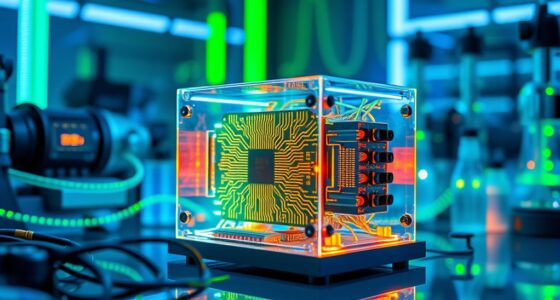
Advances in immersive technology now let you virtually honor fallen soldiers by recreating their stories and experiences. Using full-dive VR, we can simulate realistic battlefield environments, allowing us to understand their sacrifices better. AR recreations at historic sites foster emotional connections and remembrance. These tools also support healing, with VR therapy helping veterans cope with trauma. If you continue exploring, you’ll discover how these innovations preserve legacies and deepen our appreciation for those who served.
Key Takeaways
- VR and AR recreate realistic environments to honor and remember fallen soldiers through immersive experiences.
- Interactive storytelling and historical reconstructions allow visitors to virtually meet and learn about soldiers’ sacrifices.
- VR-based memorials enable emotional connections, fostering remembrance and healing for families and communities.
- Technologies like VRET assist in preserving soldiers’ stories and providing closure through simulated encounters.
- Digital reconstructions and immersive exhibits serve as educational tools to deepen understanding of military history and sacrifice.
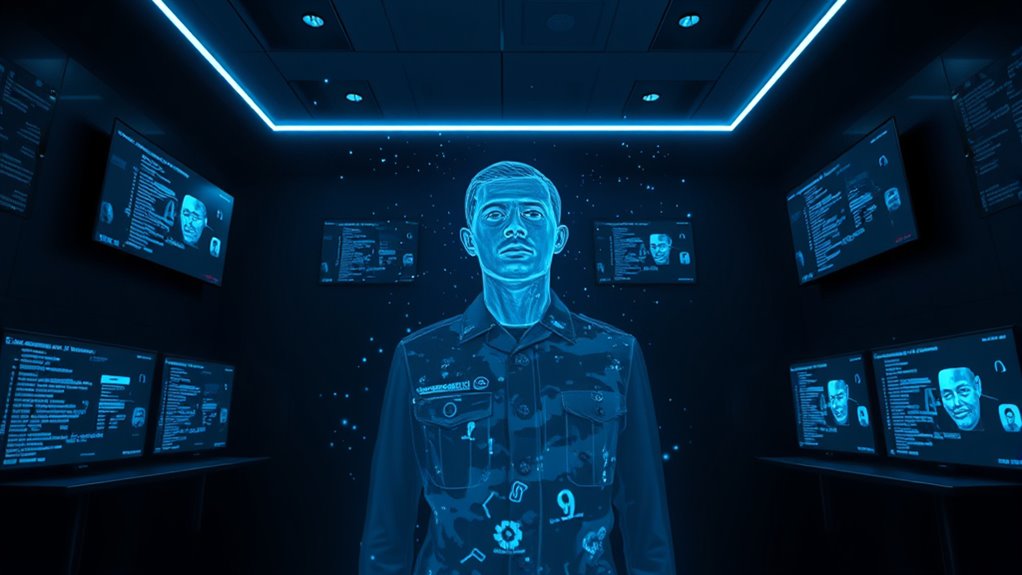
Advancements in immersive technology are revolutionizing how we honor and remember fallen soldiers. Today, virtual reality (VR) and augmented reality (AR) let you experience history and healing in ways that were unimaginable a few years ago. Military training, for instance, employs full-dive VR platforms that immerse warfighters in realistic environments, simulating mass casualty events and high-stress scenarios. These simulations trigger physiological responses, like increased heart rate and blood pressure, helping soldiers build resilience and teamwork skills in a safe setting. Future plans aim to test these systems with large operational teams, making training even more effective. Full Dive VR incorporates multisensory experiences, including tactile feedback and biometric monitoring, to enhance realism and effectiveness.
Beyond training, AR and VR are transforming rehabilitation processes for injured service members and civilians alike. These immersive tools support psychological and physical recovery, aiding patients with musculoskeletal issues by immersing them in 3D environments that promote balance and limb development. The physiological and psychological responses induced by these technologies often accelerate healing, leading to better outcomes. International studies confirm their effectiveness in clinical settings, making AR and VR valuable parts of modern rehabilitation programs. Additionally, the ability of these technologies to induce positive emotional responses can significantly improve patient motivation and engagement during recovery.
AR and VR enhance rehabilitation, accelerating healing through immersive psychological and physical recovery experiences supported by global clinical evidence.
Immersive technology also preserves history in compelling ways. Partnering with museums, VR experiences blend real footage with interactive storytelling, allowing you to explore airborne operations or battlefield stories from the past. These virtual exhibits connect you emotionally with history, making the sacrifices of fallen soldiers more tangible. They serve as powerful educational tools, investing in next-generation VR technology to ensure these stories are passed down to future generations.
In mental health care, VR exposure therapy (VRET) offers hope for those suffering from PTSD. Clinical trials demonstrate that VRET markedly reduces symptoms of anxiety and depression related to combat trauma, with benefits lasting well beyond treatment sessions. Compared to traditional therapies, VRET often yields better long-term results, helping veterans and civilians alike find relief and closure.
Finally, AR is enriching historical education by recreating battlefield scenes at historic sites. This hands-on approach enables visitors to engage directly with history, deepening their understanding of past conflicts. These technological advancements are not just about remembering the fallen — they are about bringing their stories to life, fostering healing, education, and remembrance through the power of immersive technology.
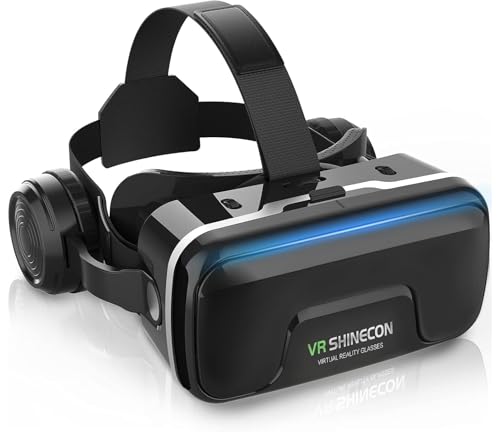
COCERKET VR Headset with Built-in Headphones, 120° FOV Aspheric Lenses for 4.7-7" Smartphones, 3D VR Glasses Adjustable Focus/IPD, Compatible iPhone Android
【2026 New Popular Design】This VR headset is the latest version, offering significantly improved comfort and focus accuracy. The…
As an affiliate, we earn on qualifying purchases.
As an affiliate, we earn on qualifying purchases.
Frequently Asked Questions
How Realistic Are the Virtual Representations of Fallen Soldiers?
The virtual representations of fallen soldiers are quite realistic, combining real-world footage with advanced CGI and accurate 3D reconstructions. You’ll notice detailed uniforms, authentic environments, and environmental sounds that boost immersion. While facial animations and movements rely on AI and motion capture, they’re approximations due to limited personal data. Overall, these reconstructions offer a compelling and respectful glimpse into soldiers’ experiences, though some details remain inevitably speculative.
What Ethical Concerns Arise From Resurrecting Soldiers Digitally?
You should consider that resurrecting soldiers digitally raises significant ethical issues. You might infringe on their autonomy if you lack explicit consent, and it could distort their legacy or disrespect cultural and religious beliefs. There’s also the risk of emotional harm to survivors, who may struggle with grief or dependency. Additionally, commercialization and legal ambiguities pose concerns, potentially exploiting or misusing their likeness without proper authorization or regard for their dignity.
Can These Virtual Soldiers Learn and Adapt Over Time?
Yes, these virtual soldiers can learn and adapt over time. Through AI-driven adaptive learning, they analyze your responses and modify scenarios dynamically, creating more realistic and challenging training. They track your performance to provide personalized feedback, which helps improve your decision-making skills. By continuously evolving based on your actions, these virtual soldiers ensure that your training remains relevant, immersive, and effective, preparing you better for real-world situations.
How Do Families Typically Respond to Virtual Reconnections?
You often feel a mix of joy, surprise, and deep emotion during virtual reunions. Tears, hugging, and heartfelt reactions are common as you reconnect with loved ones or remember fallen soldiers. While these moments bring relief and happiness, they can also evoke grief and unresolved feelings. You might experience anxiety or need time to adjust emotionally, especially if the virtual format highlights ongoing struggles or complex family dynamics.
Are There Limitations to the Technology’s Ability to Recreate Personalities?
Yes, there are significant limitations. You’ll find that technology struggles to accurately recreate a soldier’s personality because traits can change under stress, trauma, and over time. It’s challenging to capture deep emotions, moral injuries, and individual nuances from incomplete data. Plus, ethical concerns and privacy issues restrict full access to psychological details, making virtual personalities often simplified or static, and unable to fully reflect the complex, evolving nature of real human personalities.
AR historical reconstruction device
As an affiliate, we earn on qualifying purchases.
As an affiliate, we earn on qualifying purchases.
Conclusion
As you witness this breakthrough, you might wonder if bringing soldiers back digitally is truly progress or crossing a line. While technology offers a way to honor and remember those we’ve lost, it also raises questions about reality and ethics. Are we blurring the boundaries between life and artificial memory? Ultimately, it’s up to us to decide how far technology should go in reconnecting us with the past—and what it means for our future.

ACT-Informed Exposure for Anxiety: Creating Effective, Innovative, and Values-Based Exposures Using Acceptance and Commitment Therapy
As an affiliate, we earn on qualifying purchases.
As an affiliate, we earn on qualifying purchases.

The Military Metaverse
As an affiliate, we earn on qualifying purchases.
As an affiliate, we earn on qualifying purchases.