
TL;DR
SpaceX announced plans for two AI computing campuses, in Starbase, Texas, and Cochise County, Arizona, with more than $74 billion in planned investment. Local officials are scheduled to consider related proposals on Dec. 9, but key details—including Texas facility capacity and water use, and Arizona’s power arrangement—remain unresolved.
SpaceX said Nov. 12 it is advancing plans for two AI computing campuses in Starbase, Texas, and Cochise County, Arizona, describing them as more than $74 billion in planned investment. The proposals could bring construction and permanent jobs, while putting local decisions about power, water and tax incentives on the agenda; both projects still face local review.

Get business pricing on tech for your team
- Business-only prices and quantity discounts
- Tax-exempt purchasing
- Multiple users, one account, clear invoices
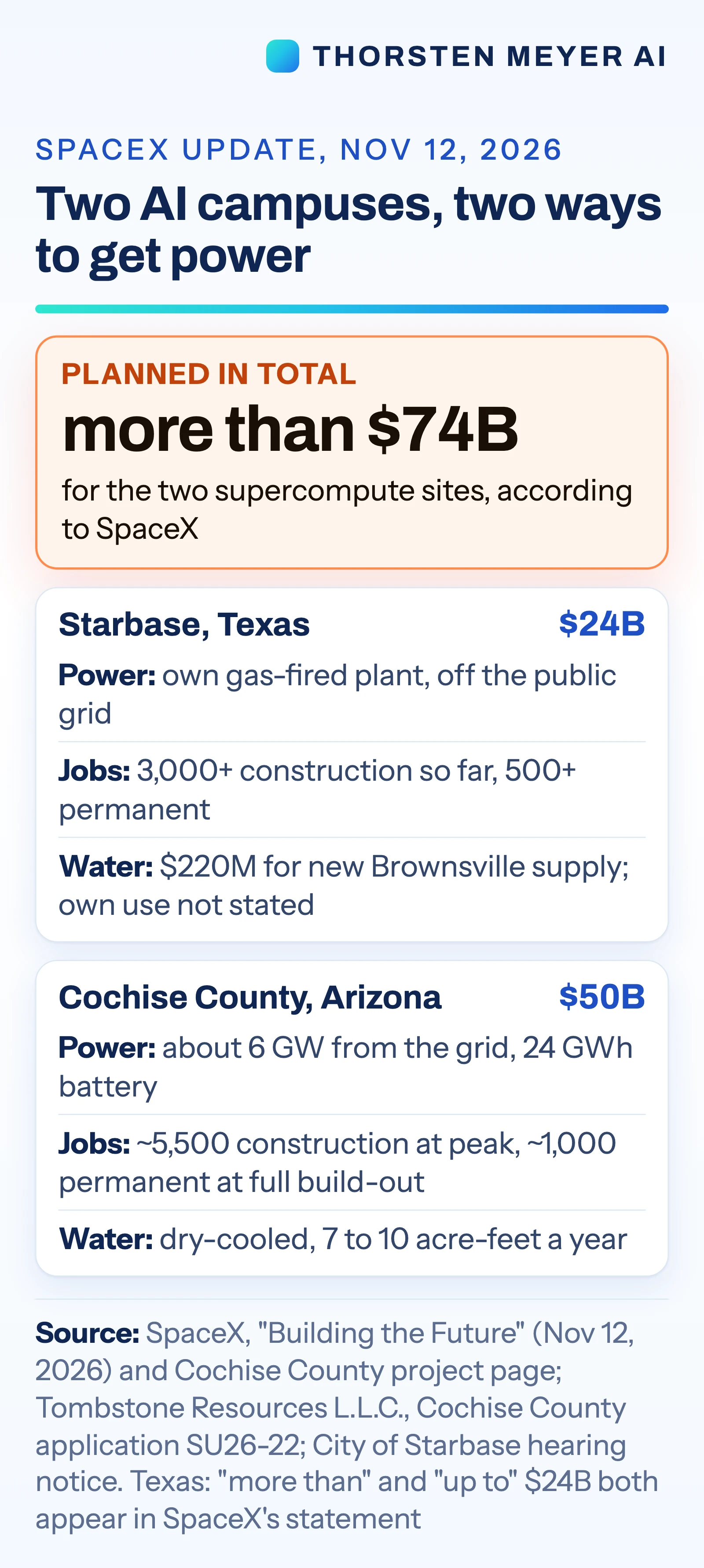
In Texas, SpaceX says it plans to invest more than $24 billion in a facility near the Port of Brownsville that would generate its own electricity instead of drawing from the public grid. A Starbase City Commission notice describes a gas-fired power plant and supercomputing facility on about 444 acres. It lists approximately $24 billion for the initial phases, with possible future expansions, but does not specify the computing facility’s capacity.
SpaceX says the Texas project has generated more than 3,000 construction jobs so far and is expected to support more than 500 permanent jobs once operational. The company also says it has committed $220 million to water and wastewater infrastructure for Brownsville and Cameron County, including $40 million already provided. The company has not stated how much water the computing site itself would use.
In Arizona, SpaceX describes a roughly $50 billion campus on about 747 acres near Cochise. The county application, filed by Tombstone Resources L.L.C., describes up to nine computing buildings, with a first phase of about 1,500 megawatts and a full build-out of approximately 6 gigawatts. The application proposes grid power delivered through local utilities, dry cooling and no cooling towers. It estimates water use at about 7 to 10 acre-feet per year, according to the source material.
Local Choices on Power and Water
The plans would put two communities at the center of a major expansion in AI computing infrastructure. The Arizona proposal’s stated full-build power demand of about 6 gigawatts makes utility arrangements a central question for residents and regulators. In Texas, an on-site gas-fired power plant could supply the campus without drawing from the public grid, while raising questions about its operating details and local effects.
Jobs and infrastructure spending are among the potential local benefits SpaceX cites. Those claims sit alongside decisions about tax treatment, energy supply and water. The projects’ scale means local approval processes will shape whether, and under what conditions, the proposals proceed.
Products Worth Considering

Bose QuietComfort Ultra Earbuds (2nd Gen), Wireless Noise-Cancelling Earbuds with Immersive Audio and Wireless Charging Case, Black

LG UltraGear 27G810A-B 27-Inch 4K UHD IPS Gaming Monitor

Samsung Odyssey G3 G30D 27-Inch FHD Gaming Monitor
As an affiliate, we earn on qualifying purchases.
From Orbital AI to Ground Campuses
SpaceX’s announcement follows its Feb. 2 announcement that it had acquired xAI. At that time, the company argued that growing electricity demand for AI could not be met with terrestrial solutions without hardship for communities and the environment, and pointed to data centers in orbit. SpaceX now presents the Texas site as also helping develop and test technologies for future space-based computing.
The two current proposals use different power approaches. SpaceX says the Texas facility would generate its own electricity; the Arizona application describes a campus supplied through the grid, with standby generators for outages and testing. In Arizona, the county documents name Tombstone Resources as applicant rather than SpaceX. The connection is indicated by SpaceX’s project page and Tombstone Resources’ notice for a community town hall.
““Together, they represent more than $74 billion in planned American investment.””
— SpaceX
Key Project Details Remain Open
Important operating and approval details are not settled in the available material. The Texas city notice does not give the power plant’s capacity, and SpaceX has not disclosed the computing facility’s water use. The source material reports turbine figures from an air registration obtained by The 956 Report, but those figures are not stated in the city notice or SpaceX’s announcement.
In Arizona, the application’s proposed grid supply and SpaceX’s promised lower power bills for local cooperative members depend on utility arrangements and regulatory decisions. It is not clear from the available documents whether the relevant electricity deal will be approved. The size of any Texas tax abatement is also not provided. Both projects remain subject to local review.
Dec. 9 Hearings Set
On Dec. 9, 2026, the Cochise County Planning and Zoning Commission is scheduled to hold a hearing on the Arizona proposal. The Starbase City Commission is also scheduled to consider a property tax abatement related to the Texas project. Those proceedings may clarify approval conditions and tax terms, though the available source material does not specify a final decision schedule for either campus.
Key Questions
How much does SpaceX say the two projects would cost?
SpaceX says the two campuses represent more than $74 billion in planned investment: more than $24 billion in Texas and roughly $50 billion in Arizona.
Where would the campuses be built?
The Texas proposal is for a site near the Port of Brownsville in Starbase. The Arizona application covers about 747 acres near Cochise along U.S. Highway 191.
How would the Arizona campus get power?
The application describes grid power delivered through the Sulphur Springs Valley Electric Cooperative and Arizona Electric Power Cooperative to a utility-owned substation on the site. The proposed full build-out is about 6 gigawatts.
What is unknown about water use?
SpaceX has not said how much water the Texas computing facility itself would use. The Arizona application describes dry cooling and estimates water use at about 7 to 10 acre-feet per year.
When will local officials consider the proposals?
The Cochise County Planning and Zoning Commission hearing and a Starbase City Commission consideration of a property tax abatement are scheduled for Dec. 9, 2026.
Source: Thorsten Meyer AI