
📊 Full opportunity report: Choosing A Postpartum Recovery Guide After Birth on IdeaNavigator AI — validation score, market gap, and execution plan.

Get business pricing on tech for your team
- Business-only prices and quantity discounts
- Tax-exempt purchasing
- Multiple users, one account, clear invoices
TL;DR
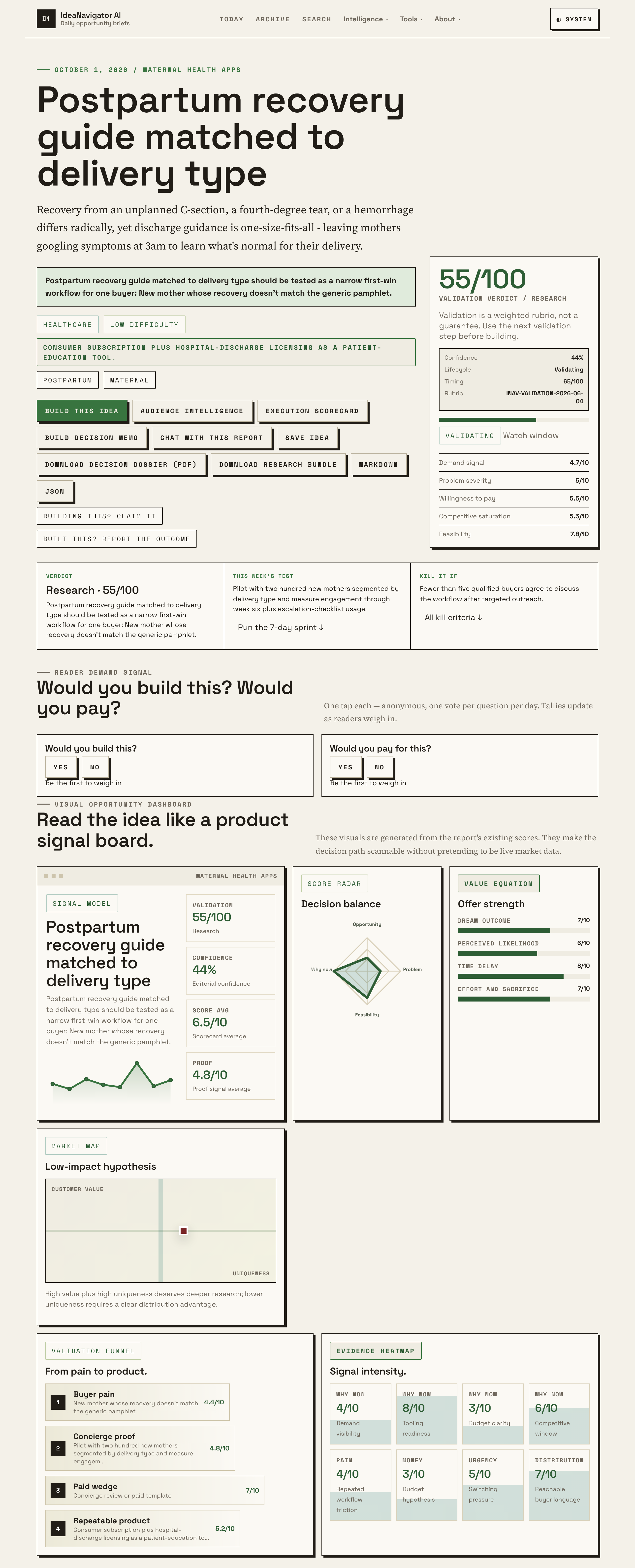
IdeaNavigator AI has outlined a proposed postpartum recovery guide that would tailor week-by-week information to a mother’s delivery details and complications. The concept includes warning-sign checklists and preparation for the six-week visit, but no product launch, clinical evaluation, or pilot results are reported.
IdeaNavigator AI has proposed a postpartum recovery guide that would tailor information to delivery details, including mode of birth, interventions, complications, and feeding. The concept targets mothers whose recovery does not fit generic discharge guidance, but it is a product proposal, not a reported launch or clinically tested service.
According to the IdeaNavigator AI proposal, the guide would begin with an intake covering a mother’s delivery mode and interventions, any complications, and feeding. It would then provide week-by-week recovery expectations for that profile, alongside warning-sign checklists and summaries to help prepare for the six-week postpartum visit. The proposal does not specify the clinical review process or how the guidance would be updated.
The proposal identifies its intended user as a new mother whose recovery differs from generic post-birth information. It names an unplanned C-section, a fourth-degree tear, and hemorrhage as examples of circumstances that can shape recovery. It argues that guidance organized around a single delivery category may leave some mothers without information that addresses their specific experience.
IdeaNavigator AI describes a suggested first test: a pilot with two hundred new mothers, grouped by delivery type. The proposed measures are engagement through week six and use of the escalation checklists. The proposal does not identify participating hospitals, a recruitment plan, pilot dates, results, or clinical oversight arrangements. It suggests a consumer subscription and licensing the tool to hospitals as a discharge education resource; these are proposed business models, not confirmed agreements.
Tailoring Guidance to Recovery
Postpartum recovery can involve different care needs depending on delivery and complications. A guide that organizes information around those details could make it easier for a mother to find relevant expectations and prepare questions for follow-up. The proposal’s focus on warning signs also places escalation information alongside routine recovery guidance, though the materials’ safety and usefulness have not been evaluated.
For hospitals, a licensed education tool could offer a way to provide information beyond a standard pamphlet. For families, a subscription could make tailored guidance available outside scheduled appointments. Those potential benefits depend on the content being clinically sound, accessible, and clear about when a symptom calls for professional care. The proposal provides no evidence yet on whether mothers would use the guide, whether hospitals would adopt it, or whether it would change care decisions.
The suggested pilot’s measures would address early engagement and checklist use, but those figures alone would not establish improved health outcomes. A fuller evaluation would need to explain how the guide handles urgent symptoms, whether advice is reviewed by qualified clinicians, and how it avoids delaying contact with a care team. Those questions matter because a digital guide would support postpartum care rather than replace individual medical assessment.
postpartum recovery guide for C-section
As an affiliate, we earn on qualifying purchases.
As an affiliate, we earn on qualifying purchases.
From Discharge to Week Six
The IdeaNavigator AI proposal describes a gap between the varied experiences of childbirth and one-size-fits-all discharge guidance. It says mothers may search online late at night to work out whether symptoms are expected, especially when their recovery does not match the standard information they were given. That is the proposal’s account of the problem; it provides no survey or usage data to measure how often this happens.
The proposal says postpartum care is receiving greater clinical attention and that new guidelines call for individualized follow-up. It does not name those guidelines, give publication dates, or quote their recommendations. Readers therefore cannot use this proposal alone to determine what current clinical guidance requires. The six-week visit is presented as a point the guide could help mothers prepare for, while the proposed weekly material would cover the period leading up to it.
Personalized maternal health information is the proposed product category. The idea’s distinguishing feature, as described by IdeaNavigator AI, is to use delivery details and complications to shape the guide, rather than treating birth as a single event type. The proposal gives no product name, interface, clinical partner, pricing, or evidence that a similar service is unavailable. It presents a testable product direction, rather than a finding about the wider market.
As an affiliate, we earn on qualifying purchases.
Clinical Review and Pilot Status
No pilot has been reported, and the IdeaNavigator AI proposal does not say whether development has started. It gives a target sample of two hundred mothers but does not identify a study site, recruitment method, comparison group, or timeline. It also does not define how engagement or checklist use would be measured, or what results would count as a successful test.
The clinical basis for the week-by-week expectations and warning signs remains unspecified in the proposal. It does not identify reviewers, explain how recommendations would differ by complication, or describe how the guide would respond when symptoms require urgent attention. Its references to individualized follow-up guidelines are not detailed enough to verify which guidance it means.
The proposal also leaves unclear how the tool would protect health information collected during intake, handle users with multiple complications, or support languages beyond English. Pricing, hospital licensing terms, and partnerships are not reported. These points remain open because IdeaNavigator AI describes an MVP and validation plan rather than a completed product.
As an affiliate, we earn on qualifying purchases.
Testing the Proposed Guide
IdeaNavigator AI names testing with two hundred mothers grouped by delivery type as the next step, tracking engagement through week six and use of escalation checklists. The proposal gives no start date or recruiting organization. Before interpreting such a pilot, readers would need details on how participants are selected, how the guide’s clinical content is reviewed, and how checklist use is recorded.
If the pilot proceeds, the proposed measures could show whether participants return to the guide and consult its escalation information. They would not, on their own, show that the guide improves recovery or replaces clinical follow-up. The proposal identifies consumer subscriptions and hospital discharge licensing as possible routes to market, but reports no sales, contracts, or adoption commitments. Whether the idea advances beyond planning remains unknown.
Source: IdeaNavigator AI
As an affiliate, we earn on qualifying purchases.
Key Questions
Has the postpartum guide launched?
No launch is reported. The IdeaNavigator AI concept describes a proposed minimum viable product and a pilot, with no release date or product details.
What information would the guide use?
The proposal says the intake would cover delivery mode, interventions, complications, and feeding. It does not describe privacy practices or how the guide would handle overlapping complications.
What would the pilot measure?
The proposed pilot would include two hundred mothers segmented by delivery type and track engagement through week six and use of escalation checklists. The IdeaNavigator AI proposal reports no findings or schedule.
Would the guide replace medical care?
The proposal describes a patient-education tool, not a substitute for professional care. It does not explain its clinical review process or how it would direct users with urgent symptoms to care.
Source: IdeaNavigator AI
Fall Picks
fall essentials
As an affiliate, we earn on qualifying purchases.