

In structured tasks like face recognition, data extraction, and speech processing, machines generally make fewer errors than humans, especially in controlled environments. They excel at consistent pattern detection and quick processing, reducing mistakes caused by fatigue or distraction. However, humans perform better with complex, unpredictable visuals and adapt more easily to new situations. To discover how these differences impact various fields, explore further insights below.
Key Takeaways
- Machines generally make fewer systematic errors and perform consistently, especially in repetitive data processing tasks.
- Humans excel in complex, context-dependent recognition, reducing mistakes in ambiguous or unpredictable situations.
- Machine errors are predictable and easier to detect and correct, whereas human errors are more variable and influenced by psychological factors.
- In recognition and data extraction, machines often surpass humans in accuracy, but humans outperform in nuanced understanding and judgment.
- Overall, machines tend to make fewer mistakes in structured, routine tasks, while humans excel in complex, contextual scenarios.

eufy Security SoloCam E42, 4K Solar Security Camera, AI Facial Recognition
- Ultra HD 4K Resolution: Captures detailed 4K footage around your home
- License Plate Recognition: Recognizes license plates up to 33 ft away
- AI Motion Detection: Detects and tracks people and vehicles automatically
As an affiliate, we earn on qualifying purchases.
As an affiliate, we earn on qualifying purchases.
Accuracy in Face Recognition: Humans vs. Machines

Since 2005, face recognition algorithms have been systematically compared to human performance, revealing that most machines now outperform humans on average difficulty datasets. You might notice that machines excel at frontal-to-frontal identity matching, often surpassing human accuracy. They’ve made significant progress with deep learning, especially since 2013, handling challenging “in-the-wild” images with high precision. However, humans still outperform machines on matching frontal-to-profile images, showing pose-related limitations for machines. Commercial systems now achieve accuracy rates over 99%, but their performance depends on image quality and demographics. While machines excel in many scenarios, they still struggle with low-quality images and pose variations. Overall, machines have become highly accurate, but some tasks remain challenging compared to human perception. Recent advancements in explainability and fairness continue to shape the development of face recognition technology, especially as technology evolves.
As an affiliate, we earn on qualifying purchases.
Learning Efficiency and Error Rates in Visual Tasks

Advances in machine vision have considerably improved accuracy and learning efficiency through the use of deep learning, AI, and neural networks. You benefit from machines that identify objects with greater precision and speed, especially in structured tasks like product inspection. AI models mimic brain processes for pattern recognition, boosting visual processing complexity. Deep learning accelerates data handling and reduces errors in repetitive tasks, but models like CNNs struggle with data shifts outside their training, lowering accuracy. Humans, however, outperform machines on complex real-world images and adapt better to visual variations. While CNNs show consistent errors and positional biases, humans display more varied, flexible mistakes. Overall, machine learning has advanced, but humans still excel in learning efficiency and error management in challenging visual environments. The ability of machine vision to process large volumes of data rapidly continues to expand, further enhancing its role in various industries. Additionally, ongoing research aims to improve the robustness of machine learning models against unexpected visual inputs, helping to close the gap in performance.
machine learning image analysis tool
As an affiliate, we earn on qualifying purchases.
As an affiliate, we earn on qualifying purchases.
Performance Disparities in Text and Data Extraction

AI systems excel at automating text extraction and classification, often surpassing human performance due to their ability to analyze large datasets quickly and consistently. When comparing accuracy, you see that:
AI systems outperform humans in automating text analysis, achieving higher accuracy and consistency.
- AI models achieve 85% to 95% accuracy, reliably identifying AI- or human-generated content.
- Precision often exceeds 90%, minimizing false positives in detection.
- Recall varies widely from 28% to over 93%, affecting how many AI texts are spotted.
- Humans perform near random guessing (~53%), struggling to detect AI artifacts without computational aid. Pattern recognition is a key advantage that machines utilize in these tasks.
While humans excel in contextual understanding, they falter with subtle AI patterns. Conversely, machine models leverage pattern recognition and scalability, often outperforming humans in large-scale, nuanced text classification tasks. Detection techniques are continually evolving to address the increasing sophistication of AI-generated texts.
automated speech recognition device
As an affiliate, we earn on qualifying purchases.
As an affiliate, we earn on qualifying purchases.
Speech Recognition: Comparing Error Patterns
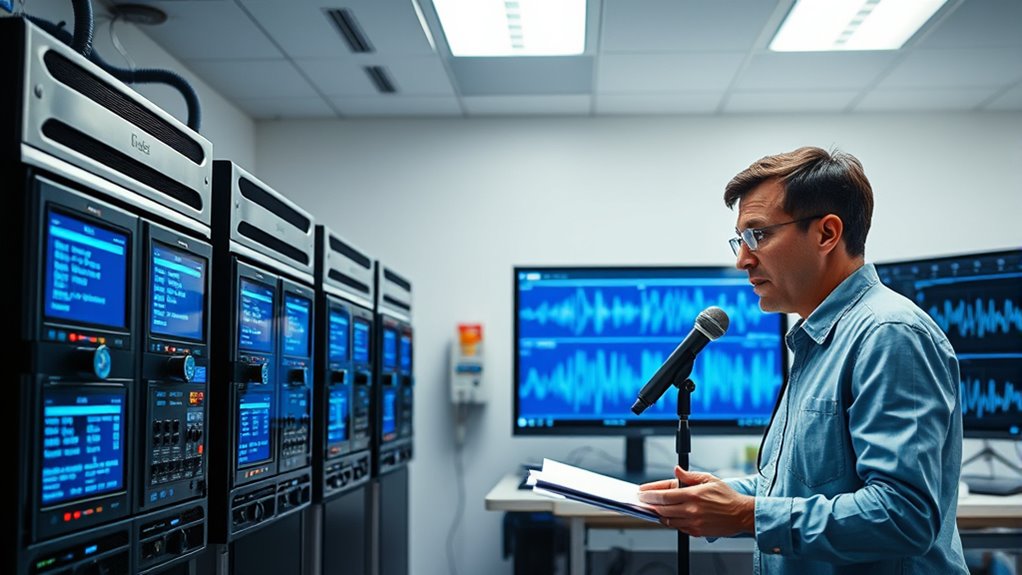
When comparing error patterns in speech recognition, it becomes clear that humans and machines tend to make different types of mistakes, especially under ideal conditions. Humans typically miss words, especially fillers, discourse markers, and backchannels in conversation, with error rates around 1–2%. Machines, however, are more prone to substitutions and insertions, with error rates often between 5–15%. In quiet environments, human errors focus on missing non-essential words, while machines struggle with both content and non-content words, especially in challenging audio. Multi-speaker scenarios cause machines to perform poorly, with error rates up to 65%. Humans leverage context and knowledge to correct mistakes, whereas machines lack this ability, making their errors more static and less adaptable to conversational nuances. Additionally, advances in error analysis techniques help identify specific weaknesses and improve speech recognition performance.
Standards and Ethical Considerations for AI Error Tolerance

You need to understand how setting error thresholds for AI varies depending on the context, balancing safety and performance. Ethical considerations require transparency and fairness when mistakes happen, especially to prevent harm or bias. Clear standards help define acceptable error levels, but these must adapt to specific applications and societal values. Assessing risk tolerance is essential in establishing appropriate error thresholds to ensure responsible AI deployment. Incorporating relationship dynamics can also influence how error tolerance is perceived, especially in systems involving human interactions.
Defining Acceptable Error Thresholds
Establishing acceptable error thresholds for AI systems is crucial to balancing performance, safety, and ethical considerations. You need clear standards to guide development and deployment. Think of these thresholds as benchmarks:
- Setting a maximum error rate, like less than 1% in customer service AI, to ensure reliability.
- Defining downtime limits, such as not exceeding 0.5%, to maintain operational continuity.
- Disaggregating metrics across data segments to detect bias and ensure fairness.
- Tying thresholds to business impact, like customer satisfaction or operational efficiency, for meaningful performance.
These benchmarks help identify when corrective actions are necessary. They also ensure AI systems maintain integrity without compromising safety or fairness, aligning technical goals with organizational standards. Rigorous testing and validation are essential to verify that these thresholds are met under various conditions and to continuously improve system robustness. Additionally, incorporating performance metrics derived from comprehensive testing can aid in early detection of issues and guide ongoing refinements.
Ethical Implications of Mistakes
Ensuring AI systems operate ethically requires setting clear standards for error tolerance that prioritize fairness, transparency, and safety. You must minimize biases from data, algorithms, or systemic issues to prevent unfair impacts on marginalized groups. Bias mitigation isn’t just about accuracy; it’s about producing balanced outcomes that reflect diverse perspectives. Transparency in decision-making helps stakeholders understand how errors happen, fostering trust. Accountability mechanisms ensure organizations investigate and address mistakes promptly, maintaining ethical integrity. Additionally, protecting privacy and adhering to regulations like GDPR are essential to prevent errors from causing data breaches or misuse. Safety and security measures, including resilient design and fail-safes, reduce risks in critical sectors. Engaging diverse stakeholders guarantees that ethical concerns surrounding AI mistakes are recognized and addressed responsibly. Implementing robust data governance policies is crucial for managing data ethically and responsibly, further supporting error reduction and ethical compliance.
Context-Dependent Error Standards
Understanding that error tolerance standards for AI must be context-dependent is essential because different environments and tasks demand varying levels of accuracy and safety. You need to contemplate factors like:
- Tailoring neural networks to specific environments, reducing parameters while lowering errors.
- Intensifying training where detection is more challenging, such as rocky versus grassy terrains.
- Excluding irrelevant classes, like not searching for birds on rocky lands, to cut false positives.
- Using dynamic “Lens” models that adapt recognition based on overlapping situations.
- Incorporating continuous learning methods ensures models adapt to new data and maintain accuracy over time.
It is also important to regularly update models with new data to maintain accuracy over time. These strategies help optimize performance for each context, ensuring AI’s errors stay within acceptable limits. Recognizing the environment’s influence allows you to set flexible standards, balancing safety, efficiency, and reliability in real-world applications.
Analyzing Error Variability and Consistency

You need to understand how error patterns differ between humans and machines to improve reliability. Human errors fluctuate with fatigue and task complexity, leading to inconsistent performance, while machines tend to be more stable but can still vary due to tuning. Recognizing these differences helps in designing systems that leverage each’s strengths for better overall accuracy. Making errors is a natural part of human development and an inherent aspect of human learning, which influences how we perceive and accept mistakes in both humans and machines. Additionally, understanding the error variability associated with different practices can guide the implementation of mindfulness techniques that promote focus and reduce mistakes in high-stakes environments.
Error Variability Patterns
Analyzing error variability patterns reveals fundamental differences between human and machine systems in how they produce and manage errors. You can think of it like this:
- Humans generate errors from cognitive lapses—forgetfulness, inattention, or stress—leading to unpredictable, high variability.
- Machine errors are more systematic, often tied to training data, algorithms, or rule limitations, creating predictable patterns.
- Human error variability fluctuates due to psychological and motivational factors, making errors less consistent across situations.
- Machine errors, however, follow stable, identifiable patterns, simplifying detection and correction.
- Studies show that these error patterns can be quantitatively analyzed to better understand and improve system performance.
- Recognizing these error patterns allows for targeted interventions and more efficient troubleshooting strategies.
While humans show diverse error types and frequencies, machines tend to have recurring mistakes. This difference influences how you assess, measure, and improve performance in human versus machine interactions.
Consistency in Performance
When comparing the consistency of human and machine performance, it becomes clear that machines generally deliver more stable results across different conditions. ML classifiers maintain high accuracy regardless of data variations, showing strong robustness. In contrast, human classifiers often fall below a kappa value of 0.4, indicating low consistency. Machines can process large datasets rapidly once trained, providing steady performance under similar conditions. Humans require extensive training and more time, with performance vulnerable to fatigue and attention lapses, leading to variability. While humans learn pattern recognition quickly initially, their accuracy plateaus, and their error rates remain relatively static. Machines, on the other hand, improve with additional data, resulting in more consistent long-term performance. This stability makes machines more reliable for tasks demanding uniform accuracy.
Practical Implications of Human and Machine Mistakes

Human and machine mistakes have significant practical implications across industries, affecting accuracy, safety, and costs. You can imagine:
Human and machine errors profoundly impact safety, costs, and accuracy across industries.
- A small data entry error causing millions in financial losses.
- Misinterpreted medical images leading to incorrect diagnoses or surgeries.
- Human errors causing workplace accidents, job losses, or legal fines.
- AI mistakes eroding user trust and hindering technological adoption.
While machines make fewer errors—up to 100 times less than humans—errors still happen, especially in specialized tasks. Human mistakes often result in costly consequences, such as faulty data, safety hazards, or compliance issues. Conversely, machine errors tend to be less frequent but can have severe outcomes when they occur. Recognizing these implications helps you understand the importance of error mitigation in critical systems and workflows. Understanding the relative frequency and impact of errors underscores the need for robust safeguards in both human-centric and automated processes.
Frequently Asked Questions
How Do Error Types Differ Between Humans and Machines?
You might notice that humans and machines make different types of errors. Humans often make random mistakes due to fatigue or distraction, like missed catches or incorrect actions. Machines tend to have systematic errors caused by hardware failures or software bugs, such as incorrect processing or sensor limitations. While both can produce similar errors like substitution or omission, humans are more prone to errors influenced by mental state, and machines by design flaws or technical faults.
What Factors Influence Machine Learning Efficiency in Error Reduction?
Factors influencing machine learning efficiency in error reduction include choosing the right techniques like ensemble methods, cross-validation, and transfer learning. You should focus on improving model complexity, tuning hyperparameters, and enhancing feature representation to minimize reducible errors. Managing data quality with proper validation and stratification is essential. Keep in mind, some errors are irreducible, so understanding their nature helps you set realistic expectations and optimize your approach effectively.
How Do Contextual Factors Impact Human Versus Machine Mistake Rates?
Imagine you’re in a busy hospital, where stress and distractions are high. Context substantially impacts mistake rates: humans are prone to errors under pressure or fatigue, while machines remain unaffected by environmental factors. For example, during emergencies, human errors spike, but automated systems maintain consistent accuracy. So, in complex or stressful settings, machines tend to make fewer mistakes, demonstrating their ability to handle challenging environments better than humans.
Are There Tasks Where Humans Consistently Outperform Machines?
You’ll find that humans consistently outperform machines in tasks requiring nuanced understanding, flexible reasoning, and contextual judgment. When dealing with complex language, ambiguous situations, or subtle inferences, humans make fewer errors because of their experiential knowledge and adaptability. Machines still struggle with these areas, especially in interpreting diverse texts or handling changing conditions. So, in tasks demanding intuition and common sense, humans remain the more reliable choice.
What Are the Long-Term Implications of Machine Errors in Critical Systems?
Imagine the year 2024, and you’re relying on a self-driving car. Machine errors in critical systems can cause catastrophic outcomes, like accidents or outages, that ripple long term. Your safety depends on continuous monitoring, but undetected faults could lead to cascading failures, increased costs, and loss of trust. Over time, these errors might trigger stricter regulations, forcing you to balance automation’s benefits with its risks, shaping future safety standards.
Conclusion
Imagine steering a dense forest—humans tread carefully, often pausing to check their path, while machines rush ahead, sometimes missing hidden roots. Both can stumble, but understanding where each falters helps you choose your guide wisely. In this landscape, humans offer cautious wisdom, and machines provide swift precision. Recognizing their mistakes isn’t about favoring one over the other, but about forging a path where both work together, guiding you safely through the unknown.