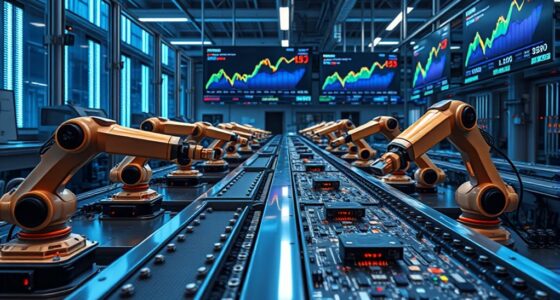
Past automation waves show you that proactive planning and adaptation are key to steering change successfully. Investing in education, retraining, and diversifying your economy can cushion the impact of technological shifts. Technologies that complement human work help prevent widespread unemployment and create new opportunities. By learning from history, you can develop strategies that turn technological progress into societal benefits. To discover how these lessons can shape your future, keep exploring the insights below.
Key Takeaways
- Past automation waves show that economic diversification reduces regional vulnerabilities and fosters resilience during technological shifts.
- Building adaptable skills and continuous learning has historically enabled workers to transition smoothly through automation.
- Proactive policies and early investments in education mitigate unemployment and societal disruption caused by technological change.
- Diversifying industries into services, tech, and creative sectors helps economies capitalize on new automation-driven opportunities.
- Lessons from history emphasize the importance of human-centric automation to enhance productivity without widespread job loss.
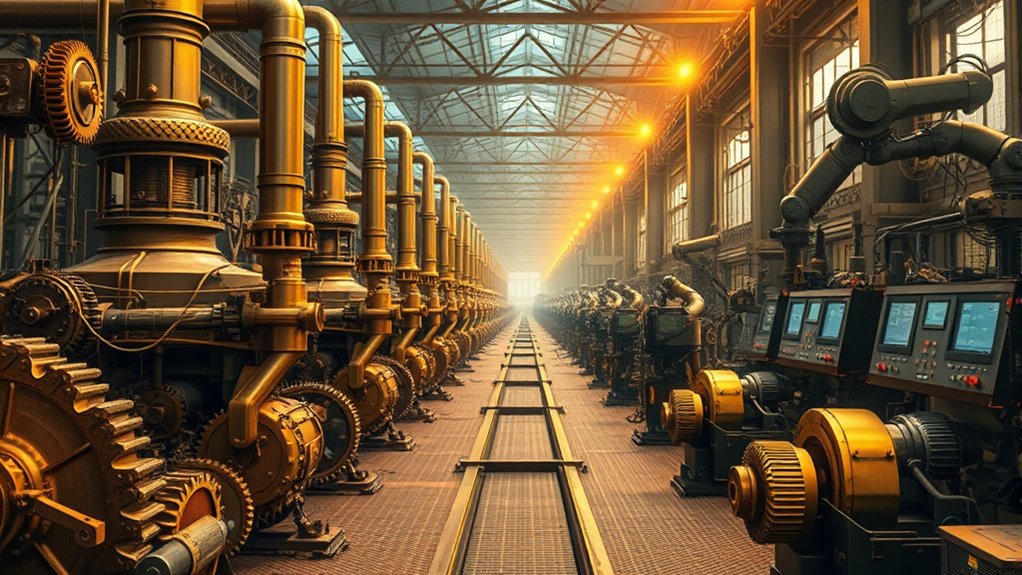
History offers us valuable lessons that can guide our actions today. When examining past automation waves, it’s clear that industries and societies have faced similar challenges and opportunities. One key takeaway is the importance of fostering technological resilience—building systems and skills capable of adapting to rapid technological change without collapsing. During previous industrial revolutions, societies that invested in flexible infrastructure and continuous learning were better able to withstand disruptions. You can see how technological resilience isn’t just about keeping pace with automation but about creating a robust foundation that can evolve alongside emerging technologies. This resilience helps prevent economic shocks and guarantees stability, especially for workers whose roles are most vulnerable to automation. Additionally, promoting active engagement among workers and policymakers can facilitate smoother transitions and innovation.
Another essential lesson is the need for economic diversification. Relying heavily on a single industry or sector leaves economies exposed when automation transforms that sector. For example, when manufacturing automation accelerated in the 20th century, regions overly dependent on manufacturing jobs faced severe unemployment and social upheaval. Conversely, economies that diversified—investing in services, technology, and creative industries—weathered transitions more smoothly. As you look to the future, you should understand that diversification isn’t just a safety net; it’s a strategic move that positions you to capitalize on new opportunities created by automation. By broadening economic bases, societies can distribute risk and foster innovation across multiple sectors.
Learning from history also highlights the importance of proactive policies. Governments and businesses that anticipated automation’s impact and invested in education and retraining programs helped their workforces adapt more effectively. When workers are equipped with new skills, the disruptive effects of automation diminish, and economies can transition more seamlessly. You should recognize that fostering continuous learning and skill development is essential for long-term resilience. It’s about creating an environment where people are prepared for change rather than reacting to it after the fact.
Furthermore, history shows that technological progress need not lead to widespread unemployment if managed wisely. When automation complements human labor instead of replacing it entirely, productivity rises without sacrificing employment. This balance requires deliberate strategies—such as incentivizing innovation that enhances human work and designing social safety nets that support displaced workers. You’re encouraged to see the potential for automation to generate new roles and industries, provided careful planning accompanies technological advancements.
In essence, understanding past automation waves reveals that resilience, diversification, proactive policies, and a focus on human skills are fundamental. These lessons empower you to navigate future technological shifts confidently, ensuring that progress benefits everyone and minimizes societal upheaval. By applying these insights, you can help shape a future where automation enhances human life rather than undermines it.
online retraining courses
As an affiliate, we earn on qualifying purchases.
As an affiliate, we earn on qualifying purchases.
Frequently Asked Questions
How Have Past Automation Waves Affected Income Inequality?
Past automation waves have widened income disparity and increased wealth concentration, often benefiting those with advanced skills or capital. You might find that automation displaces lower-skilled jobs, pushing workers into lower income brackets. Meanwhile, wealth tends to concentrate among early adopters and tech owners, fueling economic inequality. Recognizing this pattern helps you understand that future automation could deepen these disparities unless policies address income disparity and promote equitable wealth distribution.
What Industries Were Most Impacted by Previous Automation Shifts?
You see, during the manufacturing revolution and agricultural mechanization, industries like textiles, steel, and farming felt the seismic shifts firsthand. Machines replaced manual labor, transforming production lines into bustling hubs of automation. These waves swept through factories and farms, reshaping economies and workforces. You can imagine gears turning and fields sprawling under new machinery, marking a pivotal chapter where technology rewrote the rules of industry and labor.
How Did Societies Adapt Culturally During Past Technological Revolutions?
You saw societies adapt culturally during past technological revolutions by embracing change and fostering resilience. As new tools and systems emerged, communities engaged in technological adaptation, learning new skills and shifting social norms. Cultural resilience played a key role, helping people overcome fears and uncertainties. This continuous adjustment allowed societies to thrive amid innovation, demonstrating that flexibility and openness to change are essential for successfully steering technological shifts.
What Role Did Government Policies Play in Managing Automation Transitions?
Think of government policies as the steering wheel during automation shifts. They shape regulatory frameworks that guide technological change and foster public-private partnerships to ease progressions. For example, during the Industrial Revolution, governments introduced labor laws and education programs that helped workers adapt. Your role is to support policies that balance innovation with social stability, ensuring automation benefits everyone and avoids leaving people behind.
Can History Predict Which Jobs Will Be Most Affected by Future Automation?
History can provide insights into which jobs are most vulnerable to future automation through predictive models analyzing past job displacement patterns. You can expect repetitive, routine tasks to be most affected, as automation quickly replaces manual labor. While history offers guidance, it’s not foolproof—technological breakthroughs and societal shifts can alter trends. Stay adaptable and keep skills updated to navigate the evolving job landscape effectively.

School Zone Thinking Skills Workbook: 64 Pages, Preschool, Kindergarten, Problem-Solving, Logic & Reasoning Puzzles, Ages 3 to 5 (Get Ready! Book Series)
Workbooks-Thinking Skills Grade P
As an affiliate, we earn on qualifying purchases.
As an affiliate, we earn on qualifying purchases.
Conclusion
Just as past automation waves reshaped societies like rivers carving new paths, your future will flow with change. History whispers that innovation isn’t a tide to fear but a current to ride—crafting new opportunities amid the shifting currents. Embrace the lessons learned, and you’ll navigate the evolving landscape with confidence. Like a seasoned sailor adjusting to changing winds, you can steer your course toward growth and resilience in the ever-changing sea of automation.

2017 US Department of Labor Employment Workshop Participant Guide: Transition from Military to Civilian Workforce
As an affiliate, we earn on qualifying purchases.
As an affiliate, we earn on qualifying purchases.