
Executive summary
Artificial‑intelligence (AI) workloads are reshaping the data‑centre industry. AI “factories” built around large language models and GPU clusters require megawatt‑scale racks and billions of transactions per second. The resulting power demand is growing at a rate that conventional low‑voltage power architectures cannot accommodate. AI‑centric data centres already consume roughly 460 terawatt‑hours (TWh) per year, a figure that is expected to more than double to 1,000 TWh by 2026 and represent 8 % of global electricity by 2030navitassemi.com. At the same time, transformer supply chains are under strain—North American utilities have warned that distribution‑transformer demand may need to increase 160–260 % by 2050 to support electrificationrenewableenergyworld.com. To meet the AI power challenge, the industry is moving toward high‑voltage direct‑current (HVDC) distribution and solid‑state transformers (SSTs) built with wide‑bandgap semiconductors.
This white paper explains how SST technology and 800 V DC architectures combine to deliver efficiency, scalability and resilience for next‑generation AI data centres. It summarises the underlying technology, quantifies the benefits, highlights recent industry initiatives and examines adoption challenges and opportunities. The report draws on peer‑reviewed research, industry announcements and data‑centre case studies and is intended for power‑system architects, data‑centre operators and policymakers.
1 AI power demands and the limits of traditional infrastructure
Modern AI platforms such as ChatGPT and generative‑AI models run on GPU clusters with tens of thousands of accelerators. Their power consumption has outpaced the 54 V in‑rack DC distribution used in conventional data centres. A standard rack designed for enterprise servers supports a few hundred kilowatts; AI racks are moving toward 1 MW and beyond. Delivering a megawatt through 54 V conductors requires currents of ~18 kA, demanding large copper busbars and dozens of power supplies. The Navitas white paper notes that powering a 1 MW rack with 54 V busbars would require over 200 kg of copper and multiple AC/DC conversionsnavitassemi.com. As AI power levels rise, this low‑voltage architecture becomes infeasible; copper, thermal and reliability constraints would cripple the rack design.
High‑voltage DC distribution is emerging as the replacement. By converting incoming grid power (typically 13.8–34.5 kV AC) directly to 800 V DC, data centres can reduce current by an order of magnitude and cut copper consumption by ~45 %, while improving end‑to‑end efficiency by up to 5 % and lowering maintenance costs by 70 %navitassemi.comhpcwire.com. Each 800 V rack draws only 1.25 kA at 1 MW. The architecture centralises power conversion outside the rack, which eliminates thousands of individual power‑supply units (PSUs) and fans, simplifying cooling and improving reliabilityhpcwire.com. Row‑level busways can transmit 85 % more power through the same conductor size because the higher voltage reduces resistive losseshpcwire.com. These gains make HVDC the cornerstone of AI data‑centre design.
Yet HVDC alone does not solve the medium‑voltage (MV) interface problem. Conventional line‑frequency transformers step down MV AC (13.8 or 34.5 kV) to 480 V AC and then to 54 V DC through multiple stages. These 50/60 Hz transformers are bulky, heavy and passive. They offer no real‑time control, generate harmonics and are not bidirectional. The additional conversion stages introduce losses and require large switchgear, making it difficult to build modular, high‑density AI facilities.
2 Solid‑state transformer (SST) technology
Solid‑state transformers replace the iron‑core, low‑frequency transformer with a power‑electronic, high‑frequency converter that directly interfaces MV grids with LV or DC loads. A typical SST uses three stages (Fig. 1):
- Input stage (AC/DC rectifier). Wide‑bandgap devices such as silicon‑carbide (SiC) or gallium‑nitride (GaN) MOSFETs convert three‑phase MV AC into a regulated DC link. High switching frequencies (tens of kHz) allow much smaller magnetic and filtering components compared with 50/60 Hz designspowermag.com.
- Isolation stage (DC–DC with high‑frequency transformer). The DC link feeds a medium‑frequency transformer (tens of kHz) providing galvanic isolation and voltage scaling. Because the transformer operates at high frequency, its size and weight drop by up to 90 % compared with conventional unitsnpcelectric.com. Digital control regulates the power flow and protects against faults.
- Output stage (inverter or DC/DC converter). The isolated DC is converted to either low‑voltage AC or controlled DC (e.g., 800 V DC). Advanced topologies (e.g., input‑series output‑parallel (ISOP) modules) allow stacking of multiple modules to achieve higher voltages and power ratingsnavitassemi.com.
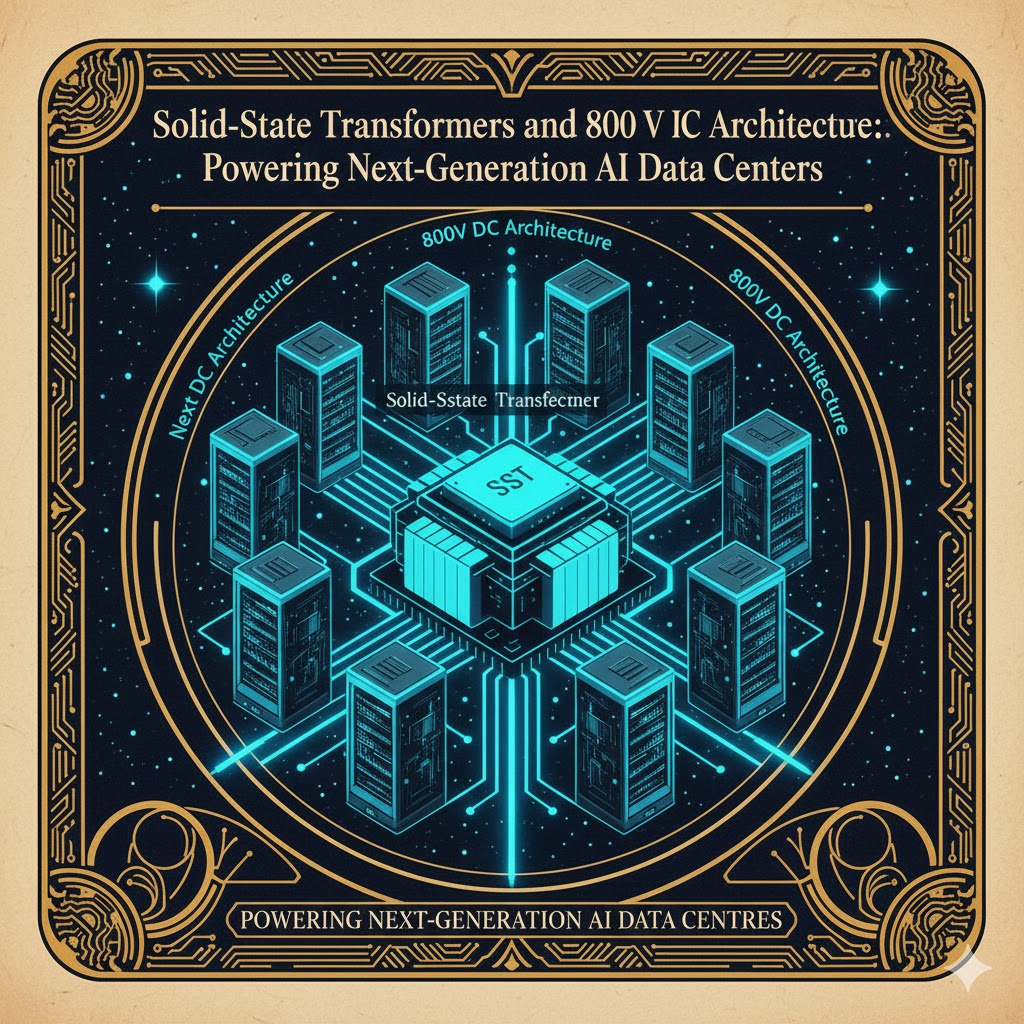
The architecture is actively controlled and bidirectional. Through embedded sensors and digital processors, the SST can regulate voltage and frequency, compensate reactive power, suppress harmonics, limit fault currents and enable bidirectional power flow, making it suitable for microgrids and integration of renewable energy and batteriespowermag.com. Figure 1 illustrates a conceptual SST converting MV AC to 800 V DC for AI racks. The rectifier and high‑frequency transformer are controlled via digital processing, and the output feeds the 800 V DC bus.
2.1 Technology enablers
For decades SSTs remained laboratory curiosities because silicon‑based power switches could not handle MV at high frequencies. The advent of wide‑bandgap semiconductors has changed this. SiC MOSFETs and GaN FETs switch faster and withstand higher voltages than silicon devices, reducing switching losses and enabling high‑frequency operation. Navitas highlights that its 3300 V and 2300 V SiC MOSFET modules simplify power‑converter stacks for 34.5 kV or 13.8 kV inputs, enabling ISOP SST architectures that convert MVAC directly to 800 V DCnavitassemi.com. GeneSiC’s trench‑assisted planar SiC MOSFETs deliver high reliability and low on‑resistance, making them suitable for mission‑critical SSTs that must operate continuously for 20 yearsnavitassemi.com. By operating at tens of kilohertz, SSTs reduce magnetic size and weight, increase power density and allow modular designs that can be hot‑swapped or stacked for higher power.
2.2 Performance advantages
Compared with line‑frequency transformers, SSTs offer several key benefits:
- High efficiency. SST prototypes achieve 97.5–99 % efficiency; NPC Electric reports that an SST can save 87 MWh per year for a 1 MW data centre at 20 % loadnpcelectric.com. SolarEdge and Infineon aim for >99 % efficiency in their 2–5 MW SST modulescompoundsemiconductor.net.
- Reduced size and weight. High‑frequency transformers shrink the magnetic core and reduce mass by up to 90 %npcelectric.com. NPC Electric notes that data‑centre SSTs can reduce occupied area by 50 %npcelectric.com. These gains free valuable floor space for compute racks.
- Improved power quality and control. SSTs provide unity power factor, harmonic filtering (total harmonic distortion < 5 %) and dynamic voltage regulationnpcelectric.com. They actively limit fault currents, offering faster protection than passive transformerspowermag.com.
- Bidirectional power flow. Unlike traditional transformers, SSTs can route energy from batteries or solar PV back into the grid. Their multi‑port capability allows simultaneous connection of MV grid, renewables and DC loadsdgmatrix.com.
- Integration of distributed energy resources (DERs). Because the output is programmable, SSTs can connect directly to battery energy storage systems (BESS), EV megawatt chargers or PV inverters, enabling microgrid functionality. Navitas notes that SST technology is poised to modernise grid infrastructure across BESS, EV megawatt charging systems and renewable energynavitassemi.com.
These attributes make SSTs particularly attractive for AI data centres, where power density, reliability and modularity are paramount.
3 Industry momentum and case studies
3.1 SolarEdge & Infineon: 2–5 MW SST for AI data centres
In November 2025, SolarEdge Technologies and Infineon Technologies announced a strategic partnership to develop a 2–5 MW modular SST building block tailored for next‑generation AI and hyperscale data centres. The companies will combine Infineon’s SiC switching technology with SolarEdge’s DC‑coupled power‑conversion topology. The joint SST will deliver >99 % efficiency and enable direct conversion from medium‑voltage (13.8–34.5 kV) to 800–1,500 V DC, dramatically reducing the weight, size and carbon footprint of traditional power infrastructurecompoundsemiconductor.netelectronicspecifier.com. SolarEdge CEO Shuki Nir emphasised that the AI revolution is redefining power infrastructure and that the collaboration brings world‑class semiconductor innovation to build efficient, scalable and reliable energy systems for the AI eracompoundsemiconductor.net. Infineon marketing chief Andreas Urschitz highlighted that the partnership will help establish next‑generation 800 V DC power systems and support decarbonisationcompoundsemiconductor.net.
3.2 Eaton & Resilient Power: scaling compact SSTs
In August 2025, Eaton completed its acquisition of Resilient Power Systems, a start‑up developing compact MV SSTs. Eaton sees the technology as a way to increase power density and revenue generation in data centres and energy‑storage markets. Heath Monesmith, president of Eaton’s electrical sector, said Resilient’s SSTs deliver high‑density electrical power in a smaller footprint than existing solutions and will help customers lower costs, improve reliability and increase efficiencydatacentrereview.com. Resilient’s ultra‑compact SSTs can improve energy efficiency and speed the deployment of projects, supporting a reliable griddatacentrereview.com. The acquisition follows predictions that transformer supplies must rise significantly to meet electrification demandsrenewableenergyworld.com.
3.3 Delta Electronics: 800 V DC ecosystem and SST
At the Open Compute Project (OCP) Global Summit 2025, Delta Electronics showcased an 800 V DC power ecosystem designed for AI data centres. The solution includes a solid‑state transformer that converts medium‑voltage AC directly to 800 V DC with up to 98.5 % efficiencydeltaww.com, a 1 MW in‑row power system with multiple 106 kW HVDC power shelves and an Energy Variance Appliance (EVA) rack that uses energy storage to smooth GPU load peaksdeltaww.com. Delta emphasised that this architecture reduces space requirements and improves power quality, while integrated liquid cooling supports high‑density AI loadsdeltaww.com.
3.4 Pilot projects and research
Prototypes of SSTs have been tested in various applications:
- Delta EV charger: Delta demonstrated a 400 kW EV charger in 2022 using an SST architecture with SiC devices, achieving 96.5 % efficiencypowermag.com.
- UT Austin hybrid SST: A 500 kVA hybrid SST developed under a U.S. Department of Energy project supports bidirectional power flow and grid supportpowermag.com.
- DG Matrix multi‑port SST: DG Matrix claims to be commercialising a multi‑port SST that can manage multiple AC and DC sources and loads, consolidating 10–20 components into one platform. The company argues that advances in SiC and modular packaging now enable production‑ready SSTs with software‑configurable functionalitydgmatrix.com.
3.5 AI‑factory ecosystem and HVDC standardisation
AI infrastructure providers such as NVIDIA are driving the transition to 800 V HVDC. NVIDIA’s HVDC white paper proposes converting 13.8 kV AC directly to 800 V DC at the data‑centre perimeter using industrial rectifiers, eliminating multiple intermediate conversion steps and reducing power losshpcwire.com. The approach enables 85 % more power through the same conductor size and reduces copper by 45 %hpcwire.com. Direct 800 V input to compute racks removes rack‑level AC/DC conversion, freeing space and improving coolinghpcwire.com. Efficiency gains of up to 5 %, maintenance cost reductions of 70 %, and improved reliability are projectedhpcwire.com. To support the transition, NVIDIA is collaborating with silicon suppliers (Infineon, Navitas, ROHM), power‑system integrators (Delta, Vertiv, Eaton) and cloud providers. Analysts estimate that AI hyperscalers may require tens of thousands of 800 V power racks; a single gigawatt of computing capacity demands roughly 1,000 800 V DC racks, implying 26,000 racks for OpenAI’s 26 GW roadmapinsightologyresearch.com.
4 Integrating SSTs with 800 V DC architecture
The combination of HVDC distribution and SSTs offers a streamlined “grid‑to‑rack” power chain for AI data centres:
- Grid connection. Medium‑voltage AC from the grid (13.8 or 34.5 kV) enters the facility. An SST performs a single high‑frequency AC/DC conversion and provides galvanic isolation. By eliminating the 50/60 Hz transformer and the intermediate 480 V AC stage, the SST reduces conversion losses and the size of switchgearhpcwire.com.
- HVDC busway. The 800 V DC output feeds a busway that delivers power to multiple rows of racks. HVDC busways can be made of copper or aluminium and transmit more power per conductor. Thinner conductors reduce copper use by 45 % and cut resistive losseshpcwire.com.
- Rack‑level conversion. Within each rack, small DC‑DC modules convert 800 V DC to the voltages required by GPUs (typically 48 V or 12 V). Removing AC/DC PSUs and fans increases rack density and reduces maintenancehpcwire.com. Energy‑storage modules (supercapacitors or batteries) located near the racks can handle sub‑second power spikes and support bidirectional flow.
Figure 2 (adapted from NVIDIA’s architecture) illustrates how SSTs fit into the HVDC power chain. The SST at the facility boundary performs medium‑voltage rectification and isolation. The 800 V DC busway distributes power to row‑level power shelves or energy‑variance appliances, which feed DC/DC converters at each rack. This architecture reduces the number of conversion stages, cuts copper usage and allows modular expansion.
4.1 Benefits to data‑centre operators
Efficiency and cost savings. Eliminating multiple conversion stages improves end‑to‑end efficiency by up to 5 %hpcwire.com. Centralised power conversion reduces maintenance costs by up to 70 % because fewer PSUs and fans need servicingnavitassemi.com. Lower cooling requirements further decrease operating expenses.
Higher power density. 800 V HVDC distribution supports racks ranging from 100 kW to over 1 MW, enabling seamless expansionhpcwire.com. SSTs reduce the footprint of MV transformers by up to 90 %, freeing space for IT equipmentnpcelectric.com.
Reliability and resilience. SSTs offer fast fault detection and current limiting, enhancing protection for sensitive GPUs. HVDC busways reduce the number of components, which lowers failure points. Bidirectional SSTs enable integration of batteries or renewable generation, enhancing resilience and providing grid services such as frequency support.
Sustainability. By improving efficiency and cutting material usage, SST‑based HVDC architectures lower the carbon footprint of data centres. SolarEdge and Infineon emphasise that their joint SST reduces CO₂ emissions by shrinking the footprint and weight of power conversion equipmentcompoundsemiconductor.net.
4.2 Challenges and considerations
While SSTs and HVDC promise significant benefits, several challenges remain:
- Cost and scale. Wide‑bandgap devices and high‑frequency magnetics are more expensive than conventional transformers, and economies of scale are still developing. Power magazine notes that SSTs remain cost‑prohibitive for many applications and must achieve significant volumes to be competitivepowermag.com.
- Reliability and testing. MV SSTs operate at high voltages and frequencies. Ensuring long‑term reliability requires rigorous testing and new standards. Researchers are exploring hybrid SSTs that combine solid‑state converters with passive components to enhance robustnesspowermag.com.
- Safety and standards. Working at 800 V DC introduces new safety considerations and necessitates standards for insulation coordination, fault management and maintenance. Adoption will depend on certification and workforce traininghpcwire.com.
- Integration with legacy infrastructure. Many data centres are built around 415 V AC distribution. Transitioning to HVDC and SSTs requires careful planning and may involve hybrid solutions to interface with existing equipment. Delta’s ±400 V transitional solution and OCP’s dual ±400 V and 800 V standard demonstrate intermediate stepsinsightologyresearch.com.
Addressing these challenges will require collaboration across semiconductor manufacturers, power‑system vendors, data‑centre operators and standards bodies.
5 Market drivers and outlook
Several macro‑trends are accelerating the adoption of SSTs and HVDC in AI data centres:
AI megaprojects. OpenAI, Microsoft, Meta and others plan to build gigawatt‑scale AI factories. Estimates suggest that a 1 GW data‑centre campus would require 1,000 HVDC power racks, and OpenAI’s 26 GW roadmap implies 26,000 800 V racksinsightologyresearch.com. Meeting this demand with 54 V systems is impossible; HVDC and SSTs are essential.
Energy‑efficiency mandates and decarbonisation. Governments and hyperscalers are pursuing net‑zero targets. SST‑enabled HVDC architectures reduce energy loss, cut copper use and integrate renewables, aligning with sustainability goals. SolarEdge and Infineon highlight that their SST supports decarbonisation of AI power systemscompoundsemiconductor.net.
Transformer supply constraints. A shortage of distribution transformers has prompted calls for new solutions; the U.S. Department of Energy predicts demand may need to grow 160–260 % by 2050renewableenergyworld.com. Compact SSTs can mitigate transformer shortages by reducing material usage and enabling quicker deployment.
Convergence with electric‑vehicle infrastructure. HVDC technologies draw on experience from EV megawatt charging systems, accelerating component development and cost reductions. The 800 V standard leverages the EV supply chain, enabling synergy between mobility and data‑centre marketsinsightologyresearch.com.
Given these drivers, analysts expect a rapid ramp‑up of SST deployment over the next five years. Industry collaborations (SolarEdge/Infineon, Eaton/Resilient, Delta/NVIDIA) signal that commercial 2–5 MW SST modules will be available by 2026–2027. As volumes increase, costs should decline, and standards will mature. In the longer term, multi‑port SSTs capable of managing grid, renewables, storage and loads on a single platform may become the “power routers” of AI factoriesdgmatrix.com.
6 Recommendations for data‑centre stakeholders
- Adopt a phased HVDC roadmap. Operators should evaluate 800 V HVDC architectures for new facilities and consider ±400 V transitional solutions to retrofit existing sites. Collaborate with vendors offering modular power shelves, busways and energy‑storage integration.
- Pilot solid‑state transformers. Engage with SST suppliers to conduct pilot deployments at the facility level. Measure efficiency, reliability and serviceability compared with traditional transformers. Use results to refine business cases and inform procurement decisions.
- Invest in wide‑bandgap expertise. Develop internal expertise in SiC and GaN technologies or partner with semiconductor providers. Wide‑bandgap devices are critical to both SSTs and HVDC power converters; understanding their characteristics will help optimise system designs.
- Plan for interoperability and standards. Participate in industry working groups (e.g., OCP, IEEE) developing HVDC and SST standards. Ensure equipment choices align with emerging certifications for 800 V DC distribution and MV SSTs.
- Leverage renewable integration and storage. Use the multi‑port capability of SSTs to co‑locate solar PV, battery energy storage and EV chargers with AI data centres. This can reduce peak demand charges, enable islanded operation during grid disturbances and provide ancillary services to utilities.
7 Conclusion
The AI revolution is catalysing a fundamental transformation of data‑centre power systems. Conventional low‑voltage architectures cannot deliver megawatt‑scale racks efficiently or sustainably. 800 V HVDC distribution and solid‑state transformers offer a path forward. By converting medium‑voltage grid power directly to high‑voltage DC, SSTs eliminate multiple conversion stages, shrink equipment size and enable active control and bidirectional operation. Industry collaborations are bringing >99 %‑efficient, multi‑megawatt SST modules to market, and major hyperscalers are standardising on 800 V power chains. While challenges remain—cost, reliability, standards—the momentum behind HVDC and SSTs suggests that the next generation of AI data centres will be built on solid‑state foundations.