

Reskilling efforts are struggling to match the rapid pace of automation, creating a widening skills gap across industries. As technology advances quickly, many workers find it hard to keep up with the new competencies needed, especially digital skills, AI, and problem-solving. Companies are investing heavily in workforce development, but obstacles like limited resources, resistance to change, and scalable programs slow progress. To discover how you can stay ahead, explore how innovative strategies are shaping the future workforce.
Key Takeaways
- Continuous upskilling and microcredentials help workers adapt to rapidly changing automation-driven skill requirements.
- Investing in workforce development strategies and flexible learning models can bridge skill gaps created by automation.
- Organizational efforts to personalize training and assess skill application improve reskilling effectiveness amid technological shifts.
- Public and private sector collaboration expands access to digital learning, supporting workers in keeping pace with automation.
- Despite challenges, proactive reskilling initiatives enhance workforce resilience and enable adaptation to automation’s evolving landscape.
The Rapid Evolution of Job Roles and Skills

The rapid pace of technological change is transforming job roles and the skills required to perform them. Automation is reshaping industries by replacing routine tasks and redefining traditional roles. You’ll see some jobs, like data entry and cashiers, decline markedly, while others shift toward higher-impact activities that emphasize creativity, problem-solving, and collaboration. Instead of outright job losses, many roles are being redefined to include automation tools, allowing workers to focus on strategic tasks. Management tasks are increasingly automated too, further changing job content. As these shifts occur, ongoing adjustments in responsibilities and skills become essential. You’ll need to adapt quickly, acquiring new competencies to stay relevant in evolving fields, especially in roles that blend technology oversight with human interaction. Rapid technological change is also creating new opportunities for workers who can upskill and pivot into emerging sectors. Recognizing the importance of adaptability in this landscape can help individuals better navigate these transformations.
Key Drivers Behind Reskilling Demands
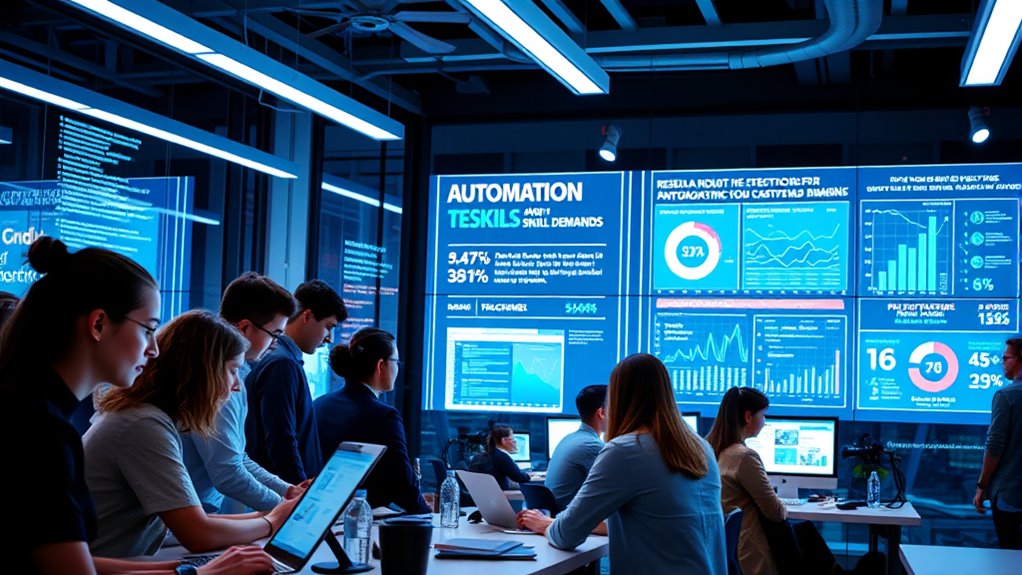
Rapid technological advancements are the primary force driving the increasing need for reskilling across industries. As AI, automation, and data analytics evolve, companies must adapt by upskilling their workforce. Emerging technologies integrate into existing workflows, creating demand for new skills. Skill gaps and talent shortages emerge because current talent pools can’t meet these demands, making reskilling essential. Employee motivation also fuels demand, as workers seek career stability and growth. Additionally, businesses rely on reskilling to implement innovative strategies and stay competitive. Economic shifts, demographic changes, and government support further accelerate these needs. Industries like manufacturing and high-tech are especially impacted. Research indicates that organizations investing in reskilling initiatives see improved agility and resilience in the face of rapid change. Here’s a quick overview:
| Driver | Impact | Response |
|---|---|---|
| Technological Disruption | Forces skill upgrades across sectors | Reskilling programs become essential |
| Emerging Technologies | Require new competencies | Continuous learning is prioritized |
| Skill Gaps & Shortages | Limit workforce effectiveness | Targeted reskilling addresses shortages |
A significant challenge is the rapid pace of change, which makes it difficult for workers to keep their skills current without ongoing training.
Corporate Investments in Workforce Development

You can see companies investing in workforce development through in-house learning platforms, credentialing programs, and microcredentials. These initiatives help bridge skill gaps and prepare employees for automation-driven changes. By focusing on targeted training, organizations aim to enhance productivity and guarantee future readiness. Moreover, many organizations are leveraging digital transformation efforts to modernize their workforce systems and better respond to labor market shifts. Implementing advanced training methods such as simulation-based learning can further accelerate skill acquisition and adaptation.
In-House Learning Platforms
Why are more companies turning to in-house learning platforms to develop their workforce? They see the value in managing training internally, with 83% already using Learning Management Systems (LMS). Investing in these platforms is a strategic move, as the corporate eLearning market is expected to nearly double by 2027, reaching $462.6 billion. Organizations prioritize closing skill gaps through targeted training, which drives increased LMS spending. Most LMS management—83%—is handled internally, allowing companies to customize and control their learning programs. However, nearly half are dissatisfied, citing usability and costs as challenges, spurring ongoing improvements. The strong ROI, with $1 spent generating $30 in productivity, and higher retention rates, underscores the effectiveness of in-house platforms in boosting workforce capabilities efficiently. Additionally, the market’s rapid growth indicates that organizations are increasingly recognizing the importance of market expansion and investing accordingly. Furthermore, integrating innovative approaches such as diverse design options can enhance employee engagement and learning outcomes.
Credentialing and Microcredentials
As companies continue to invest in in-house learning platforms to close skill gaps, many are also turning to micro-credentials and credentialing programs as strategic tools for workforce development. These credentials are increasingly valued by employers, with 90% willing to offer higher starting salaries for candidates who hold them. They also influence hiring decisions, as 85% of employers prefer candidates with micro-credentials, and 87% have hired at least one in the past year. To maximize their impact, you should consider:
- Prioritizing industry-relevant micro-credentials aligned with current job demands. Incorporating credentialing programs that address evolving skill needs ensures relevance and competitiveness.
- Encouraging employees to pursue micro-credentials to boost productivity and confidence.
- Recognizing micro-credentials as cost-effective, flexible pathways for upskilling and career growth.
- As the market for online micro-credentials is projected to double expenditure by 2025, investing in these programs becomes even more critical for staying competitive. market growth These programs help bridge skill gaps efficiently, making them essential in a shifting labor landscape.
Workforce Academy Initiatives
Companies increasingly recognize that investing in workforce development is essential for maintaining competitiveness in a rapidly evolving labor market. Many allocate around 11% of their budgets to staff training, reflecting its strategic significance. The global training market is expected to reach $6.4 trillion by 2026, showing growth and opportunity. Organizations with thorough training programs see a 218% increase in income per employee and are 17% more productive. However, only 12% of learners apply their skills at work, and many employees prefer practical, workplace-based training. Managers often feel training programs don’t meet learners’ needs. To stay ahead, companies are emphasizing flexible, personalized learning, continuous assessment, and leveraging technology. Digital learning adoption is accelerating rapidly, transforming traditional training models. Public support and international cooperation are also crucial for expanding effective workforce academy initiatives. Investing in workforce development is increasingly vital as automation continues to reshape job requirements and skill demands worldwide.
Critical Skills for Future Job Markets

What skills will you need to thrive in the future job markets? You’ll want to focus on critical abilities that keep you ahead. First, data literacy and analytics are crucial for making informed decisions as data grows. Second, creative thinking fuels innovation and problem-solving in fast-changing environments. Third, resilience and adaptability help you handle workplace shifts and uncertainties. Additionally, technology literacy—understanding AI, machine learning, and emerging tools—will be essential. As automation advances, skills like AI and automation expertise, leadership, and lifelong learning become increasingly valuable. Developing these skills positions you for high-income roles in programming, data science, cybersecurity, and digital marketing. Embracing critical thinking, collaboration, and continuous learning will keep you competitive in the evolving job landscape. Staying informed about industry trends and technological advancements is also vital for maintaining a competitive edge in rapidly changing markets. Cultivating a growth mindset can further enhance your ability to adapt and thrive amid technological disruptions.
Challenges in Implementing Effective Reskilling Programs

Implementing effective reskilling programs faces several hurdles that can hinder success. You’ll need to address gaps in training content, manage scaling challenges, and prove the return on investment to gain buy-in. Without overcoming these obstacles, your efforts risk falling short of their full potential. Additionally, programs require careful planning and ongoing evaluation to ensure they remain aligned with organizational goals and the evolving job landscape. Recognizing the importance of vibrational alignment can enhance engagement and effectiveness in reskilling initiatives.
Training Program Gaps
Despite the recognized importance of reskilling, many organizations face significant hurdles in creating effective programs. These gaps often stem from:
- Limited funding and resources—covering costs for trainers, materials, and employee time strains budgets, making scaling difficult. Only 16% of companies feel prepared to upskill their workforce.
- Time constraints and workload pressures—employees struggle to find time for training amid daily tasks, with 53% citing balancing operations as a top challenge.
- Curriculum and engagement issues—less than half excel at designing relevant content, and only 25% provide motivating incentives, reducing training effectiveness and participation.
– Moreover, organizations often lack the expertise to develop and implement effective training programs, which further hampers progress. Expertise in training development remains a critical component that many companies need to strengthen to bridge these gaps.
These gaps hinder progress, leaving organizations unable to fully prepare their workforce for automation’s demands, risking skill shortages and competitive disadvantage.
Scaling Challenges Persist
Scaling effective reskilling programs remains a significant challenge for organizations, primarily because of limited resources and organizational constraints. Financial costs for trainers, materials, and employee compensation can be overwhelming, especially when reskilling large groups, which averages nearly $25,000 per worker. Time constraints also limit participation, as employees struggle to find room in their busy schedules. Many companies lack the capacity to develop inclusive training, and a poor learning culture can hinder progress. Resistance to change and organizational inertia slow down efforts, while operational disruptions complicate balancing reskilling with daily demands. Without strong management or clear incentives, engagement drops. These barriers make it difficult to scale programs effectively, leaving many organizations unable to meet their future workforce needs through reskilling. Furthermore, limited access to high-quality training resources and the need for ongoing support further complicate scaling efforts, making sustainable reskilling initiatives even more challenging. Developing effective training methodologies and integrating innovative learning technologies could help overcome some of these hurdles.
ROI and Adoption
How can organizations guarantee their reskilling efforts deliver measurable value? You need to focus on tracking key metrics, such as productivity gains, cost savings from reduced turnover, and employee retention improvements. To maximize ROI, consider these strategies: 1. Prioritize programs aligned with business goals to ensure relevance. 2. Foster a culture of continuous learning and employee engagement. 3. Monitor and adapt training content regularly to stay current with evolving technology. Additionally, leveraging advanced analytics and AI platforms can provide deeper insights into program effectiveness, enabling data-driven decisions that enhance overall reskilling success measuring program effectiveness. Incorporating educational and skill-building toys into training can also make learning more engaging, especially for diverse learning styles.
Impact of Automation on Work Culture and Structures

Automation is transforming work culture and organizational structures at a rapid pace, prompting both opportunities and challenges for businesses and employees alike. You may notice shifts in job security, with automation displacing hundreds of thousands of workers, especially in manufacturing. Companies are increasingly automating tasks rather than augmenting human effort, leading to concerns about lower wages and job loss. Workplaces are adapting structurally, shifting roles toward skills that machines can’t replicate, but resistance to change remains. Leadership plays a crucial role in managing these cultural shifts through clear communication. As AI adoption accelerates—75% of workers now use it—organizations must navigate cultural adjustments and foster a resilient workforce. Without careful management, automation could foster mistrust and diminish workplace cohesion. Effective leadership and communication are essential in guiding organizations through these changes, ensuring staff remain engaged and adaptable.
Barriers to Scaling Reskilling Initiatives

You might face obstacles like limited training programs that can’t keep up with evolving skills, making it hard to scale reskilling efforts. Technology adoption can also slow progress, especially when organizations struggle with integrating new tools. Without addressing these barriers, expanding workforce development remains a significant challenge. Additionally, insufficient financial resources can hinder the implementation of comprehensive training initiatives necessary for effective reskilling.
Training Program Limitations
Scaling reskilling initiatives faces significant challenges due to various program limitations. You often see programs focusing more on upskilling than reskilling, leaving employees dissatisfied (62%) and unprepared for future roles. Additionally, many training efforts fail to target essential skills like digital literacy, AI, and soft skills, reducing relevance and engagement. You also encounter one-size-fits-all approaches that don’t meet diverse employee needs, limiting effectiveness. Research shows that only 33% of companies effectively measure the impact of their reskilling programs, which hampers continuous improvement. Here are key barriers: 1. Lack of tailored content and clear career pathways, decreasing motivation. 2. Inadequate focus on emerging skills, such as AI, with only 41% of programs incorporating these. 3. Insufficient measurement methods, making it hard to track ROI and justify continued investment.
These limitations hinder the scaling and success of reskilling efforts across organizations.
Technology Adoption Challenges
Adopting new technologies to support reskilling efforts often faces significant hurdles related to data complexity, integration, and scalability. About 25% of organizations cite data complexity as a major barrier, making it hard to manage and analyze the information needed for effective training. Integration issues also hinder progress; 22% find AI projects too difficult to embed within existing systems. Limited tools for AI development and high project costs—each cited by around 21%—further slow adoption. These technical challenges are compounded by data silos and legacy systems, which prevent seamless integration. Without scalable infrastructure and simplified data management, expanding reskilling initiatives becomes formidable, stalling efforts to prepare your workforce for rapid technological change. Overcoming these barriers requires strategic investments and streamlined processes. Additionally, technological infrastructure plays a crucial role in enabling the expansion of reskilling programs at scale.
Scaling Workforce Development
Expanding workforce development programs to meet the demands of a rapidly evolving job market often encounters multiple barriers. First, regional disparities make scaling difficult; for example, 70% of companies in Sub-Saharan Africa face skills gaps, and success in one area doesn’t guarantee success elsewhere. Second, program effectiveness varies with context—what works in one country or industry may fail in another—adding complexity to expansion efforts. Third, limited evidence of successful large-scale implementations hampers confidence, especially when pilot programs don’t translate seamlessly to broader populations. These challenges are compounded by differences in social, economic, and political environments, requiring careful adaptation. Data shows that workers with up-to-date skills are 30% more likely to remain employed in emerging sectors. Overcoming these barriers demands tailored approaches, significant resources, and coordinated efforts to guarantee workforce development scales effectively and sustainably.
The Role of Microcredentials and Certification Programs

Have you noticed how microcredentials and certification programs are transforming workforce development? They’re meeting the urgent need for rapid skill updates, especially as 39% of employee skills are expected to become outdated between 2025 and 2030. With 90% of students believing certificates help them stand out, and companies like Google and IBM endorsing microcredentials, their industry recognition is clear. Over the past five years, microcredentials have grown 250% in popularity. They’re essential for digital skill acquisition, as many workers seek GenAI training—yet few receive it. Microcredentials fill skill gaps quickly, boost employability, and promote career growth. They’re also a time-efficient way to stay relevant, aligning industry needs with workers’ aspirations in today’s fast-changing job market. Microcredentials provide targeted skill acquisition without lengthy degree commitments, making them a flexible and strategic tool for ongoing professional development.
Strategies for Building Workforce Resilience

How can organizations effectively build workforce resilience in today’s rapidly changing landscape? Start by focusing on soft skills development—emotional intelligence, problem-solving, and collaboration—to boost adaptability. Next, establish support systems like mentorship programs and peer networks, creating a culture where employees feel valued and motivated. Finally, foster a culture of innovation by encouraging experimentation and idea-sharing across teams. These strategies help employees adjust to technological shifts and automation, ensuring they stay engaged and capable. Additionally, investing in leadership development equips managers to align goals with workforce capabilities, promoting continuous growth. Emphasizing ongoing learning and digital literacy also strengthens resilience, making your workforce more agile and prepared for future disruptions. Automation offers increased efficiency and productivity by streamlining manual tasks. Together, these approaches create a resilient foundation capable of steering through automation’s evolving demands.
Navigating the Future of Work in a Skills-Based Economy

Charting the future of work in a skills-based economy requires a proactive approach to address the widening skills gap and its implications. You’ll need to stay ahead of rapid technological changes, as nearly 44% of workers’ skills will be disrupted in five years. Organizations face significant challenges, with 81% experiencing tech skill shortages in AI, big data, and cybersecurity. If unaddressed, a global skills shortage could create over 80 million unfilled roles, costing trillions. To succeed, you must prioritize reskilling, as 44% of workers will need new skills, especially in AI, data analytics, and problem-solving. Embracing skills-based hiring and flexible work arrangements will help you adapt, retain talent, and navigate the evolving landscape of work effectively. Skills shortages & gaps are a major risk, with 78% of survey respondents emphasizing their critical impact on organizational success.
Frequently Asked Questions
How Can Small Businesses Effectively Implement Reskilling Programs?
You can effectively implement reskilling programs by securing leadership support and fostering a culture of lifelong learning. Identify skill gaps early using data-driven methods and focus on roles vulnerable to disruption. Engage employees with interactive, hands-on training, and communicate clear career paths. Allocate resources wisely, balancing internal and external training, and continuously evaluate progress. This approach boosts workforce adaptability, satisfaction, and guarantees your team stays relevant in a changing landscape.
What Role Do Government Policies Play in Workforce Reskilling?
Government policies play a crucial role in workforce reskilling by providing funding, incentives, and frameworks that make training accessible and effective. You benefit from subsidies covering up to 90% of training costs and programs designed to include diverse populations. These policies foster public-private partnerships, align training with industry needs, and promote equitable access, helping you adapt to labor market changes and stay competitive in an evolving job landscape.
How Can Individuals Identify the Most Valuable Skills to Learn?
You can identify the most valuable skills to learn by analyzing current market demand and industry trends. Focus on high-demand areas like AI, analytical thinking, content creation, and emotional intelligence. Stay updated through industry reports, online courses, and networking. Assess your strengths and interests to choose skills that align with your career goals. Continuously seek feedback and adapt your learning to stay ahead in a rapidly evolving job landscape.
What Are the Long-Term Career Prospects in Emerging Green Economy Roles?
The long-term prospects in green economy roles look promising, with industries expanding rapidly and creating millions of new jobs worldwide. You’ll find stability and higher earning potential, especially in renewable energy, environmental engineering, and sustainability management. As governments invest heavily and regulations tighten, demand for green skills will only grow. By staying current with industry trends and gaining relevant certifications, you can secure a resilient, rewarding career in this evolving sector.
How Do Cultural Differences Impact Global Reskilling Initiatives?
You see, cultural differences shape how people approach reskilling worldwide. For example, in Singapore, lifelong learning is a norm, so workers actively pursue new skills. Conversely, in regions where job stability is prioritized, people may see little need to upskill, reducing engagement. These attitudes influence program design, participation, and success. Recognizing and adapting to local cultural values guarantees initiatives resonate, encouraging ongoing learning and better workforce resilience globally.
Conclusion
To stay ahead in this whirlwind of change, you must embrace reskilling like your career depends on it—because, in today’s world, it does. The pace of automation is faster than ever, threatening to make skills obsolete overnight. By investing in continuous learning and leveraging innovative programs, you can turn this challenge into an opportunity. Remember, your adaptability isn’t just important; it’s the superpower that will keep you relevant in the future of work.