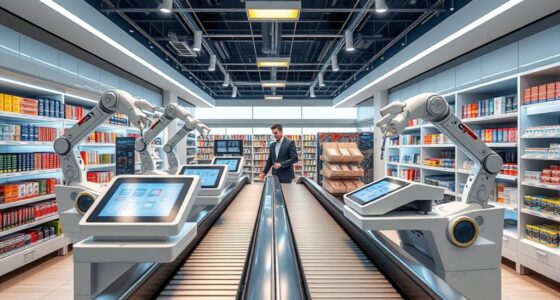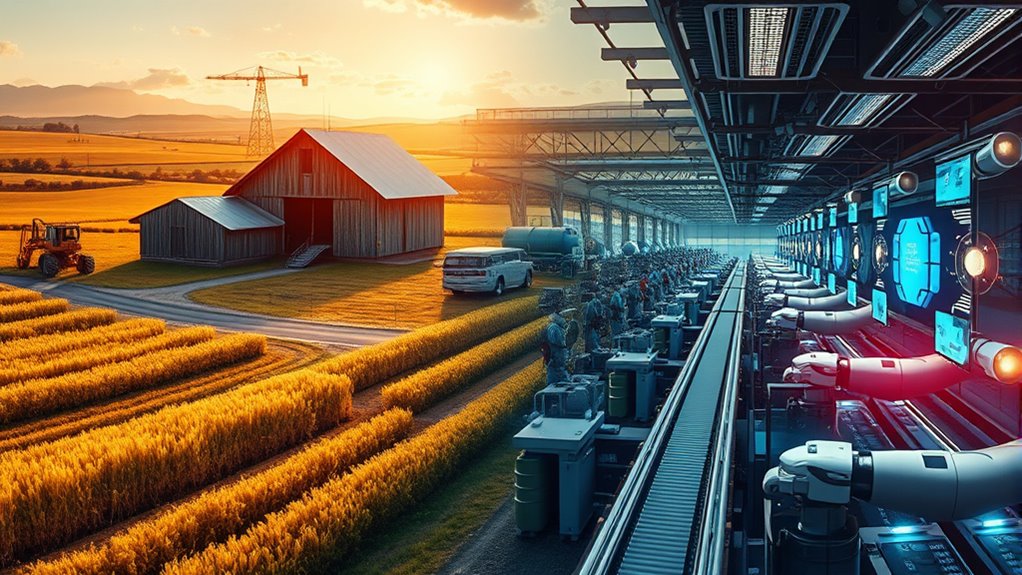

Automation has transformed work from early water wheels and textile inventions to today’s AI and quantum computing. You’ve seen how water and steam power boosted industries, then mechanical devices like spinning jennies and power looms revolutionized factories. Now, AI and robotics are reshaping jobs, making processes smarter and more efficient. If you keep exploring, you’ll discover how these innovations keep evolving and what that means for the future of work.
Key Takeaways
- Early mechanization, like water wheels and spinning jennies, replaced manual labor, boosting productivity in agriculture and textiles.
- The Industrial Revolution introduced steam-powered machinery, transforming manufacturing and enabling large-scale factory work.
- Digital automation, including robots and programmable systems, replaced manual tasks in factories, increasing efficiency and safety.
- AI and IoT technologies now enable intelligent, adaptive automation, reshaping roles and decision-making across industries.
- Future innovations like quantum computing and blockchain continue to redefine work processes, emphasizing data security and rapid problem-solving.
The Dawn of Mechanical Innovation in Textiles and Milling
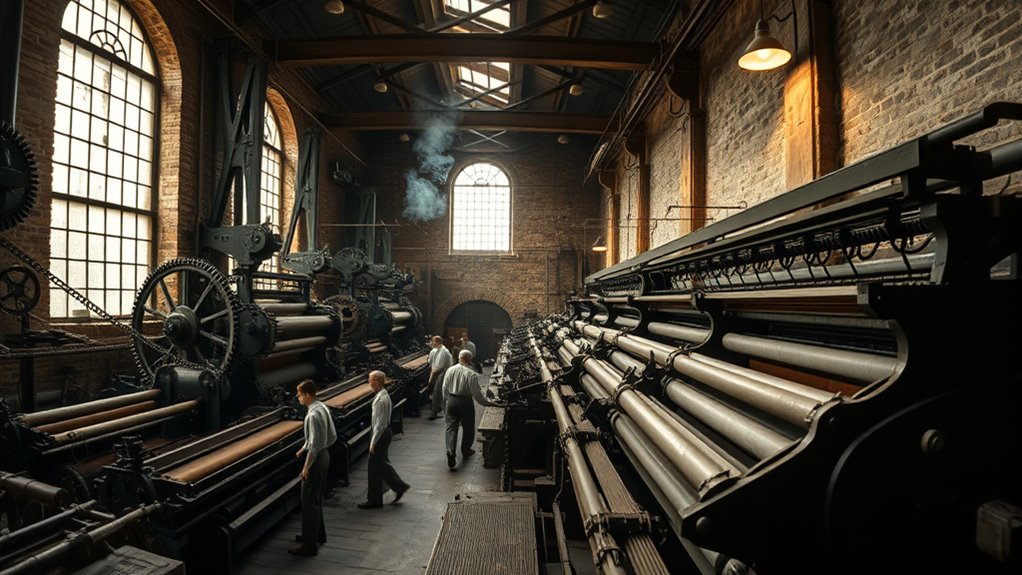
The dawn of mechanical innovation in textiles and milling marked a pivotal shift from manual labor to machine-driven production. You see, inventors like James Hargreaves designed the spinning jenny in 1764, doubling textile output by letting you operate multiple spindles simultaneously. Then Richard Arkwright’s water frame, patented in 1769, harnessed water power to produce stronger cotton yarns for weaving. John Kay’s flying shuttle loom, invented in 1733, made weaving faster and easier, allowing one person to work alone. Samuel Crompton’s spinning mule combined previous inventions to create fine and coarse yarns. Later, Edmund Cartwright’s power loom automated weaving, further boosting efficiency. These innovations transformed textile manufacturing, enabling large factories, increasing production, and laying the groundwork for even greater mechanization ahead. The development of machine tools and the rise of the factory system further accelerated manufacturing capabilities, making mass production feasible on an unprecedented scale.
The Rise of Water and Steam Power in Industry
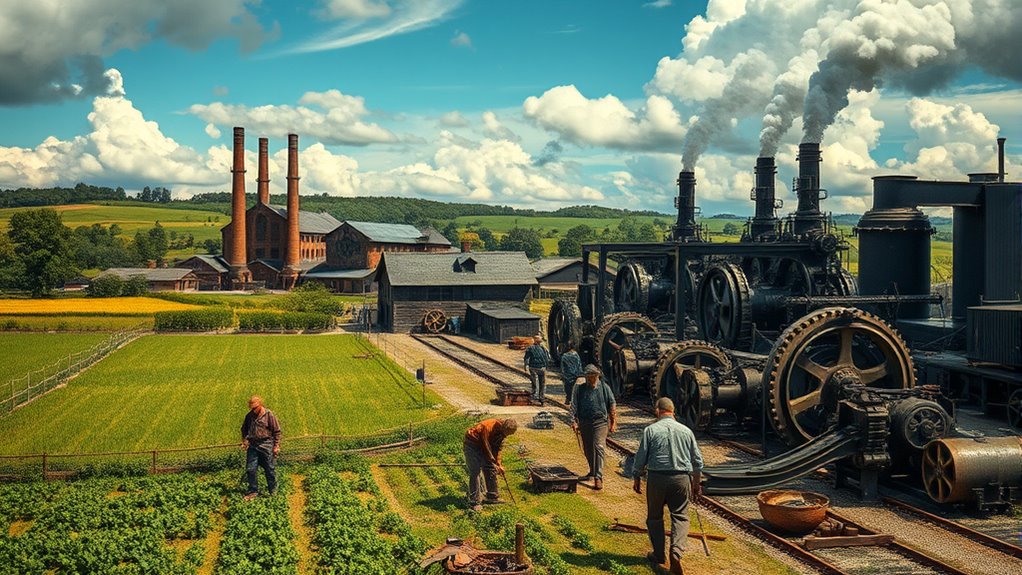
You notice how water power fueled early industry, especially in Britain’s ironworks, with turbines boosting efficiency to over 75%. As water resources became scarce, steam engines offered reliable, scalable power that transformed manufacturing and control over labor. This shift not only improved productivity but also laid the technological foundation for modern industrial automation. Water power had been in use for over 2,000 years by the mid-19th century, supporting tasks from grain milling to large-scale cotton spinning. Additionally, the development of early mechanical systems enabled more precise control and automation in factories. The transition from water to steam power also facilitated the growth of factory systems, which centralized production and further advanced industrial efficiency. The adoption of engine technology marked a pivotal point in overcoming geographical and resource limitations, leading to widespread industrial expansion. Embracing these innovations exemplifies how technological limits can inspire new solutions and drive progress.
Water Power Adoption
Water power revolutionized early industry by providing a reliable energy source for mills and machinery from the 1500s through the mid-1800s. It fueled textile and iron industries, transforming manufacturing. Larger iron waterwheels replaced wooden ones, boosting power output. Technological advancements, like water turbines, increased efficiency—over 75%, with James B. Francis’s 1848 turbine reaching 90%. These turbines adapted to different water flows, supporting industrial scale-up. As innovations like water turbines improved, industries could expand their capacity and productivity more effectively. Additionally, the development of advanced turbine designs played a crucial role in optimizing energy conversion and supporting larger industrial operations. Moreover, the adoption of automation technologies further enhanced manufacturing processes, paving the way for modern industry. However, resource scarcity in parts like NW England pushed industries toward steam power. The environmental impact grew, along with factory growth and global reach. As water resources declined, industries shifted to steam, marking a key technological shift. Proper custodian services for managing Gold IRAs became increasingly important for investors seeking secure diversification.
Steam Engine Development
Steam engine development marked a pivotal shift in industrial technology, transforming how work was done across factories, mines, and transportation. You’ve likely heard of early inventors like Thomas Savery and Thomas Newcomen, who created simple steam pumps to raise water from mines. Denis Papin’s piston-cylinder concept laid groundwork, but it was James Watt’s 1765 improvements—especially the separate condenser—that made steam engines much more efficient. Watt’s innovations enabled engines to power machinery beyond pumping, fueling factory growth. The widespread adoption of these engines in various industries accelerated industrialization and economic development. In transportation, pioneers like Nicolas-Joseph Cugnot and George Stephenson built steam-powered vehicles and locomotives, transforming travel and freight. These advancements increased power, efficiency, and scale, setting the stage for industrial expansion and reshaping work for generations. Additionally, the development of spiritual energy in the industrial age can be seen as a metaphor for how human innovation fuels collective progress and adaptation, illustrating the profound influence of technological advancements on society’s evolution. Furthermore, the integration of artificial intelligence into industrial processes is beginning to redefine manufacturing and labor dynamics, highlighting the ongoing importance of innovation. This era also highlighted the importance of innovation and adaptation as essential components for societal growth and resilience.
Industrial Efficiency Gains
The rise of water and steam power revolutionized industrial efficiency by dramatically increasing the scale and speed of production. Water wheels and turbines enabled factories to operate larger machinery, boosting output. Water power sites often spurred infrastructure like railroads, further enhancing industrial growth. However, geographic limitations meant some regions, like Greater Manchester, couldn’t fully tap into water resources, prompting a shift to steam power. Environmental impacts included river pollution and ecosystem disruption, while seasonal water flow affected reliability. Despite these challenges, water power contributed considerably to economic growth, with its direct mechanical energy valued at around $294 per horsepower in 1880. Water power had been in use for approximately 2000 years, attracting investments in mills and infrastructure that shaped the industrial landscape and laying the groundwork for future technological innovations.
The Birth of Modern Automation With Mechanical Devices
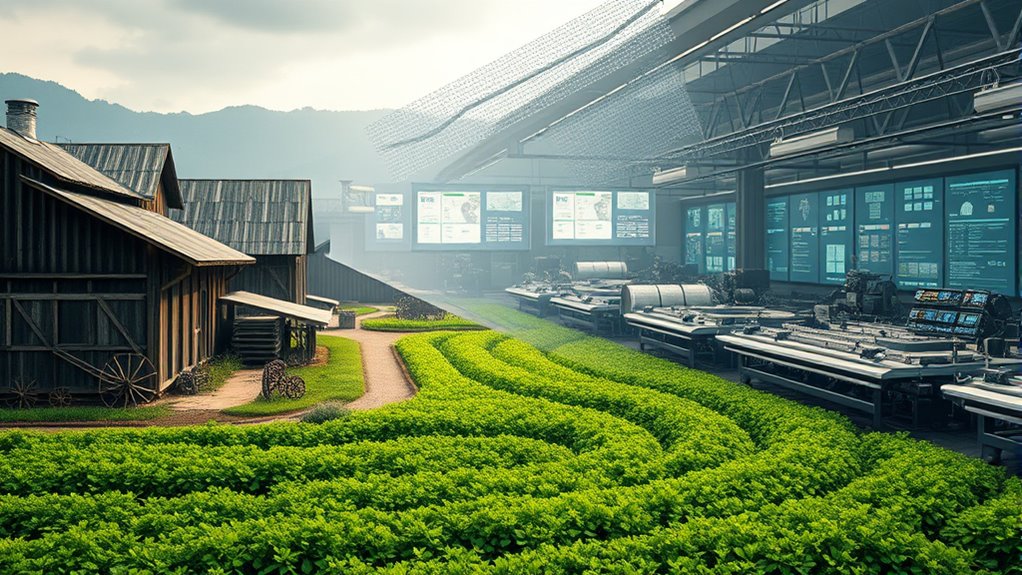
Modern automation with mechanical devices began to take shape during the early centuries of the Common Era, as inventors and engineers created machines that could perform tasks with minimal human intervention. Water wheels, developed around the 1st century BC, harnessed water power for milling and other processes. Windmills, first documented between the 7th and 9th centuries, were used to grind grain and pump water, advancing labor mechanization. By the 9th century, improvements in mill machinery optimized grain processing, increasing productivity and replacing manual labor. These early devices laid the groundwork for future industrial automation. During the Industrial Revolution, steam engines and mechanized mills replaced water and wind power, enabling continuous production. Innovations like Oliver Evans’ 1785 automatic flour mill marked the shift toward fully automated industrial processes. These advancements contributed to the development of more sophisticated automation systems in later centuries, including innovations in mechanical engineering that further enhanced automation capabilities. Additionally, the influence of indigenous cultures can be seen in the design and use of traditional tools and techniques that inspired early mechanical innovations. Moreover, the integration of early technological innovations into various industries exemplified the ongoing evolution of automation throughout history, with recent developments integrating sound healing science and other emerging fields to optimize industrial processes. Recognizing the importance of payment processing also played a role in modern automation, especially as digital transactions and security measures became essential to industrial and commercial growth.
The Emergence of Robotic Automation in Manufacturing
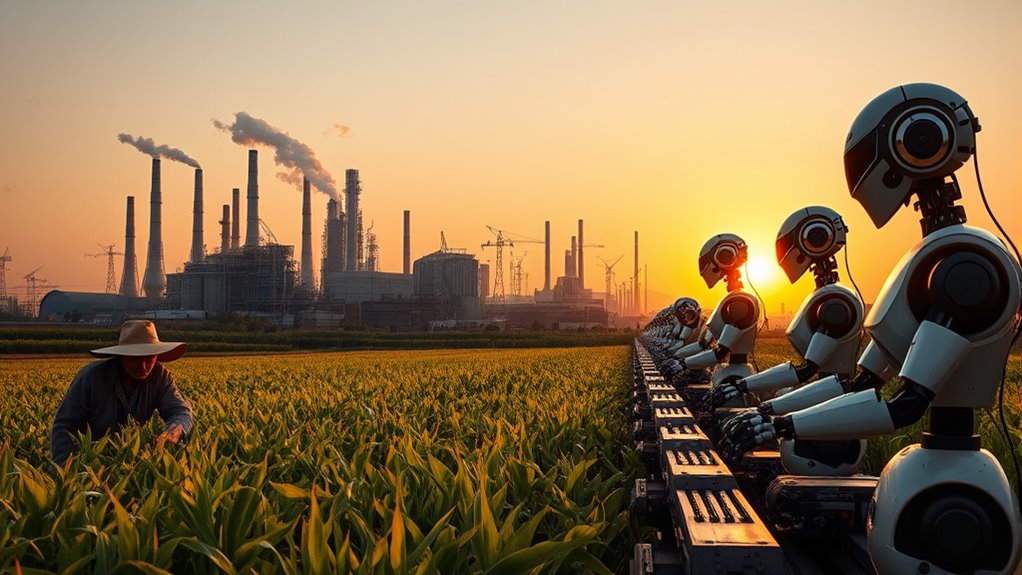
Mechanical devices evolved from simple water and wind-powered mills to complex automated systems that began transforming manufacturing processes. In the early 1960s, the first industrial robotic arm, “Unimate,” was installed at a GM plant, performing tasks like lifting hot metal parts with programmed movements. This robot improved safety, efficiency, and consistency, marking a turning point in automation.
Mechanical devices evolved from mills to automated systems, revolutionizing manufacturing with robots like Unimate in the 1960s.
- It could follow up to 200 stored movements, handling hazardous or strenuous tasks.
- The Stanford Arm introduced greater flexibility with wider movements and multiprogrammability.
- Robots like Unimate and the Stanford Arm boosted productivity, enabling tasks like welding and assembly.
- Computer control innovations, including NC machines and the MH-1 mechanical hand, advanced robotic capabilities further. High-capacity controllers allowed for more complex and precise operations.
- As technology progressed, the integration of digital platforms facilitated remote monitoring and control of robotic systems, further enhancing manufacturing efficiency. Additionally, the development of robotic sensors enhanced the ability of machines to adapt to their environment, improving their functionality and safety.
The Computer Revolution and Digital Control Systems
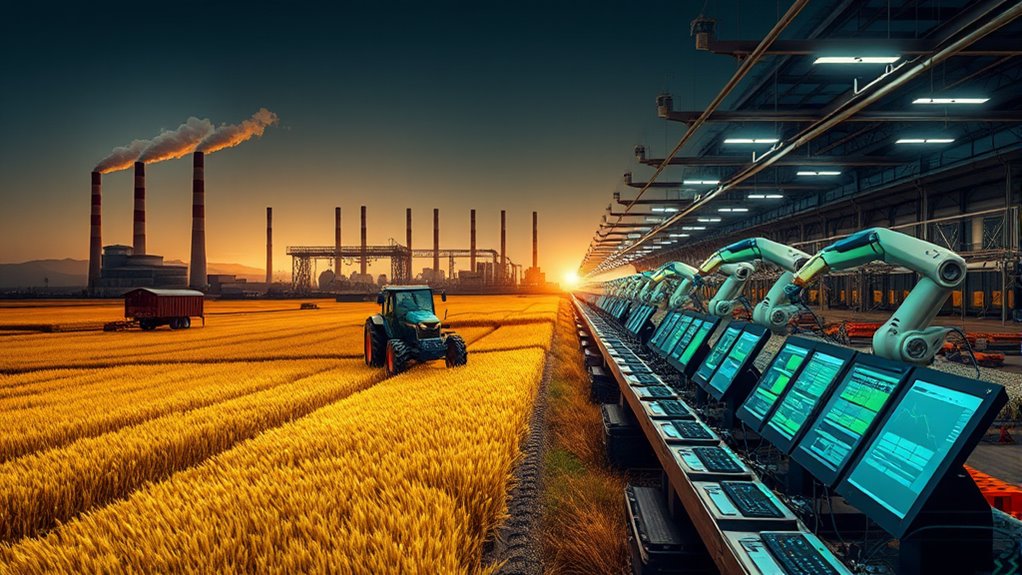
As digital control systems emerged, they transformed manufacturing and computing by enabling precise, programmable automation. Early on, inventions like Babbage’s Analytical Engine and Boolean algebra laid the groundwork for digital logic. During the 1940s, electronic computers such as ENIAC and the Manchester Mark I introduced reprogrammability and stored memory, revolutionizing data processing. The 1960s saw the development of integrated circuits, making control systems smaller and more reliable. The creation of ARPANET in 1969 established networked digital control and communication, while the release of the first DRAM chips in 1970 vastly increased memory capacity. These advancements fueled the rise of software-driven automation in industries and laid the foundation for modern digital control systems that streamline manufacturing, data management, and complex operations today. The development of microprocessors in the 1970s further accelerated digital control capabilities, making automation more accessible and widespread across various sectors.
The Role of Artificial Intelligence and Machine Learning
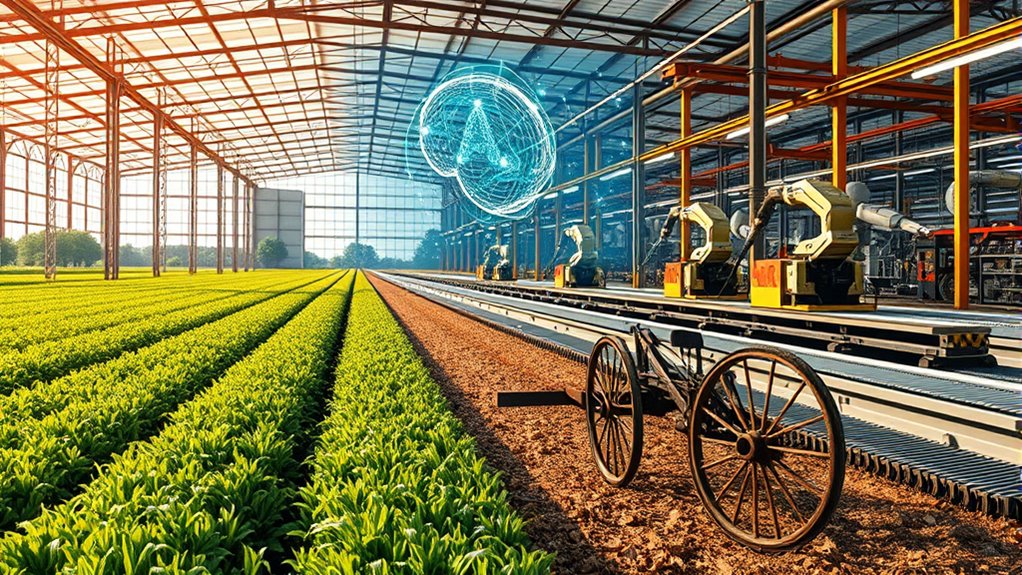
Have you ever wondered how artificial intelligence and machine learning are transforming industrial automation? Today, these technologies drive a market worth over USD 17.3 billion in 2023, expected to hit USD 65.8 billion by 2031. They enable adaptive automation that goes beyond simple rules, making factories smarter and more efficient. You’ll see predictive maintenance and real-time data analysis become standard practices, reducing downtime and boosting productivity. Autonomous decision-making systems learn continuously from their environment, improving over time. These advancements power applications like advanced robotics, quality control, and faster processes.
- Enable real-time monitoring and optimization in smart factories
- Improve product quality and safety standards
- Drive digital transformation and Industry 4.0 adoption
- Integrate with sensors and control systems for responsive operations
The Impact of the Internet of Things on Industry

The Internet of Things (IoT) is revolutionizing industry by enabling interconnected devices and systems to communicate seamlessly, leading to smarter and more efficient operations. You’ll see this in manufacturing, where control systems like robots and computers monitor and manage processes. IoT platforms facilitate real-time data exchange, reducing human labor costs and boosting productivity. With advancements like 5G and edge computing, data is processed faster at the source, allowing for immediate insights. The market for industrial IoT is booming, expected to reach over USD 286 billion by 2029, driven by demand for digital transformation and predictive maintenance. Despite challenges like protocol standardization, IoT’s benefits—enhanced asset monitoring, operational efficiency, and innovative R&D—continue to accelerate industry growth worldwide.
Autonomous Systems and Smart Technologies
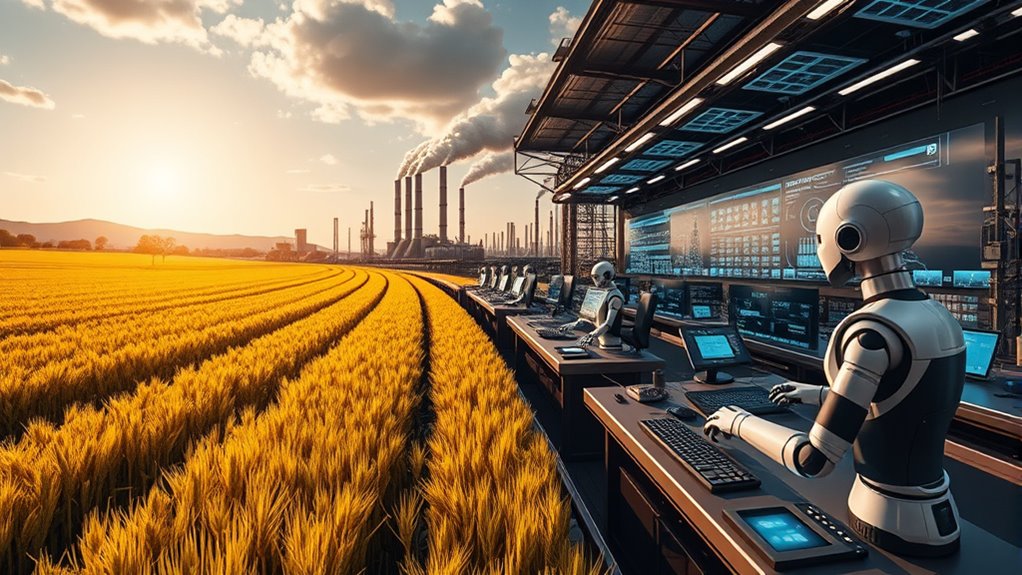
Autonomous systems and smart technologies are rapidly transforming industries by integrating advanced AI, sensors, and connectivity to enable machines to operate independently and efficiently. You’ll see these innovations improve productivity across sectors like manufacturing, mining, logistics, and agriculture. The market is projected to hit nearly $33 billion by 2025, reflecting rapid growth and adoption worldwide. Companies like BMW test humanoid robots, while Rio Tinto employs autonomous trucks, and Einride develops driverless freight networks. These systems enhance precision, reduce costs, and address labor shortages.
- Use AI and connectivity for real-time decision-making
- Employ sensors for accurate data collection
- Automate complex operations in factories and mines
- Overcome labor gaps with intelligent machines
Future Directions: Blockchain, Quantum Computing, and Sustainability
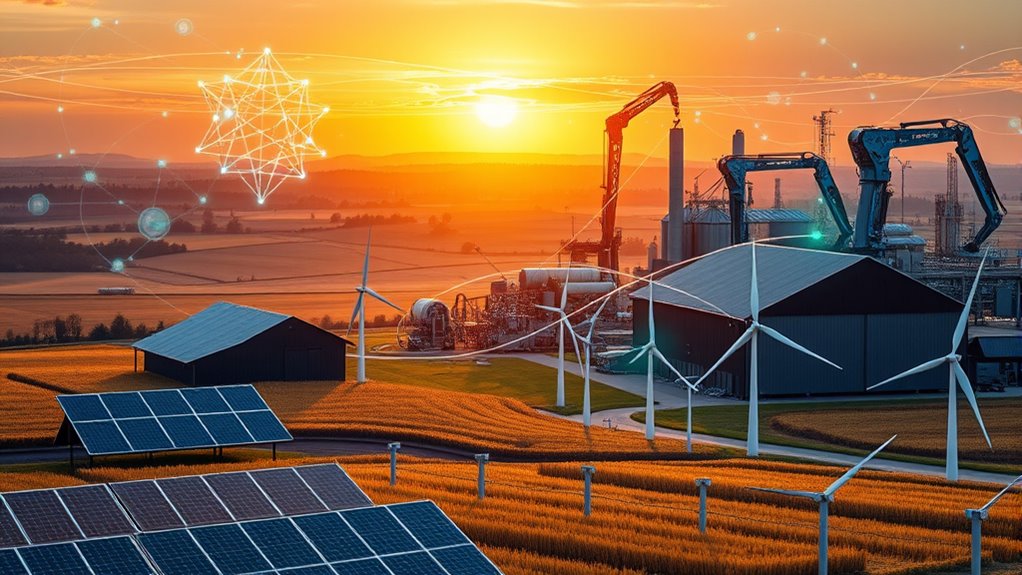
As you explore future automation, blockchain offers secure, transparent ways to facilitate processes across industries, especially with smart contracts that boost efficiency. Quantum computing promises unprecedented speed for solving complex problems, potentially transforming fields like cryptography and logistics. Meanwhile, emphasizing sustainability helps guarantee that technological advances reduce environmental impact while maintaining performance.
Blockchain for Secure Automation
How can blockchain revolutionize secure automation in the future? By providing a decentralized, tamper-proof digital ledger, blockchain guarantees data integrity and security across automated systems. It enables seamless, trusted data exchanges and smart contracts that execute automatically without intermediaries. This enhances transparency and reduces fraud risks. In supply chains, blockchain tracks materials, authenticates products, and verifies ethical sourcing, boosting trust and efficiency. In manufacturing, it monitors equipment, manages product lifecycles, and optimizes asset use. Blockchain also supports secure data storage, helping companies comply with environmental standards and promote sustainability. Its integration with automation reduces administrative burdens and enhances reliability. As technology advances, blockchain’s role in securing and streamlining automation will only grow, shaping a more trustworthy and efficient digital future.
- Ensures data integrity with cryptographic security
- Facilitates transparent, tamper-proof transactions
- Automates complex business processes with smart contracts
- Supports sustainable and ethical sourcing practices
Quantum Computing Speed Gains
Have you ever wondered how quantum computing could transform the speed and efficiency of automation technologies like blockchain? Quantum computers can solve certain problems exponentially faster than classical systems, revolutionizing data processing. They excel at tackling optimization tasks in logistics and finance, making operations more efficient. Quantum algorithms, like Shor’s and Grover’s, can break traditional encryption but also develop quantum-resistant cryptography, enhancing security. Recent advances include topological qubits, which offer greater stability and error correction, paving the way for scalable, reliable quantum hardware. Google’s milestone demonstrated quantum speed surpassing classical capabilities in minutes. As quantum hardware and software improve, you’ll see faster simulations, better cryptography, and smarter optimization, fundamentally changing how automation integrates into industries across the board.
Automation’s Environmental Impact
Automation is increasingly shaping sustainable manufacturing by optimizing resource use and minimizing environmental impact. It reduces energy consumption through precise, consistent operations and minimizes waste by ensuring accurate production, which cuts material loss. Automated air quality sensors enable real-time emissions monitoring, helping factories adjust processes to meet standards. Additionally, automation conserves natural resources by optimizing their use and handles hazardous materials safely, reducing spills and contamination. Emerging technologies like blockchain enhance supply chain transparency, supporting sustainable practices. AI-driven processes improve energy efficiency and waste management, while automation promotes circular economy principles through reuse and recycling. These innovations collectively help reduce manufacturing’s greenhouse gas emissions, pollution, and resource constraints, paving the way for more sustainable and environmentally friendly industrial practices.
The Changing Workforce and Regulatory Challenges
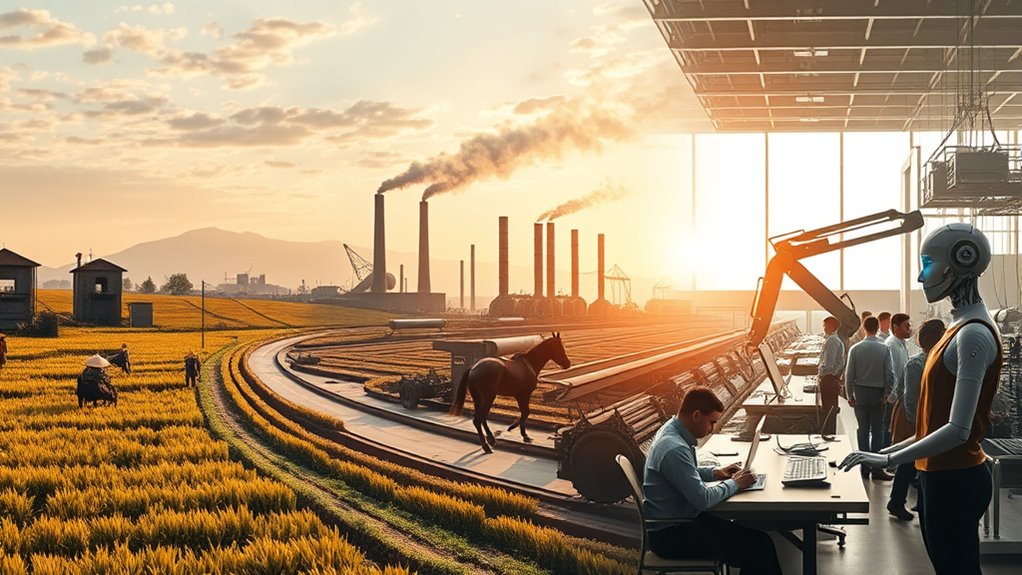
The increasing integration of AI and automation is rapidly transforming the workforce, presenting significant regulatory challenges. You face job displacement, with around 14% of workers already displaced and millions more at risk—especially in manufacturing, retail, and energy sectors. In advanced economies, 60% of jobs could be replaced by AI, sparking concerns among younger workers, who worry more about job security. Companies are investing in automation, but only 1% feel fully prepared, highlighting the need for robust retraining programs. Meanwhile, existing labor laws struggle to keep up, risking workers’ protections and wage stability. As managerial tasks and manual roles shift or disappear, policymakers must balance innovation with social safety nets, ensuring workers aren’t left behind in the AI-driven economy.
Frequently Asked Questions
How Did Early Automation Influence Social and Economic Structures Historically?
Early automation reshaped social and economic structures by displacing artisans and rural workers, prompting rural-to-urban migration as factories grew. You’d notice rising inequality, with the wealthy gaining more while many lost jobs. Automation also led to social unrest and fears of dehumanization. Over time, these changes increased productivity and economic output, but they created divisions between skilled and unskilled workers, affecting societal stability and class dynamics profoundly.
What Are the Key Differences Between Mechanical and Digital Automation Systems?
Think of mechanical and digital automation systems as two different engines driving progress. Mechanical automation relies on physical parts like gears and levers, making it simple, robust, and less dependent on electricity. Digital automation, however, uses sensors and software, offering flexibility and adaptability but needing power and more maintenance. You’ll find mechanical systems in basic tasks, while digital ones excel in complex, connected processes.
How Do Cybersecurity Concerns Impact the Adoption of AI and Iot in Industry?
Cybersecurity concerns influence your industry’s AI and IoT adoption by making you cautious about vulnerabilities. You recognize that integrating these technologies can boost threat detection and operational efficiency, but risks like data breaches and system hacks slow progress. To move forward confidently, you need robust security measures, clear regulations, and ongoing human oversight. Balancing innovation with security guarantees you can harness AI and IoT’s full potential without exposing your systems to unnecessary threats.
In What Ways Is Automation Shaping Workforce Skills and Employment Trends?
Automation is transforming workforce skills and employment trends by automating routine tasks, making creativity, problem-solving, and digital collaboration more valuable. You’ll need to reskill regularly, focusing on AI literacy and adaptability, to stay relevant. As new roles emerge in AI-assisted fields, those who embrace continuous learning and develop ethical judgment will have better job prospects and higher salaries. Staying proactive in skill development helps you thrive amid rapid technological change.
What Regulatory Challenges Arise With the Integration of Emerging Automation Technologies?
You face regulatory challenges as automation technologies evolve rapidly. Existing laws often don’t cover AI and automation, creating gaps and cross-border issues. Privacy and security concerns grow with increased data collection, demanding stronger safeguards. Ethical dilemmas and accountability become complex, especially with opaque AI decisions. Regulators struggle to keep rules current, balancing innovation and oversight. You need adaptable, transparent frameworks that address risks, while ensuring compliance keeps pace with technological advancements.
Conclusion
So, you see, as automation keeps marching forward—from spinning jennies to AI—you’re invited to sit back and enjoy the show. The worker’s replaced, the factory’s smarter, and somehow, we’re all still here wondering if the robot overlords will throw a party or take over your job. One thing’s for sure: the future’s bright, possibly with a side of blockchain, quantum leaps, and a dash of sustainability—just don’t forget to blink first.