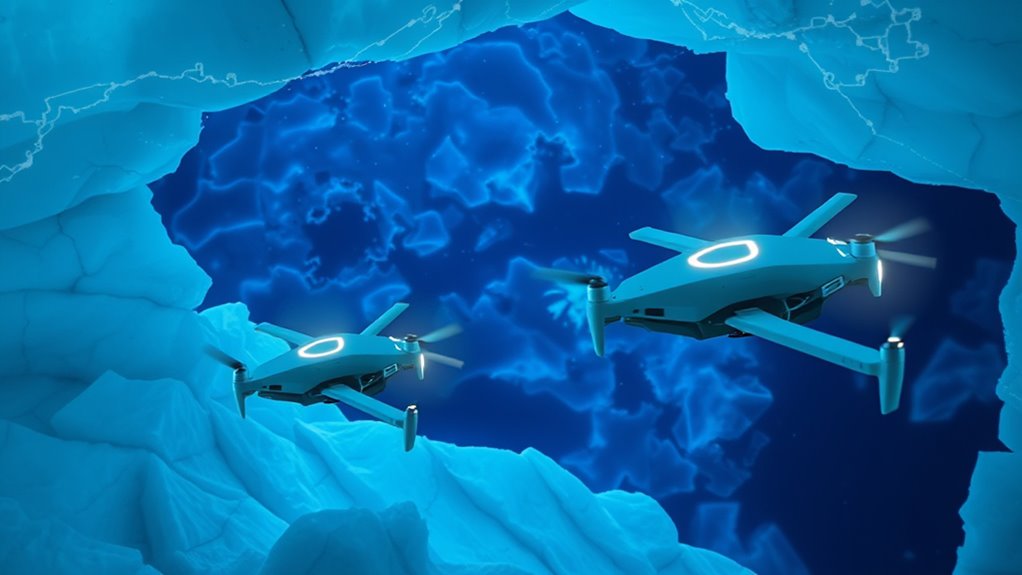

Artificial intelligence is transforming ocean exploration beneath ice by enabling faster data processing and deeper insights. AI-powered underwater robots and imaging tools can operate in harsh environments, capturing high-quality images and mapping the seabed where humans can’t go. AI accelerates discoveries by analyzing vast datasets quickly and accurately, revealing hidden ecosystems and geological features. To find out how these innovations are opening new frontiers in icy depths, keep exploring what’s underway.
Key Takeaways
- AI-powered underwater robots and sensors enable detailed exploration beneath ice sheets and in deep-sea environments.
- Machine learning processes vast ice and ocean data in real-time, accelerating discovery of hidden marine ecosystems.
- AI enhances imaging hardware to capture high-quality visuals in extreme cold and low-light conditions beneath ice.
- Autonomous AI systems facilitate remote exploration of inaccessible icy regions without human presence.
- Data from AI-driven missions contributes to mapping and understanding uncharted areas beneath polar ice sheets.

Artificial Intelligence is revolutionizing oceanic discovery by enabling more efficient and all-encompassing exploration of the world’s oceans. You’re now able to process vast amounts of underwater visual data rapidly, thanks to AI platforms like Ocean Vision AI. These systems combine expertise from multiple disciplines and use machine learning to classify and interpret complex scenes, marine life, and seabed features. AI tackles the backlog of unexamined data by automating tedious analysis tasks, so researchers can focus on insights rather than manual sorting. Centralized AI hubs foster collaboration among research groups by sharing open datasets and imaging tools, creating a unified approach to ocean exploration. Data pipelines built by AI systems handle enormous repositories of images and videos, making large-scale oceanographic data manageable and accessible. Additionally, gamification strategies involving the public boost AI training efforts, engaging enthusiasts worldwide to contribute to marine data annotation and discovery.
In real-time, AI algorithms operate during oceanic missions, processing sensory information instantly. This capability enhances operational efficiency by reducing delays associated with manual data analysis, such as examining sonar readings or underwater imagery. AI-powered sonar systems, like those used in Seabed 2030, automate high-quality mapping of the ocean floor, aiming to cover the entire seabed by 2030. Autonomous AI systems make decisions without human input, which is essential for exploring deep-sea and remote areas where human presence is limited. Combining deep learning with machine learning pushes exploration coverage toward near-complete, moving beyond the current 5% of the ocean that’s been mapped.
For coastal and ocean resilience monitoring, AI-driven analytics process environmental data from satellites, vessels, and sensors in near real-time. This allows you to detect climate-induced ocean changes swiftly, transforming large data volumes into actionable insights. AI helps forecast and monitor oceanic conditions, supporting climate-smart policies and resilience efforts. Large-scale deployment accelerates NOAA’s ability to study marine ecosystems, providing timely information to protect vulnerable habitats. AI-enhanced underwater imaging hardware withstands extreme pressures and corrosive saltwater, ensuring reliable data collection. By optimizing power usage and integrating sophisticated lenses, AI maintains image clarity despite low light and turbidity. Custom interfaces enable seamless communication between hardware and processing systems, so you can continuously gather high-quality marine data. Overall, AI’s role in ocean exploration extends from mapping the seabed to understanding climate impacts, accelerating discoveries beneath the ice and across the depths of our planet’s oceans.
Frequently Asked Questions
How Does AI Improve the Safety of Deep-Sea Exploration?
AI improves your safety in deep-sea exploration by analyzing real-time sensor data to predict failures and prevent accidents. It enables autonomous vehicles to navigate dangerous terrains, avoiding obstacles and hazards. AI continuously monitors environmental conditions, providing early warnings of risks. It also enhances training through immersive simulations, helping you prepare for emergencies. Overall, AI’s proactive safety measures reduce risks, ensure mission success, and protect both crew and equipment in extreme underwater environments.
What Are the Environmental Impacts of Deploying AI in Icy Oceans?
You know what they say, “Every coin has two sides.” Deploying AI in icy oceans impacts the environment by increasing energy consumption for data centers, stressing freshwater resources, and producing greenhouse gases. These activities can accelerate ice melt and harm fragile ecosystems. While AI advances discovery and protection efforts, you must balance its benefits with mindful use of energy and resources to prevent further ecological damage in these sensitive regions.
Can AI Detect New Species Beneath the Ice?
Yes, AI can detect new species beneath the ice. It analyzes large volumes of underwater images and videos rapidly, identifying unfamiliar and rare organisms that might be missed manually. With real-time classification, you can uncover previously unknown biodiversity and monitor habitats effectively. This technology helps you understand species’ adaptations, track environmental changes, and make informed conservation decisions, all while maneuvering the challenging, icy environment with greater precision.
How Does AI Handle Data Transmission in Remote Ocean Locations?
You might find that AI handles data transmission in remote oceans with impressive ingenuity. It processes and compresses data locally, reducing the burden on limited bandwidth. By employing machine learning for feature detection and anomaly alerts, AI guarantees critical info gets prioritized. Hybrid communication systems, combining satellite, acoustic, and optical tech, enhance reliability. This smart approach minimizes delays, manages energy efficiently, and adapts to challenging conditions, keeping ocean data flowing despite remote obstacles.
What Are the Limitations of Current AI Technologies in Oceanic Research?
You face several limitations with current AI in oceanic research. Data scarcity and sparse sampling restrict model accuracy, while the complexity of ocean data causes dimensionality issues. Computational demands are high, increasing costs and environmental impact. AI models often lack transparency and struggle with subsurface feature detection. Additionally, integrating physics-based models remains challenging, and reliance on poor-quality data hampers performance, making it harder to fully explore and understand ocean systems.
Conclusion
As you witness AI’s astonishing advances beneath the icy abyss, you see it streamline and strengthen your search for secrets hidden in the deep. With waves of wisdom fueling exploration, AI accelerates discovery, amplifying your awareness of oceanic wonders. This brilliant blend of brains and bubbles beckons you to believe in boundless breakthroughs beneath the bright, breaking ice, where the future of oceanic observation opens, offering endless excitement and extraordinary insights into Earth’s enigmatic depths.