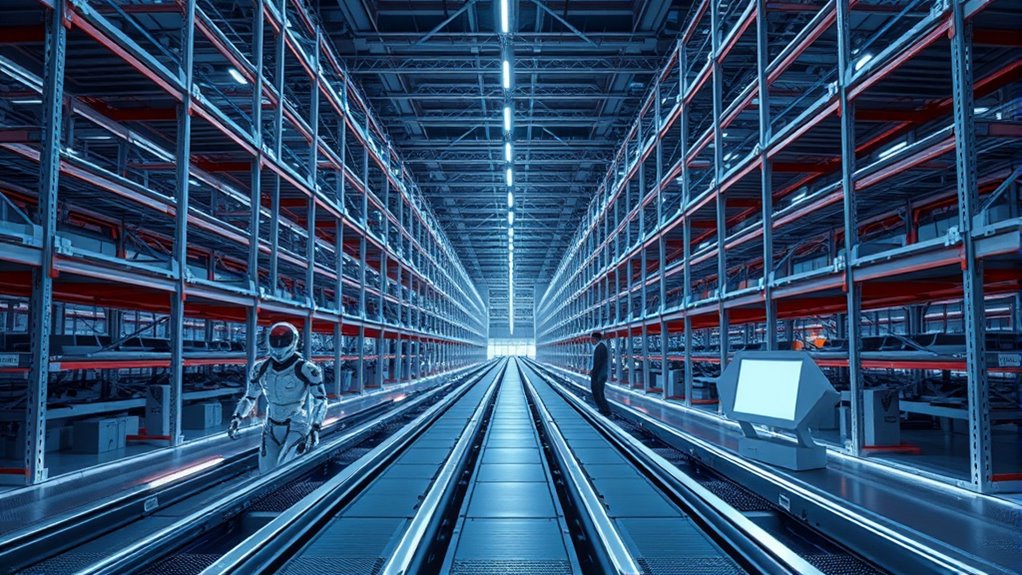

Inside the warehouse of the future, you’ll see humans working alongside smart machines like robots, cobots, and autonomous vehicles. These tools boost efficiency, safety, and space use, while workers handle oversight, maintenance, and problem-solving. Wearables and augmented reality help workers stay connected and productive. Combining human skills with advanced automation creates resilient, sustainable systems that adapt to changing demands. Keep exploring to discover how this seamless partnership continues to evolve and shape the industry.
Key Takeaways
- Future warehouses will feature seamless human-machine collaboration through cobots, enhancing safety, productivity, and operational flexibility.
- Automation technologies like AMRs and robots handle repetitive tasks, allowing humans to focus on oversight, problem-solving, and quality control.
- Wearables and augmented reality tools improve safety, efficiency, and real-time decision-making for human workers.
- Integration of AI, IoT, and machine learning optimizes workflows, demand forecasting, and energy management.
- Balancing automation with workforce development ensures resilience, adaptability, and long-term competitiveness in warehouse operations.

Food Delivery Robot for Restaurant and Hospitality Service, Autonomous Mobile Robot with Obstacle Detection, Touch Screen, Voice Communication and Multi Tier Serving Tray Design
- Customizable Styles and Accessories: Variety of customization options available
- Autonomous Obstacle Avoidance: Detects obstacles for safe navigation
- AI Voice Interaction: Engages customers with voice commands
As an affiliate, we earn on qualifying purchases.
As an affiliate, we earn on qualifying purchases.
The Evolution of Warehouse Automation Technologies
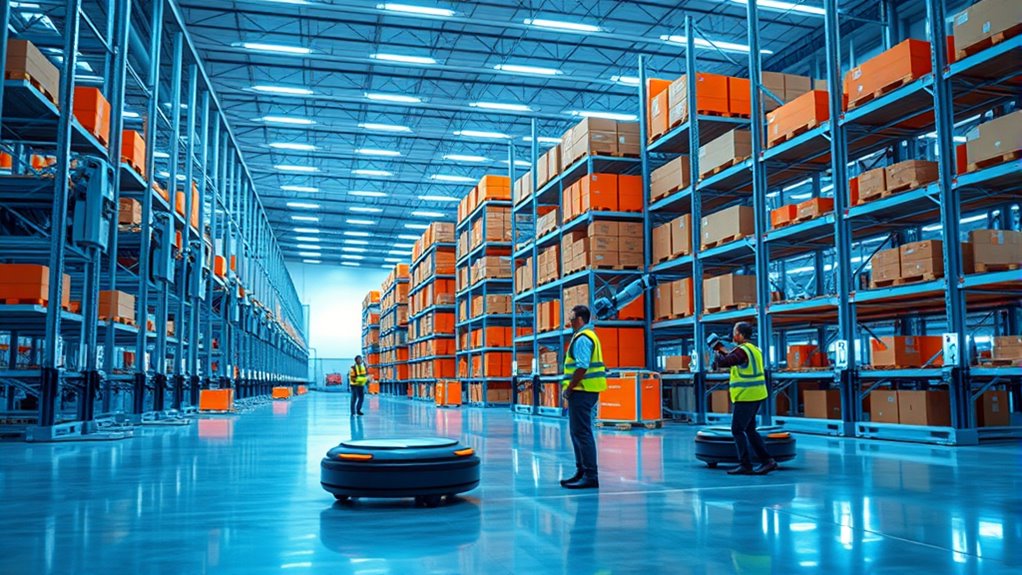
The evolution of warehouse automation technologies has been rapid and transformative, driven by advancements that improve efficiency, space utilization, and safety. You now benefit from innovations like autonomous mobile robots (AMRs), which are projected to reach $4.1 billion by 2028, and AI and machine learning, making operations smarter and more responsive. Automated guided vehicles and goods-to-person robots boost productivity, while high-density storage systems maximize space. Cobots, designed to work safely alongside humans, are changing collaboration in warehouses. Despite high initial costs and integration challenges, automation adoption is accelerating, especially in large facilities and sectors like consumer goods and automotive. With robot shipments expected to grow by 50% annually, the future of warehouse automation is poised for continued evolution, transforming traditional warehouses into smart, efficient hubs. Color accuracy has become increasingly important in ensuring that automated systems correctly interpret visual data, further enhancing operational precision.
collaborative robots (cobots) for industrial use
As an affiliate, we earn on qualifying purchases.
As an affiliate, we earn on qualifying purchases.
The Role of Human Workers in Automated Environments
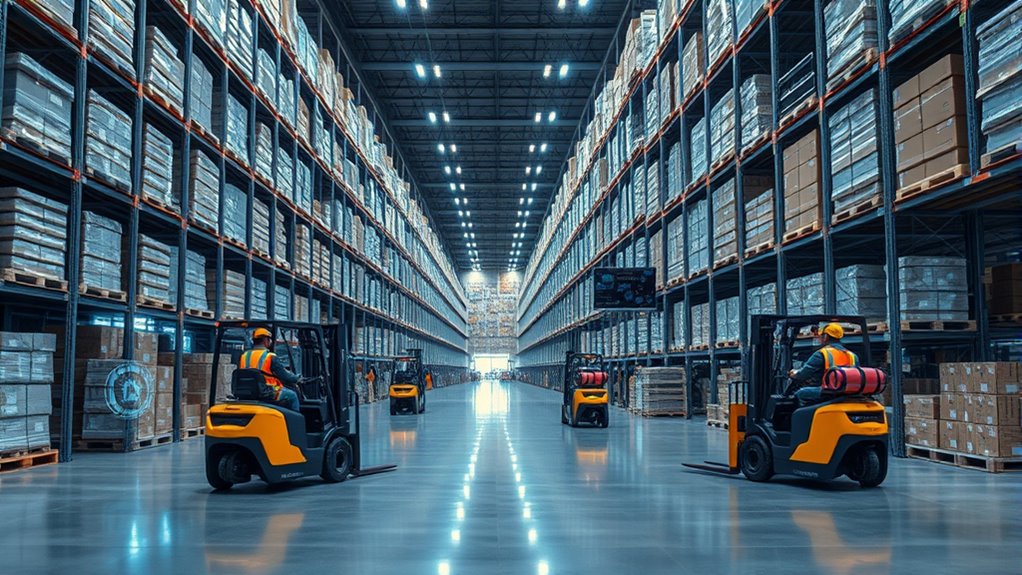
As automation transforms warehouse operations, human workers still play an essential role in maintaining efficiency and safety. Your critical thinking and problem-solving skills are crucial for handling unexpected issues that robots can’t manage, like troubleshooting or quality checks. Your flexibility allows warehouses to adapt quickly to changing demands and conditions, ensuring smooth operations. Human creativity and judgment complement robotic precision, boosting productivity and job quality. Tasks like oversight, maintenance, and safety monitoring remain outside automation’s reach, requiring your intervention. Your evolving roles include managing automated systems, analyzing data, and optimizing processes. By combining your skills with machines, you help prevent failures, improve safety, and sustain warehouse resilience. Automation increases safety by reducing manual labor risks, and this collaboration ensures operations stay efficient, accurate, and safe in the warehouse of the future. Additionally, understanding privacy policies and data protection measures is vital as automated systems often collect and process large amounts of operational data to improve performance.

Kelvix Innovative Neck Fan Small Cooling Device Travel Wearable Fan Adjustable Speed Fan Perfect for Outdoor Sports
- Powerful High-Speed Motor: Delivers strong, adjustable airflow
- Adjustable Airflow Settings: Three speed options for comfort
- Flexible ABS Construction: Twistable soft tubes for easy angle adjustment
As an affiliate, we earn on qualifying purchases.
As an affiliate, we earn on qualifying purchases.
How Robots Are Transforming Order Fulfillment
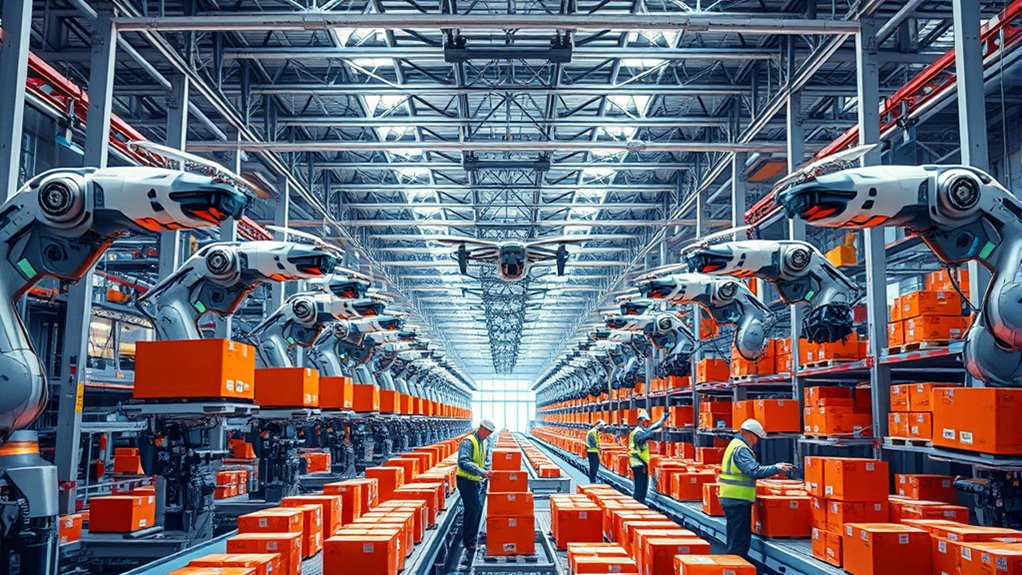
Robots are revolutionizing order fulfillment by automating key tasks and increasing efficiency across warehouses. They handle picking, placing, palletizing, sorting, packaging, and transporting goods, markedly boosting productivity. This automation reduces errors, speeds up processing times, and cuts operational costs, enabling warehouses to meet growing e-commerce demands. As demand for robots increases—with over 100,000 shipped in 2021—the technology evolves, integrating advanced systems like AGVs and AMRs. Here’s a deeper look: The impact of automation has further transformed warehouse operations by enhancing scalability and flexibility.
| Task Type | Impact |
|---|---|
| Picking & Placing | Faster, more accurate order processing |
| Palletizing | Improved handling of bulk goods |
| Sorting & Packaging | Higher order accuracy, reduced errors |

Lenovo Legion Glasses Augmented Reality Glasses Stereo Audio Micro OLED 60Hz Plug & Play USB-C Black
- Built-in Stereo Speakers: Integrated high-quality stereo audio
- High-Contrast Micro OLED Screen: 50,000:1 contrast ratio with 3D support
- Plug & Play USB-C Connectivity: Compatible with Android, Apple, and laptops
As an affiliate, we earn on qualifying purchases.
As an affiliate, we earn on qualifying purchases.
Enhancing Workforce Efficiency With Wearables and AR
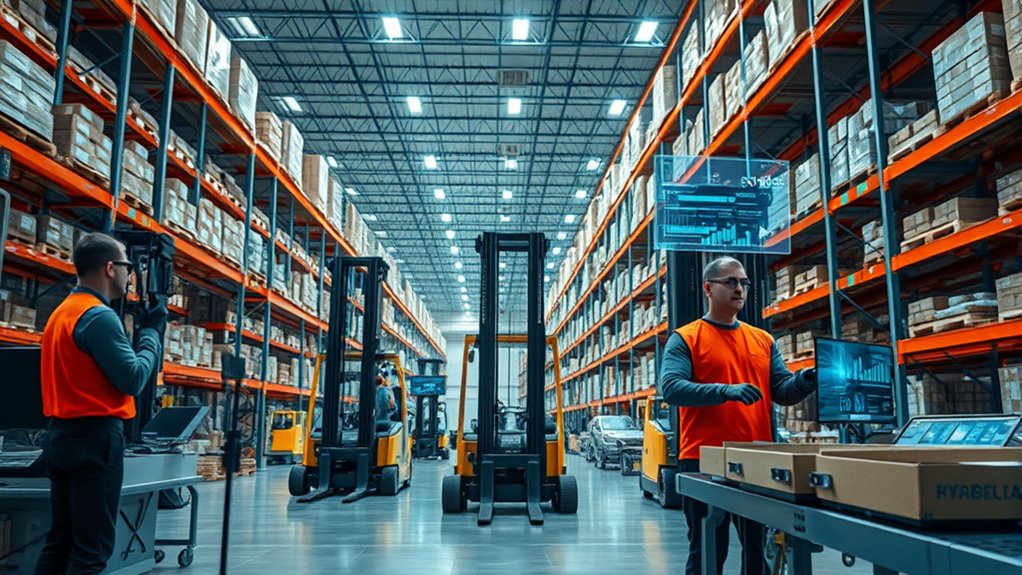
Wearables and AR devices boost safety by monitoring health and alerting you to hazards, reducing injuries and fatigue. They also streamline tasks through real-time guidance and visual cues, making work faster and more accurate. By integrating these technologies, you can work smarter, safer, and more efficiently. Data analytics from these devices help managers make informed decisions to optimize workflows and improve overall safety protocols. Incorporating vibrational energy techniques can further enhance focus and productivity in demanding work environments.
Wearables Boost Safety
Enhancing safety in warehouses has become increasingly achievable through wearable technologies and augmented reality (AR). These innovations support workers by reducing injuries and improving safety practices. Wearables like exoskeletons and ergonomic sensors help prevent musculoskeletal injuries and correct unsafe movements in real-time. They also monitor environmental hazards, alerting you to dangers like extreme temperatures or gases. These devices encourage safer habits by providing immediate feedback and tracking injury metrics, enabling better safety protocols. The global wearable tech market is projected to grow at a 14.6% CAGR, reaching $231 billion by 2032. Wearables can also incorporate preventive maintenance features that notify workers when equipment requires servicing, reducing the risk of accidents caused by equipment failure. Imagine: – Wearing smart helmets that alert you when you’re too tired or in hazardous environments – Using sensor-integrated wearables that correct your posture instantly – Relying on ergonomic gloves and exoskeletons that reduce physical strain and injury risk
AR Streamlines Tasks
Have you ever wondered how augmented reality (AR) can transform warehouse tasks? AR streamlines processes by providing real-time instructions, optimizing routes, and reducing errors. With AR, you see item locations and quantities through smart glasses, cutting search times and boosting picking efficiency by up to 25%. It automates manual tasks, replacing printed instructions and handheld scanners, making workflows smoother. During training, AR offers immersive, hands-on experiences, speeding up onboarding and improving retention. It also provides real-time inventory visibility, helping you manage stock levels and layout more effectively. Route optimization via AR ensures faster, safer navigation, with updates and hazard alerts displayed instantly. When combined with automation, AR enhances overall efficiency, making warehouse operations more agile and responsive. Using AR to support inventory management can further improve accuracy and reduce stock discrepancies.
Balancing Cost Savings and Workforce Development
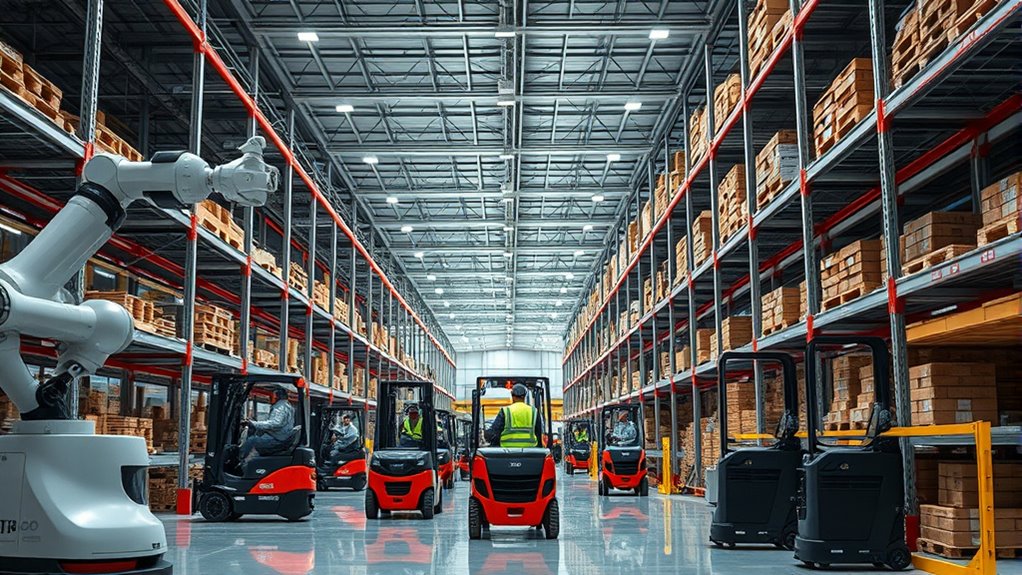
Balancing cost savings with workforce development is a critical challenge for modern warehouses, as increasing automation can substantially cut expenses while also transforming job roles. Automation reduces labor costs by up to 60%, cutting expenses that often account for over half of operations. It also lowers errors by 99%, boosting reliability. To adapt, you’ll need to focus on workforce upskilling, integrating AR and wearable tech for faster training, and shifting roles toward maintenance and oversight. Consider these points:
- Automation cuts overtime and improves efficiency, freeing staff for higher-value tasks
- Workforce training must evolve with new tech, emphasizing skill development
- Investment in employee education guarantees smooth tech integration and long-term growth
- As the industry shifts toward more intelligent, automated operations, ongoing training ensures workers can effectively manage and maintain new systems, fostering a more resilient workforce technological evolution. Additionally, embracing generative AI can optimize workflows and enhance decision-making processes within warehouse management.
Balancing these factors is key to maintaining a competitive, adaptable warehouse.
Overcoming Challenges in Implementing Automated Systems
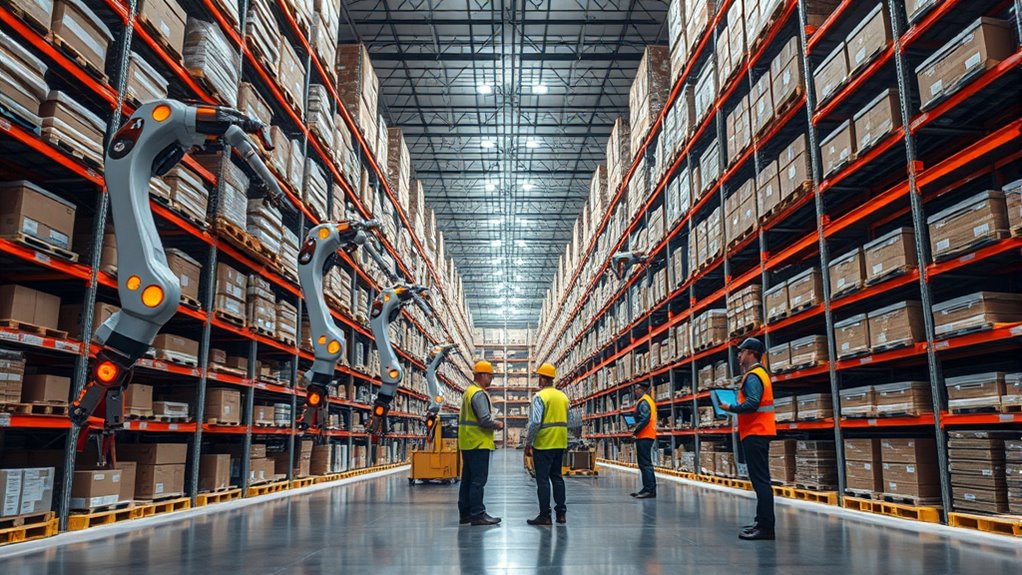
Implementing automated systems can be costly and complex, often requiring careful planning and strategic financing to manage upfront expenses. You’ll also face integration challenges, such as ensuring compatibility with existing systems and data synchronization. Addressing these hurdles head-on is key to successfully transforming your warehouse into a more efficient and reliable operation.
High Implementation Costs
Why do many warehouses hesitate to adopt automation despite its long-term benefits? High implementation costs are the main barrier. You face a hefty initial investment, ranging from $500,000 to over $15 million, depending on the system and facility size. Upfront expenses include hardware like robots and conveyor belts, software integration, and necessary infrastructure upgrades. These costs can quickly add up, especially for larger or customized systems. Additionally, ongoing expenses such as maintenance, staff training, and energy consumption increase total ownership costs. Consider these points:
- Large capital outlays for hardware, software, and facility improvements
- Continuous costs for maintenance, support, and upgrades
- High initial investment for customized or advanced systems
- Automation technology often requires specialized expertise for installation and ongoing support, adding to the overall costs. Moreover, the initial investment can be a significant deterrent, especially for small to medium-sized enterprises that need to carefully assess their budgets before proceeding. These financial hurdles can make automation seem formidable, even when the long-term benefits promise savings and efficiency gains.
Workforce Transition Strategies
Adopting automation in warehouses isn’t just about installing new equipment; it also requires managing how your staff adapts to these changes. To succeed, involve employees early and keep them engaged through ongoing communication. Change management frameworks can boost your chances of success sixfold by addressing cultural shifts and role disruptions. Training programs should be role-specific, helping staff learn to operate and maintain new systems, while continuous updates keep skills current. Implement automation gradually through phased rollouts and pilot tests to identify issues early and minimize disruptions. Engage stakeholders through open communication, building trust and gathering feedback. Redefine roles and performance metrics to reflect new responsibilities, ensuring your workforce stays aligned with operational goals and adapts smoothly to the evolving warehouse environment. Incorporating elements of workforce transition strategies, such as involving employees in planning and decision-making, can further facilitate a seamless integration of automation.
Integration Complexities and Solutions
Integrating automated systems into a warehouse can be complex due to the variety of existing technologies and data sources involved. You’ll encounter system incompatibility among warehouse management, ERP, robotics, and IoT devices. Legacy systems often resist seamless integration, causing delays. Data silos and communication gaps hinder operational flow, making coordination difficult. Managing this complexity feels like fitting pieces of a jigsaw puzzle together. Integration complexities can also lead to increased operational costs if not addressed properly. To overcome these challenges, consider:
- Using APIs and cloud-based solutions to connect legacy systems with modern automation tools for real-time data sync
- Implementing a gradual system overhaul to minimize disruptions
- Adopting unified data management strategies to ensure consistency and operational efficiency
These solutions help simplify integration and accelerate automation deployment.
Future Trends: The Synergy of Humans and Machines
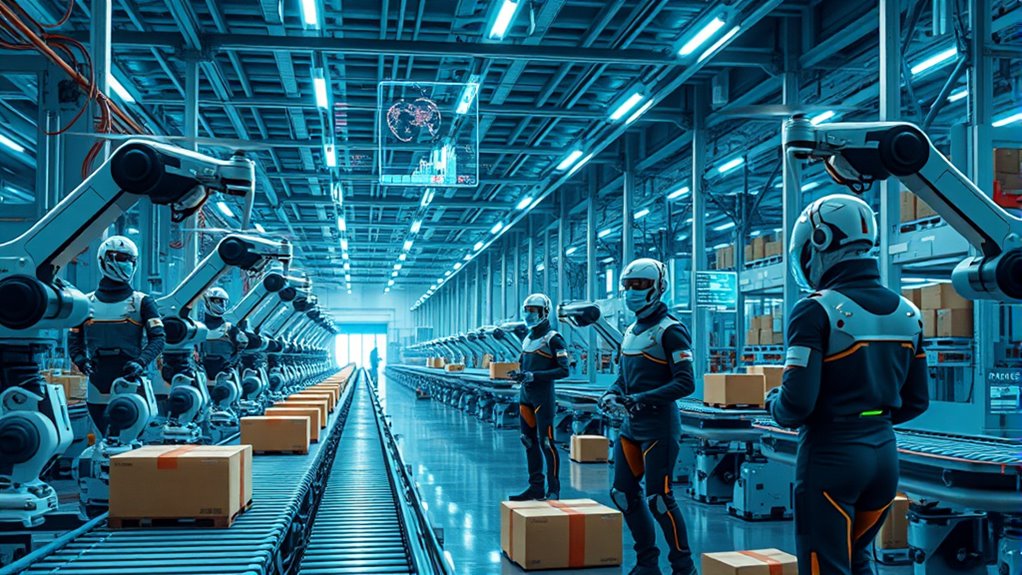
The future of warehouse operations hinges on the seamless collaboration between humans and machines, leveraging their combined strengths to boost efficiency and adaptability. You’ll see more cobots working alongside workers, improving safety and productivity. Augmented reality tools will deliver real-time data, reducing training time, and helping staff make faster decisions. Wearable devices will keep workers safe and connected, enabling hands-free access to critical information. Automation will handle repetitive tasks, freeing humans to focus on strategic, higher-value work, increasing job satisfaction. Advanced technologies like IoT, AI, and machine learning will predict demand and optimize workflows, making operations more flexible and scalable. Automation enhances efficiency, accuracy, and productivity in inventory management, order fulfillment, and logistics. This synergy will give your warehouse a competitive edge, improve customer satisfaction, and help address labor challenges—all while creating a more responsive, efficient environment. Additionally, integrating human-centered design principles ensures that new technologies are user-friendly and enhance worker experience and engagement.
Building Resilient and Sustainable Warehouse Ecosystems
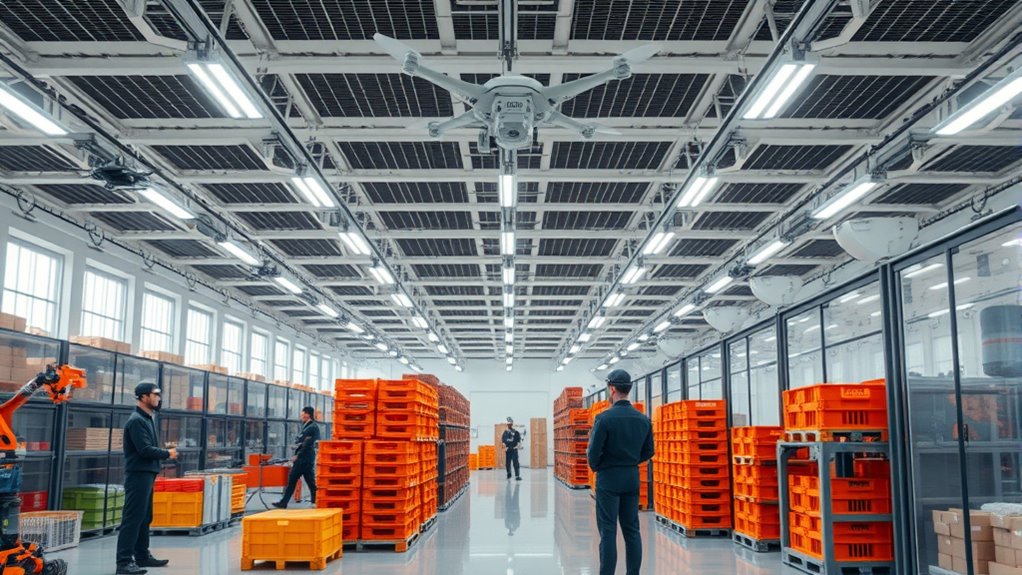
As warehouses embrace advanced automation and smart technologies to boost efficiency, they also face increasing pressure to become more resilient and environmentally sustainable. You can achieve this by adopting energy-efficient practices that cut power use, such as solar panels and smart lighting. Solar panels on rooftops can supply up to 176% of a warehouse’s annual electricity needs, drastically reducing reliance on fossil fuels. To build a sustainable ecosystem, focus on:
- Integrating eco-friendly technologies like hydrogen fuel cells and lithium-ion batteries to lower energy costs
- Implementing waste reduction strategies, including recycling and sustainable packaging
- Consolidating inventory and optimizing storage to maximize space and reduce operational costs
- Utilizing data analytics to identify energy-saving opportunities and improve overall operational efficiency
These measures help create a resilient, eco-conscious warehouse capable of adapting to future demands while minimizing its environmental impact.
Frequently Asked Questions
How Do Automated Warehouses Ensure Worker Safety Alongside Robots?
You can see that automated warehouses prioritize worker safety by removing humans from dangerous tasks, reducing injury risks. They use real-time hazard detection with IoT, enforce safety protocols, and design ergonomic workstations. Workers monitor machinery, ensuring quick responses to issues. Plus, data analysis helps improve safety measures continually. Overall, automation minimizes accidents, while safety is maintained through advanced technology, training, and smart environment design.
What Skills Will Human Workers Need in Future Automated Warehouses?
You’ll need a mix of technical and soft skills in future automated warehouses. Focus on learning robotics, programming, and data analysis to operate and troubleshoot advanced systems. Soft skills like collaboration, problem-solving, and adaptability will help you work seamlessly with machines and teams. Gaining knowledge of AI and machine learning will also be *essential* for optimizing processes and making data-driven decisions, ensuring you stay valuable in evolving roles.
How Is Data Security Managed in Connected Warehouse Systems?
Data security in connected warehouse systems is like a fortress, guarded by multiple layers of protection. You implement multi-factor authentication and role-based access controls to keep unauthorized users out. Encryption shields data at rest and during transit, while secure pipelines and firewalls block threats. Regular audits, network segmentation, and continuous monitoring act as vigilant guards, ensuring your data stays safe and compliant amidst evolving cyber threats.
What Environmental Benefits Come From Warehouse Automation?
You see that warehouse automation offers significant environmental benefits. It cuts energy use by employing efficient motors, smart lighting, and climate controls that activate only when needed. Automation reduces waste through precise inventory management, minimizes errors, and decreases transportation emissions. Additionally, it lowers the carbon footprint by reducing warehouse space needs and utilizing renewable energy sources. Overall, automation helps you operate more sustainably while boosting efficiency and scalability.
How Do Automation Providers Address Labor Displacement Concerns?
Think of automation as a double-edged sword; it can cut jobs or carve new opportunities. Automation providers address labor displacement by emphasizing upskilling, transforming workers into system overseers, problem solvers, and decision-makers. They promote safer, more engaging roles, blending human skills with robots. This partnership reduces strain, prevents injuries, and helps workers grow into more meaningful roles—turning potential job threats into gateways for career evolution.
Conclusion
As you embrace the future of warehouse automation, remember that combining human ingenuity with machine efficiency creates powerful results. Remarkably, by 2025, it’s estimated that 70% of warehouse tasks will be automated, boosting productivity and safety. But success lies in balancing technology with workforce development, ensuring resilience and sustainability. Stay adaptable, leverage new tools like wearables and AR, and you’ll thrive in this evolving landscape where humans and machines work seamlessly together.