
📊 Full opportunity report: Backyard Home Reports On Construction And Home Improvement on IdeaNavigator AI — validation score, market gap, and execution plan.

Get business pricing on tech for your team
- Business-only prices and quantity discounts
- Tax-exempt purchasing
- Multiple users, one account, clear invoices
TL;DR
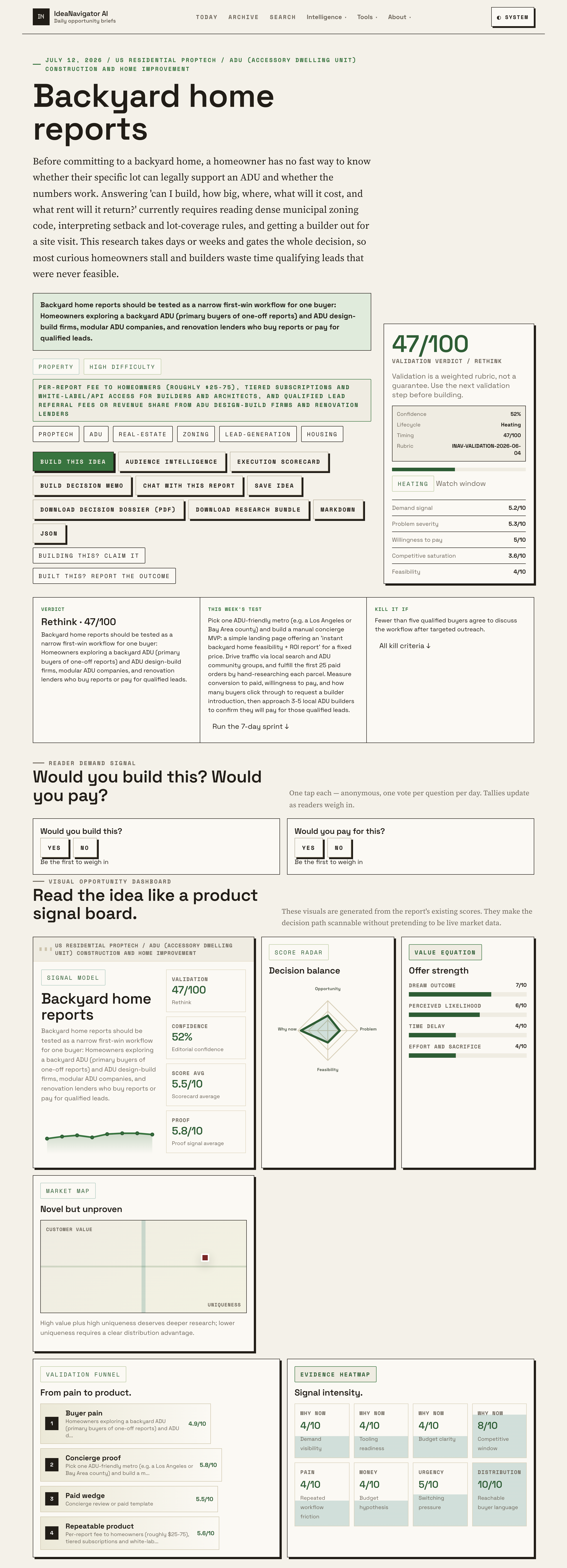
IdeaNavigator AI has outlined a proposed paid report service that would estimate whether a specific property could support an accessory dwelling unit, or ADU, and whether a project may be financially viable. The concept has not been shown to be a launched product; its rules, estimates and demand would need to be tested in one local market.
IdeaNavigator AI has proposed a paid report service for homeowners considering a backyard accessory dwelling unit, or ADU, that would estimate whether a specific lot can support a unit and what its costs and rental returns might be. The concept addresses a decision bottleneck for homeowners and builders, but no operating product or market results were provided.
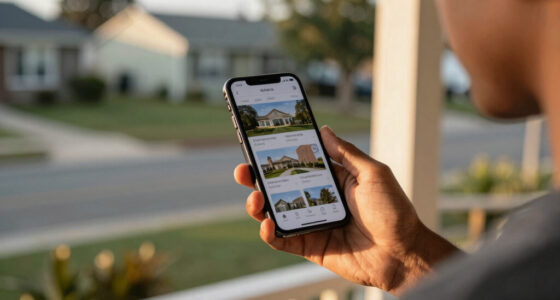
The proposed web app would let a homeowner enter an address and receive a property-specific PDF. For an initial market, the plan calls for using county parcel data, including boundaries, lot size and existing building footprints, alongside a manually curated set of local zoning rules and statewide ADU law. The report would estimate allowed unit types and size, relevant setbacks and lot coverage, and the area that may be available to build.
It would also include a build-cost range and projected rental income based on local rent comparisons. Those figures would be estimates for early decision-making, not a substitute for a site assessment, permit review, contractor quote or financing approval. IdeaNavigator AI did not provide a tested methodology, report examples or evidence that the estimates have been validated against completed projects.
The suggested business model combines one-off homeowner fees of roughly $25 to $75 with subscriptions or white-label and API access for builders and architects. The proposal also identifies referral fees or revenue sharing from ADU firms and renovation lenders. A builder-introduction button could capture leads, though the concept does not specify how providers would be screened or how lead quality would be measured.
Potential Uses for Homeowners and Builders
For homeowners, the proposed service is intended to provide an initial assessment before they seek professional advice. Zoning and parcel restrictions vary by location, so an answer for one address may not apply to a nearby property. The report would present relevant rules and uncertainties to help homeowners assess whether to pursue further planning.
For builders, the service could provide information about prospective customers’ properties and project budgets. The proposal offers no evidence yet that homeowners would pay for reports, that estimates would be reliable enough to influence decisions, or that builders would pay for referrals.
The service could also help lenders and architects identify people exploring projects, depending on data accuracy and referral practices. Because a report could inform a construction or borrowing decision, errors in zoning interpretations, costs or rent projections could affect users. The report would need to explain what has been checked and what requires confirmation.
ADU Rules and Local Data
IdeaNavigator AI presents the proposal against a backdrop of expanding ADU policies and housing demand. It says California began legalizing ADUs statewide in 2016 and has loosened rules repeatedly since. The proposal also cites more than 45,000 ADUs permitted in Los Angeles County in 2023 and says ADUs account for roughly one in five new housing units produced in California. Those figures are presented in the proposal; it does not provide supporting links or a definition of the unit-counting period for the statewide comparison.
The suggested timing rests on two developments: local parcel and zoning data are more available, and language models may help parse codes. But zoning analysis still depends on the rules in force in a particular jurisdiction and how they apply to the site. A usable service would need to distinguish state requirements from local restrictions, identify exceptions and flag cases that need a planner or other professional to review.
The proposal describes the wider U.S. housing shortage as a shortage of millions of units. That figure is not tied to a particular estimate or date in the concept. It helps explain the housing rationale, but the more immediate test for this product is whether its local reports are accurate and useful enough for homeowners and businesses to pay for.
Accuracy, Demand and Liability
No launch, pilot or customer results are reported. The proposal does not identify a selected county, a completed parcel analysis, a price tested with buyers or an agreement with a builder or lender. It is therefore unclear whether this is an active service, a business concept under review or a product in development.
Many operating details are also unresolved. The report would need to explain how often zoning rules are updated, how it handles incomplete parcel records and what happens when a local code is ambiguous. The proposed build-cost bands and rent comparisons have no stated data sources, geographic coverage or accuracy measures. It is also unclear who would be responsible if a homeowner relied on an incorrect estimate.
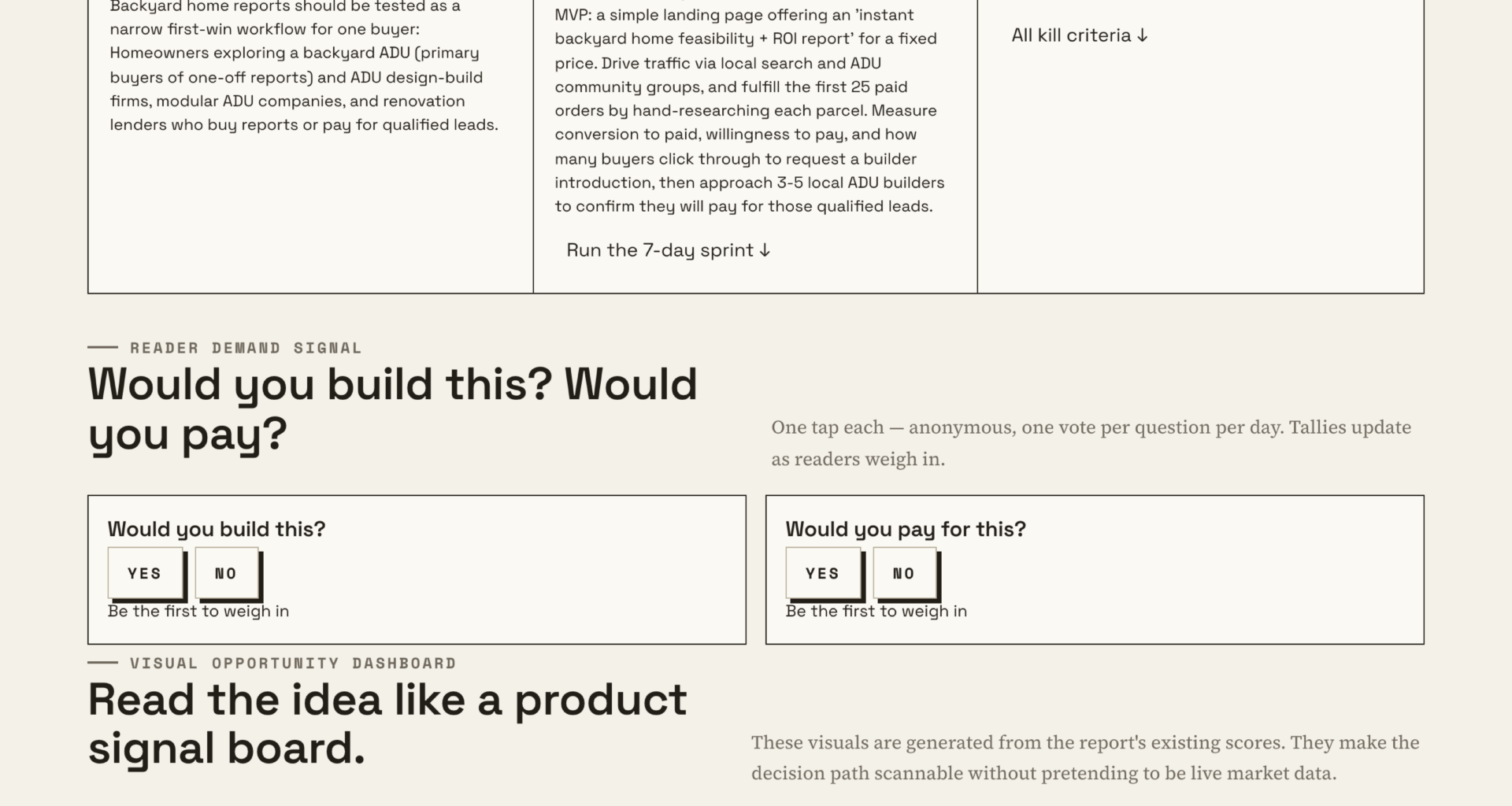
IdeaNavigator AI suggests manually researching the first 25 paid orders, but does not say those orders have been collected. Nor does it report whether three to five local builders have agreed to pay for qualified referrals. Interest, conversion and willingness to pay remain untested.
Testing One Local Market
The proposed next step is to choose one ADU-friendly metro or county, such as an area in Los Angeles or the Bay Area, and offer a fixed-price report through a simple landing page. The first 25 orders would be fulfilled by hand, letting the team compare what customers request with the parcel research and local rule checks required to answer them.
The suggested measures are paid conversion, willingness to pay and the share of customers who ask for a builder introduction. The plan also calls for speaking with three to five local ADU builders about whether they would pay for those referrals. Those results would help establish whether the report can attract buyers and support a second revenue stream; no timetable or success threshold has been announced.
If the service proceeds, the initial market would need a defined rule set, clear caveats and a process for correcting outdated or disputed information. Expansion to other counties would require additional local rule work. The immediate milestone is validation, not a confirmed rollout.
Source: IdeaNavigator AI
Key Questions
Is the backyard ADU report service available now?
No availability was reported. IdeaNavigator AI outlined a proposed service and a manual pilot approach, but did not say that a product has launched.
What would a homeowner receive?
The proposed PDF would estimate which ADU types and sizes may fit a property, relevant zoning constraints, buildable area, construction costs and rental income. These would be estimates requiring local and professional confirmation.
How much might a report cost?
The proposal suggests a one-off homeowner price of about $25 to $75. No tested price or completed sale was reported.
How would the idea be tested?
The plan proposes choosing one local market, manually completing the first 25 paid reports, tracking purchases and builder-introduction requests, and asking three to five builders whether they would pay for qualified leads.
Source: IdeaNavigator AI
Columbus Day / Indigenous Peoples' Day Picks
long weekend sales
As an affiliate, we earn on qualifying purchases.